
The Graceful Ghost
I’ve been putting together a few recital programs and have grown to love this piece. Bolcom’s “Graceful Ghost” is a charming combination of haunting and humorous. There are so many interpretations of this piece, and I’ve included a few here - which one is your favorite?
I haven’t done a post like this in a long time! Truthfully, I meant for this to be a “Music Monday” Post, but I got a little preoccupied practicing my instrument and watching the Lorena docuseries (and eating dinner with a friend) to finish it in time so now it is just an anyday-of-the-week music appreciation post about a new piece I am working on.
Recently, I started putting together a few recital programs worth of music that I’ve always wanted to play. Delving into new solo repertoire has been a really enjoyable endeavor and enhances my love of this instrument. Rather than just practicing repertoire for orchestra concerts and excerpts for auditions, I have added several sonatas and various other solo selections to my regular practice regiment. I spent quite a bit of time researching music and eventually selected several pieces that were either entirely new to me, or that I was fairly unfamiliar with. I realized after some investigation that there are some vastly underrated pieces in the violin world that deserve a little more attention and spotlight. I am dedicating several of my Music Monday posts (even if they don’t get published until Wednesday) to the discoveries I have made, and the selections that I have decided to learn and one day, hopefully quite soon, perform.
The first piece from my chosen Recital Repertoire is “The Graceful Ghost” by William Bolcom.
I first came across this charming piece for violin and piano several years ago when sight-reading through music with my dear friend James Barnett, the creator of the LOFT recital series in Minneapolis.
The piece is titled “Graceful Ghost Rag, Concert Variation for Violin and Piano.” It was written in 1979 and was originally a solo piano piece that the composer arranged for violin and piano. According to allmusic.com
William Bolcom had a strong interest in classic American popular music, especially ragtime. Graceful Ghost, his most popular composition, sprang from that interest. Bolcom’s earlier career was centered on New York City and Yale University. While in New York, he investigated the great compositions of the ragtime era (roughly 1890 to 1925), exemplified by composers such as Joplin, Turpin, Hayden, and others. His investigation into their proper interpretation (especially Joplin's recurring but widely overlooked admonition never to play ragtime fast) led him to becoming a leading pianist in the ragtime revival of the 1960s, along with Paul Jacobs and Joshua Rifkin, among others. Among the items Bolcom recorded was his own set of Three Ghost Rags, a commemoration of his late father. Graceful Ghost, with a stately, benign melody and a wistful sense of loss, was the breakout hit of the album on which it appeared and has remained Bolcom's most widely known composition. (The other two "ghost rags" are Poltergeist and Dream Shadows.)
In 1979, Bolcom prepared the violin version, which he and Sergiu Luca played in 1981. It eschews bravura effects, instead concentrating on the violin's lyrical qualities in sonorities, mainly at mezzo piano and quieter. There appears to be a slight expansion of the piece in this version, including a little more material in the accompaniment to compensate for the lines that are lifted from the original piano piece to the violin. However, the violin does not simply take all the melodic material. Instead, the melodies pass weightlessly from the keyboard to the violin, requiring close interpretive sympathy and each instrumentalist's ability to pick up the other's phrasing and dynamics. Lacking that quality, the music becomes earthbound, preventing the ghost from serenely floating in the violin part.
The Graceful Ghost is performed and recorded quite regularly BUT what I find really interesting is that this piece is a Rag. A Rag is a style of music originally credited to Scott Joplin that became popular around the beginning of the twentieth century. It is classified as a type of jazz ‘that emphasizes a syncopated melody with a heavily accented accompaniment part. Ragtime music is in 2/4.” (from the free dictionary)
The interesting question is “to swing, or not to swing” – in many forms of Jazz the melodic line is “swung” meaning that the rhythm is relaxed so that two eight notes (or sixteenth notes) form a long-short relationship with the first of every pair receiving more impetus/inflection/accent. Ragtime is not typically a style of music that receives this treatment, and if you listen to early recordings of Scott Joplin play his own compositions they are quite strict and in time, especially when compared to more contemporary performers.
Here is a comparison (sometimes the internet is so cool):
When researching this piece and listening to different versions, I heard several different approaches – some swing and some don’t. Some take great liberties with the timing, some play it fast, and others play it slow. So what is correct? Well, I watched a ton of videos, and listened to countless recordings. Below are a few for you to compare. I can’t play all of the videos here, but here are a few of my favorite performances – of the original piano version, as well as the violin and piano version.
I am still coming to my own conclusions about how to interpret this piece, but I think I will reflect on Joplin’s upright rhythmic nature, and refrain from swinging throughout this piece. I love the melodic line of this piece, I also love the sonorities and how this piece is both somber and playful. I think that is the charm of this piece, and most likely why it has remained one of Bolcom’s most popular compositions. I hope you enjoy both versions of this piece. Which is your favorite from this selection? Leave a comment below.
Piano Solo
Violin and Piano
This next one is in the original key of B-flat (the violin version was transcribed to A minor).
Buy Sheet music:
 look inside
|
Graceful Ghost Rag - Concert Variation Violin and Piano. Composed by William Bolcom. Piano. American, Jazz, Ragtime, Classical, Contemporary. 12 pages. Published by Edward B. Marks Music (HL.9430). |
corpßonore - sound // body // wellness
corpßonore - sound // body // wellness comes to life November 1st! That is 2 days from now! I am excited and nervous and very overwhelmed with all of the work left to do BUT I guarantee it will be worth it to check this out. We are brewing (in the spirit of halloween) up a podcast, publication with newsletter, and personalized and group coaching and workshops. I hope you take a moment to check it out, subscribe, listen, and participate. Thanking you for being part of my team, readership, fans, friends, tribe, circle, network, etc. This project is a long time coming and worth the wait (and patience on my end).
I am so excited to announce that corpßonore - sound // body // wellness will officially launch into the great big worldwide web on November 1st!
What is it?
Corpßonore is a performers resource comprised of an online publication, podcast, and personal/private guidance and coaching.
At corpßonore we believe that being a great musician goes beyond the music. Longevity and sustainability in a music career comes from the development and maintenance of a sound body and mind.
Our mission is to provide accessible information, tools, and support that foster balance, fulfillment, and sustainability for the performer in life and on stage.
What does corpßonore mean?
corps sonore is a term coined by John-Philippe Rameau in the early 18th century initially to discuss frequency, vibration, and tuning based on the notion that establishes the triad as the building block of harmony, and the principle of the corps sonore, which he established as the scientific basis for music theory. corps sonore translates to mean “sound body” or “resonant body” and that resonated with me because you need a sound body to make music with your body but it is also a term steeped in music history, and a concept that Rameau applied to so many aspects of nature and life in his later years.
When developing our own “sound body” we created one word from the two by using the german symbol for ss, called the Eszett or scharfes S, which depending on the font looks like this: ß. We also added “wellness” to the description to open up even more discussion opportunities.
A Little Backstory
Several years ago, while I was working on my dissertation I hatched the idea of bringing the information I was digging up in my research to a larger audience in an accessible and approachable format. I was lucky at the time to be affiliated with an institution that afforded me access to a vast library system, scholarly journals, medical publications, published dissertations, and other research. It was fantastic, but still quite difficult to navigate because research and information typically exists in isolated departments and the discoveries made in exercise science for example don’t often make it to the music building, and you don’t find performers discussing the advances in performance psychology the same way they talk about so-and-so’s new recording. It struck me that so much significant research exists in peer-reviewed journals, academia, and in arenas of life that do not often or easily overlap with “traditional” or “standard” music pedagogy or mix well with pop culture.
After doing a little digging myself, I realized that there are very few purveyors of this information to the working musicians of the world in any genre. I know so many freelance musicians, orchestral players, touring musicians, and teachers who are not affiliated with a University and therefore have to work so hard to access some of this information. This does not sit well with me.
This is a problem!
This means that most of the music teachers you see or send your child to, and the performers you cherish and celebrate onstage are missing out on some majorly effective research and information. How can you pass something on if you don’t know it exists? How can you make the best choices if you don’t know all of your options?
Facts:
This needs to change
Valuable and important information does not need to come in stuffy and unapealing packaging and formats.
We believe that helpful and pertinent information is meant for every musician, from young beginning violin students and their teachers, to old and seasoned blues guitarists, to internationally celebrated singers, and everything in between.
The Partnership
I approached Madeline with my idea for this project very early on because I knew she would be the perfect partner for something like this. She was instantly taken with it.
For my readers who don’t know Madeline, she is a retired/former/ex opera singer who is a BirthFit Coach, Yoga Teacher and Therapist, and Holistic Nutritionist based in Portland, Oregon. She knows so many things that musicians should know! You can find her online at http://www.posanatherapeutics.com, and on instagram.
Madeline and I met in grad school and lived together for two years. She talked me into doing my first (and only so far) triathlon, we also ran the Hood to Coast Relay together. In the past, pre-corpßonore she helped me eat appropriately the day of or night before a big performance or audition. I would never have known or thought about some of the things she suggested.
The Details
We are working hard to creat podcast episodes that feature different musicians from all genres. Our goal is to explore the musician beyond the music. So you will hear some personal questions and responses. We have a fantastic list of guests lined up so make sure to subscribe!
Our online publication will be available at https://www.corpsonore.com starting November 1st, and will also be delivered directly to our subscribers via newsletter. Our articles cover everything from time management, to music reviews, shoulder tension releasing techniques, recipes, the negative effects of sugar, and so much more. We want this to be interesting and appealing to a wide audience.
We offer workshops, classes, lessons, coachings, masterclasses, and guidance via the internet and in person. If this is something you are interested in learning more about please leave us a message, send an email, or stay tuned for more info.
What can you do?
Subscribe to our website here
Subscribe to our podcast (more details coming soon).
Tell us what you want to know about (you can tell me directly via Active Violinist too)
What musical guests do you want to hear from on our show? Who are you curious about? We want to hear from you - it can be anyone from that street performer you walk by everyday on your way to work, to your absolute favorite DJ. It doesn’t matter, we want to talk to them!
Are you the owner of a business, teaching studio, etc.? We would love to hear from you and craft creative ways to engage with the music community through partnerships and much more.
Share this with your friends, family, and aqcuaintances and help us build momentum.
You can email me directly at hannah@activeviolinist.com or corpsonore.sbw@gmail.com with questions, queries, suggestions, support, words of wisdom, dream podcast guests, or whatever you have up your sleeve or in your cauldron.
Lastly, A massive thank you to the incredibly talented Meghan Irwin for the creation of our logo and branding. You simply MUST check out more of her work here and follow her beautiful creations on Instagram. Fun fact: Meghan and I have known eachother for over 10 years, and she also created the Active Violinist Logo AND the 100 Days of Practice charts and certificates available in my shop. I truly want corpßonore - sound // body // wellness to be successful so I can pay her what she is truly worth as an artist, collaborator, designer, and creator.
Thank you!
Fit as a Fiddle - Workshop with Pamela Frank and Howard Nelson
My review of the “Fit as a Fiddle” class with Pamela Frank and Howard Nelson. This was all about healthy string playing, overcoming injury, and injury prevention primarily for violin and viola players. Frank and Nelson have a 1-year residency at USC this year co-teaching lessons.
This post is just another reason why moving to Los Angeles is pretty awesome. I first saw Pamela Frank give a masterclass several years ago when I was a student in Minnesota and I have been a huge fan ever since. I’ve watched countless videos and masterclasses online but have not had the opportunity to attend anything in person until this Fall when she and Physical Therapist Howard Nelson began a 1-year appointment at USC where they will be teaching collaboratively: Frank coaching the musical elements, Nelson analyzing movement patterns and habits in an effort to enhance the players technical and artistic abilities through freer movement patterns, and proper physical alignment.
This presentation/workshop/masterclass was their introduction to the music school and explained their work together, what brought them together as collaborators, and the importance of this information for other performers. It was held at USC on September 24th and was open to the public.
The presentation loosely consisted of 3 components: Frank’s own case study and the steps Howard took to guide her to a more neutral set up and ease her pain, a masterclass featuring a current USC student, and an informational workshop to acquaint string players with their anatomy and potential risk factors for injury.
Frank and Nelson’s partnership grew out of Pamela’s own issues specifically while preparing for a performance at the Library of Congress in 2012.
Pamela candidly explains that she had intense pain on her left and right sides (particularly in her shoulders and arms), her lower back, and neck; she suffered from regular headaches and was in mild to strong discomfort most of the time. She spoke about the levels of discomfort she endured while preparing her performance and says she quite literally could not play afterward. She went to Howard for help and rehabilitation.
Together, they filmed and captured many of Frank's movements and posture to analyze in detail where she deviated from a neutral position. They even examined the way she walked to see where she was compromising her daily habits and patterns and found weaknesses not just in her playing position, but in her standing, walking, bowing, and sleeping positions as well.
She was shocked at how impaired her movements were, and worked hard to correct and heal some of her faulty patterns (many of which she had been repeating for decades). She changed how she sleeps, adding additional pillows for joint support, she changed her violin case, her purse (now a very swanky fanny pack), her stand height, violin set up, and even the concept of good chamber music. She said it was like becoming a whole new person; She didn't realize how much she moved her head and neck when she should be using her arms and hands (even with seemingly simple movements like putting a shirt on overhead, shampooing her hair, etc.). Frank said it was humbling to realize how some of these faulty movement patterns can define you as a person.
Frank warned the audience that you have to “check your ego at the door” for work like this as you most likely have to relearn things you have been doing incorrectly for years. Howard showed an image of Frank performing with faulty playing posture (from the Library of Congress performance), and even though it sounded terrific, it was not “good.” He was not interested in the sound, only the basic mechanics of how efficiently (anatomically speaking) she could play the violin. He notes that often, your body falls back on what is familiar even if it is a bad habit and one must unlearn these habits and relearn motions with a better setup, a different head position, various accessories, etc. to fix and correct the issues. This can take a long time, and a great deal of work.
Pamela’s “heroic” return to the stage happened at the Verbier Festival in 2014 (nearly 2 years after the Library of Congress performance) with Josh Bell, Nobuko Imai, Steven Isserlis, and Mark-Andre Hamelin playing the Franck Piano Quintet. It was a media-intense performance with cameras, Livestream, and video equipment everywhere, and especially stressful for someone trying only to apply all of the information she had worked so hard on with Howard during therapy.
Frank says that since then she has no pain and that she used to “need” regular massage therapy but that it is no longer required in order to continue playing the violin. She also says she approaches teaching entirely differently looking at posture and playing positions in a whole new light.
I love that a violinist of Frank's caliber speaks so openly and candidly about her physical pain and the steps she took to address it, and overcome it to keep playing and teaching. It is so rare that performers at that level have the confidence to speak about their own struggles, and feel so passionate about sharing this information with other performers and teachers.
The Big Lessons
The following are important points for everyone to learn gleaned from the workshop.
Your daily habits can hurt you and what you do all day ADDS UP!
It is not just the way you play, it is what you do all day that matters the most (sitting, standing, walking, sleeping, everything).
For example, people sleep for approximately 1/3 of their life. If done with poor body positioning, the body is set up for pain and stress during the day regardless of whether one plays an instrument, sits at a computer, is an athlete, etc.
"Don't power through.
just because you can, doesn’t mean you should (playing-wise)
don’t ignore numbness, pain, tingling, or any discomfort as this is generally an indication of a problem or issue that needs to be addressed.
Anatomy and Risk Factors
The following are how basic anatomy (without all of the fancy terms) impacts your body and injuries. These points were mostly from the handout created for the class.
Risk Factors for injuries
Injury and pain come from the concept of "how far out of neutral" are you? You can improve symptoms by adopting a new movement pattern that is closer to "neutral."
Risk factors for “out of neutral”:
Head Position
Side bent to the left too much and too often
In front of the shoulders, so that your ear is forward of your shoulder
Locked, not free
Flexed downward
Right Shoulder and Arm (for violin and viola)
Elbow above shoulder height
Raising right shoulder
The bow arm position is inherently a position that pinches the nerves in and around the rotator cuff so extra care should be taken with the movements and placement of this arm/shoulder/side of the body
Left Shoulder and Arm (for violin and viola)
Raising Left shoulder to secure instrument
this is very common in players that don’t use a shoulder rest and also happens with players who use equipment that doesn’t properly fit their body.
Hugging the left arm into the body.
This was one of the major issues that Pamela Frank struggled with when addressing her pain.
I always teach (thanks to Michael Nicholson for this handy visual) that you should leave room for “one piece of cake” between your ribs and your left elbow.
Bringing Left elbow across the body, while the forearm/hand is rotated outward.
Shoulder blade tilted down and forward
Spine Positions
Excessive Spine movement
Tilting too much at the waist, especially to the left
Spine collapses, or arches backward too often, too far.
Instrument Position
For example, violin or viola points downward towards the ground too far, too often
Risk Factors for Tension:
Holding the breath – are you breathing well? Easily? Never hold your breath!
Excessive facial expressions
Tight mouth and jaw
Excessive use of muscles, more than what is necessary for the job.
Frank says: divorce your body from the music making! What can your HANDS do to make the music exciting NOT your body and your bad habits? The music is already exciting, all you have to do is play it on your instrument, there are no bizarre body contortions (that hinder the quality of performance) required. She lays out a beautifully simple path of music making through your body. It is so straightforward it almost shines with effortless and beauty:
eyes – brain – heart – hands – out of your body to your audience
She also lists a few exciting musical elements that do not include inappropriate body movements. Things like:
rhythm
timing
sound
bow angle, location, speed, stroke
internal dynamics
rubato
She also has a few simple moves and positions that offer relief in the middle of a practice session, or while you’re teaching, or hanging out, or if you need to check in on your levels of tension in the body while playing.
For relief – rest hands on head to prevent dangling and gravity pulling out of alignment. This helps serratus anterior

taken from violinist.com
Talk and play – keep the head straight and look in the mirror, do not hold the instrument with head, keep it free. Your head should be able to move a little bit and should NOT be rigid.
Tips for Playing Healthy and ENJOYING a long career free of aches and pains.
Set-Up: Customize to YOUR body. Every person’s anatomy is different and needs to specific attention. Make sure you have a shoulder rest AND chin rest that work for YOUR BODY.
Set Up size – fill clavicle (collarbone) to chin with support – shoulder rest + chin rest. Have the instrument meet you!
Howard and Pam recommend the SAS chin rest.
I’m definitely going to try one of these. After the class I tried my setup and realized that I have to drop my head quite substantially to keep my violin supported. My shoulder rest feels great so I am going to explore some more chin rest options.
Preventative: have a good, healthy workstation (proper stand height, lighting, etc.)
Music Stand – Have it at the highest height possible that still allows you to see other player/the conductor. At home, the stand MUST be at eye level. Do NOT let your stand height be too low, especially in the playing environment you are in the most (private practice).
Chairs/Sitting – a chair should fit your body, so you have the option to use the backrest. Feet should be firmly planted on the floor (not tucked underneath, out in front, crossed at the ankles, etc.)
This reminded me of the Starker quote my teacher Sally O’Reilly, always used to say about our sitting posture: you should sit in a way that if suddenly your chair burst into flames you could easily stand up and walk away.
Self-Videotaping: Helps look for a neutral position. Important to playback without sound so you can see your body mechanics with an unbiased eye. Also playback without looking to see if you can HEAR the difference between 2 different ways of playing (posture specific).
Interestingly, Nelson and Frank found that most performers prefer the way a good set up sounds when comparing blind recordings.

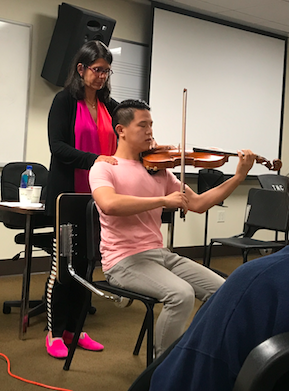
Pamela Frank working with a viola student at USC to find better alignment. The entire class agreed that when his setup was more efficient his sound was even more gorgeous.
Preventative Measures
The following are things you can do to avoid pain.
Warm up – get the heart rate moving to improve circulation in the body before playing. Ex: jumping jacks, light calisthenics, stair climbing, fast walking, etc.
Exercises: Periodically stretch to the opposite directions that you play, Arm raises, daily walking without distraction
Breaks - Begin with 1 minute of good movement for every 20 minutes of bad movement. Ex 1 min of stretching for every 20 or 30 minutes of practicing. Do the same for time spent at the computer. Stretch to opposite side that you play.
I do this using the Pomodoro Method of setting a timer for 25 minutes of practice, followed by 5 minutes of rest. During my 5 minutes of rest, I often stretch and move my body in opposite ways to holding the violin. I find that by inserting well timed and regular breaks in my practice sessions, I can practice more consistently and my endurance throughout the week improves (meaning I can more easily practice 4+ hours per day every day rather than being so fatigued I have to take more days off or extended periods of rest).
In Rests – put the instrument down (on knee, lap, floor)
Carrying your instrument – Use the lightest case possible. Do not keep additional music in your case.
If you use a backpack case, hold the straps in front so there’s less weight directly on your shoulders.
If your case has one strap, switch shoulders periodically.
Avoid static standing with your instrument. Put it down if caught in conversation with a friend/colleague/foe.
When Practicing
“Less is More” Don’t repeat anything without changing something. Practice with 100% expression.
Ex. Think of scales like long beautiful phrases; if you practice them like this, the Beethoven concerto is no longer intimidating, it is merely an extension of what you practice daily.
Simulate performance.
“You get what you train for” – train for freedom of movement in performance by creating stressful situations to get comfortable with the feeling of being on stage or in the high-stress performance environment.
Pro tip: create a nervous situation (at home) to get comfortable with that performance environment so you can learn to let it (the tension) go and feel more free on stage/in the performance.
During Practice, work on what you DON'T do well, for efficiency there is no need to go over the things you already do well just to play them.
And….ACCEPT NERVES AND “MISTAKES” AS PART OF THE PERFORMANCE. THEY HAPPEN TO EVERYONE – PLAYING CAREFULLY AND TRYING TO AVOID MISTAKES CAUSES TENSION
playing carefully is a desire for Control, which creates tension which leads to problems and pain
and finally: EMBRACE RISK.
All information listed here was gathered at the class in September through my own notes, from the handout they created specifically for this event and from referencing the post Laurie Niles created for violinist.com which you can read here.
You can find out more about the collaboration between Pamela Frank and Howard Nelson on their website www.fitasafiddle.nyc