
My Timani Lesson
A quick recap of my introduction to Tina Nilssen and Timani. I am so excited about this work and have been thinking about it nonstop for the past month. Working with Tina was the highlight of the whole PAMA weekend. She has such amazing insight into the body of the musician. Enjoy!
This year I (finally) had the good fortune of attending the Performing Arts Medicine Association (PAMA) Symposium. When I discovered that it was going to be held at UCLA this year, I jumped at the chance to be there. I read and reread the schedule and topics presented and planned out my days. The symposium ran from Friday - Monday morning with a certificate course, “The Essentials of Performing Arts Health” scheduled for the Thursday before. I relied heavily on their journal, Medical Problems of Performing Artists(MPPA), for source material when I was researching my dissertation, “Using Iyengar Yoga to Enhance Violin Playing.” It is by far the most comprehensive source for articles about musicians health.
The Workshop
One of the Seminars was lead by Tina Margareta Nilssen, from Norway. Her workshop was titled “How Can We Help to Prevent Repetitive Strain Injury in Music Students While Simultaneously Enhancing Musical Expression,” and took place on Saturday afternoon. I was excited to attend her workshop because Tina and I had connected via social media, and it is not every day you meet someone also invested in Musicians Health and Wellness in person.
Her workshop politely blew my mind. While her workshop title is long and kind of ungainly, she emphasizes “Anatomical knowledge and physical implementation to create freedom and joy of playing.” Her workshop was upbeat and engaging. She has the type of presentation that is compelling and instantly makes you feel like you know her but also that you want to know more. I pretty much rushed the stage afterward to pepper her with more questions, and she (shockingly) asked if I would like to meet outside of the symposium to do more work (so I said yes, duh).
The Lesson
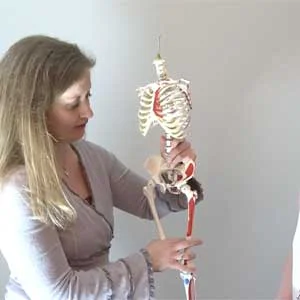
We met at Disney Hall for a private lesson and in true music student fashion (I got nervous beforehand). The first thing we did was discuss the ideal body of a musician (turns out it’s a chocolate-covered caramel – delicious) before I played for her, and she videotaped it. When I watched the footage, I thought my posture looked pretty good, but after 20-30 minutes or so of work together, I could see a subtle but dynamic difference in my playing. It was shocking.
We worked for approximately another hour, going over sitting posture and standing posture, and subtle cues to bring awareness back to areas of my body I was neglecting. After I played, we did not run scales and talk about technique or wrist placement, or anything most violin teachers narrow in on. Instead, we worked on how to breathe 3-dimensionally. We also talked about the appropriate musculature necessary for playing the violin, the function of specific muscles, and which muscles should be holding and supporting versus moving and applying pressure. I have news for you: much of violin pedagogy and what you are/have been taught by violin teachers with no anatomy knowledge or training can be damaging and does not provide optimal motion. This rocked my boat. For years during graduate school I had a teacher who was so “right” about alignment and somatic integration for violinists and being the good student that I was, I tried to do everything he asked by at least 110%. Come to find out that a teacher who is only partially informed and armed with an overabundance of confidence (and an exacting attitude) can do more harm than good. He celebrated my posture but chastised my performance nerves. I felt betrayed when I discussed this with Tina. For years, in an attempt to do what is correct, I was doing what is incorrect.
I always felt reasonably competent when it comes to filling my lungs, particularly in the front and sides. I have worked on this, for seemingly countless yoga hours. What I quickly realized is that I do not breathe into the back of my chest and ribcage. Also, I have always received praise for my great posture when I play. People point it out onstage, and I took pride in my stance, either seated or standing. But very subtly it is not so great. My chest and lower ribs jut forward, and my bottom pops out making it difficult to breathe into my back and also puts a strain on my Psoas muscle (which, incidentally, I learned quite a bit about at a different PAMA Symposium workshop). When I get nervous, which I was, it makes it even more difficult to breathe, make a good sound, and remain calm. It also exacerbates the nerves because again, as I discovered at the symposium, the Psoas muscle is intricately connected to the body’s fight or flight response. So everything I thought I was doing “right” was hindering my internal alignment and putting a considerable strain on my whole system making playing the violin, particularly when nervous even harder! This type of revelation makes me want to turn back the clock and redo all those silly auditions where I was so nervous and desperate to find control, without realizing I’m impeding my body’s natural wellbeing.

Alex Rosales Garcia working with Tina Nilssen on sitting posture at Disney Hall
I stayed after my lesson to observe her work with a bassoon player. Our instruments have different demands, but the improvement in sound with just a small amount of breath and posture work was so profound it was almost hilarious. To the untrained eye, it might appear that not much had changed, but internally, his body was supporting his breath and instrument more fully resulting in a tone that was large, round, and singing. It was beautiful and sounded so natural and free.
I would have stayed even longer to see another violinist have a lesson, but I had to run off to a gig. Tina graciously agreed to meet with us the next day and continue working together. It was fun, and the group setting (there were two of us plus Tina) had a relaxed workshop feel where we could freely ask questions as they arose and learned different applicable exercises or practices. She kept having to remind us that we were skipping around in her typical training but still, we could see and hear results. I was so excited to go home and practice because I LOVED my sound. My violin was singing, and I had a positive full-body experience while playing. How many of my colleagues can relate to that last statement? Sometimes I love to play but am sore afterward. Sometimes I play and feel great but am disconnected from the sound. These two days opened my eyes to the sensation of fully feeling the music pass through me and my instrument. It feels borderline profound, and I wish I could explain it better.

Tina is the first musician I have encountered that synthesizes information in a way that is practical, attainable, easy to understand and apply, and musically focused. I have tried Alexander technique, some body mapping, yoga, etc. but this is the first time I have experienced the results so immediately and thoroughly in a manner that focuses on optimal musical expression by the performer.
I signed up for the Timani community after our work together so I could learn more and keep improving. The last thing I want to do is mismanage my body in the practice room, or even worse – pass on incorrect information to my students. As I internalize some of these points, I want to incorporate them into my own teaching and pass them on to my students. You can check out more about Tina click here and Timani here, and you can sign up for the community (the first month is free and packed full of useful information) here.
Fit as a Fiddle - Workshop with Pamela Frank and Howard Nelson
My review of the “Fit as a Fiddle” class with Pamela Frank and Howard Nelson. This was all about healthy string playing, overcoming injury, and injury prevention primarily for violin and viola players. Frank and Nelson have a 1-year residency at USC this year co-teaching lessons.
This post is just another reason why moving to Los Angeles is pretty awesome. I first saw Pamela Frank give a masterclass several years ago when I was a student in Minnesota and I have been a huge fan ever since. I’ve watched countless videos and masterclasses online but have not had the opportunity to attend anything in person until this Fall when she and Physical Therapist Howard Nelson began a 1-year appointment at USC where they will be teaching collaboratively: Frank coaching the musical elements, Nelson analyzing movement patterns and habits in an effort to enhance the players technical and artistic abilities through freer movement patterns, and proper physical alignment.
This presentation/workshop/masterclass was their introduction to the music school and explained their work together, what brought them together as collaborators, and the importance of this information for other performers. It was held at USC on September 24th and was open to the public.
The presentation loosely consisted of 3 components: Frank’s own case study and the steps Howard took to guide her to a more neutral set up and ease her pain, a masterclass featuring a current USC student, and an informational workshop to acquaint string players with their anatomy and potential risk factors for injury.
Frank and Nelson’s partnership grew out of Pamela’s own issues specifically while preparing for a performance at the Library of Congress in 2012.
Pamela candidly explains that she had intense pain on her left and right sides (particularly in her shoulders and arms), her lower back, and neck; she suffered from regular headaches and was in mild to strong discomfort most of the time. She spoke about the levels of discomfort she endured while preparing her performance and says she quite literally could not play afterward. She went to Howard for help and rehabilitation.
Together, they filmed and captured many of Frank's movements and posture to analyze in detail where she deviated from a neutral position. They even examined the way she walked to see where she was compromising her daily habits and patterns and found weaknesses not just in her playing position, but in her standing, walking, bowing, and sleeping positions as well.
She was shocked at how impaired her movements were, and worked hard to correct and heal some of her faulty patterns (many of which she had been repeating for decades). She changed how she sleeps, adding additional pillows for joint support, she changed her violin case, her purse (now a very swanky fanny pack), her stand height, violin set up, and even the concept of good chamber music. She said it was like becoming a whole new person; She didn't realize how much she moved her head and neck when she should be using her arms and hands (even with seemingly simple movements like putting a shirt on overhead, shampooing her hair, etc.). Frank said it was humbling to realize how some of these faulty movement patterns can define you as a person.
Frank warned the audience that you have to “check your ego at the door” for work like this as you most likely have to relearn things you have been doing incorrectly for years. Howard showed an image of Frank performing with faulty playing posture (from the Library of Congress performance), and even though it sounded terrific, it was not “good.” He was not interested in the sound, only the basic mechanics of how efficiently (anatomically speaking) she could play the violin. He notes that often, your body falls back on what is familiar even if it is a bad habit and one must unlearn these habits and relearn motions with a better setup, a different head position, various accessories, etc. to fix and correct the issues. This can take a long time, and a great deal of work.
Pamela’s “heroic” return to the stage happened at the Verbier Festival in 2014 (nearly 2 years after the Library of Congress performance) with Josh Bell, Nobuko Imai, Steven Isserlis, and Mark-Andre Hamelin playing the Franck Piano Quintet. It was a media-intense performance with cameras, Livestream, and video equipment everywhere, and especially stressful for someone trying only to apply all of the information she had worked so hard on with Howard during therapy.
Frank says that since then she has no pain and that she used to “need” regular massage therapy but that it is no longer required in order to continue playing the violin. She also says she approaches teaching entirely differently looking at posture and playing positions in a whole new light.
I love that a violinist of Frank's caliber speaks so openly and candidly about her physical pain and the steps she took to address it, and overcome it to keep playing and teaching. It is so rare that performers at that level have the confidence to speak about their own struggles, and feel so passionate about sharing this information with other performers and teachers.
The Big Lessons
The following are important points for everyone to learn gleaned from the workshop.
Your daily habits can hurt you and what you do all day ADDS UP!
It is not just the way you play, it is what you do all day that matters the most (sitting, standing, walking, sleeping, everything).
For example, people sleep for approximately 1/3 of their life. If done with poor body positioning, the body is set up for pain and stress during the day regardless of whether one plays an instrument, sits at a computer, is an athlete, etc.
"Don't power through.
just because you can, doesn’t mean you should (playing-wise)
don’t ignore numbness, pain, tingling, or any discomfort as this is generally an indication of a problem or issue that needs to be addressed.
Anatomy and Risk Factors
The following are how basic anatomy (without all of the fancy terms) impacts your body and injuries. These points were mostly from the handout created for the class.
Risk Factors for injuries
Injury and pain come from the concept of "how far out of neutral" are you? You can improve symptoms by adopting a new movement pattern that is closer to "neutral."
Risk factors for “out of neutral”:
Head Position
Side bent to the left too much and too often
In front of the shoulders, so that your ear is forward of your shoulder
Locked, not free
Flexed downward
Right Shoulder and Arm (for violin and viola)
Elbow above shoulder height
Raising right shoulder
The bow arm position is inherently a position that pinches the nerves in and around the rotator cuff so extra care should be taken with the movements and placement of this arm/shoulder/side of the body
Left Shoulder and Arm (for violin and viola)
Raising Left shoulder to secure instrument
this is very common in players that don’t use a shoulder rest and also happens with players who use equipment that doesn’t properly fit their body.
Hugging the left arm into the body.
This was one of the major issues that Pamela Frank struggled with when addressing her pain.
I always teach (thanks to Michael Nicholson for this handy visual) that you should leave room for “one piece of cake” between your ribs and your left elbow.
Bringing Left elbow across the body, while the forearm/hand is rotated outward.
Shoulder blade tilted down and forward
Spine Positions
Excessive Spine movement
Tilting too much at the waist, especially to the left
Spine collapses, or arches backward too often, too far.
Instrument Position
For example, violin or viola points downward towards the ground too far, too often
Risk Factors for Tension:
Holding the breath – are you breathing well? Easily? Never hold your breath!
Excessive facial expressions
Tight mouth and jaw
Excessive use of muscles, more than what is necessary for the job.
Frank says: divorce your body from the music making! What can your HANDS do to make the music exciting NOT your body and your bad habits? The music is already exciting, all you have to do is play it on your instrument, there are no bizarre body contortions (that hinder the quality of performance) required. She lays out a beautifully simple path of music making through your body. It is so straightforward it almost shines with effortless and beauty:
eyes – brain – heart – hands – out of your body to your audience
She also lists a few exciting musical elements that do not include inappropriate body movements. Things like:
rhythm
timing
sound
bow angle, location, speed, stroke
internal dynamics
rubato
She also has a few simple moves and positions that offer relief in the middle of a practice session, or while you’re teaching, or hanging out, or if you need to check in on your levels of tension in the body while playing.
For relief – rest hands on head to prevent dangling and gravity pulling out of alignment. This helps serratus anterior

taken from violinist.com
Talk and play – keep the head straight and look in the mirror, do not hold the instrument with head, keep it free. Your head should be able to move a little bit and should NOT be rigid.
Tips for Playing Healthy and ENJOYING a long career free of aches and pains.
Set-Up: Customize to YOUR body. Every person’s anatomy is different and needs to specific attention. Make sure you have a shoulder rest AND chin rest that work for YOUR BODY.
Set Up size – fill clavicle (collarbone) to chin with support – shoulder rest + chin rest. Have the instrument meet you!
Howard and Pam recommend the SAS chin rest.
I’m definitely going to try one of these. After the class I tried my setup and realized that I have to drop my head quite substantially to keep my violin supported. My shoulder rest feels great so I am going to explore some more chin rest options.
Preventative: have a good, healthy workstation (proper stand height, lighting, etc.)
Music Stand – Have it at the highest height possible that still allows you to see other player/the conductor. At home, the stand MUST be at eye level. Do NOT let your stand height be too low, especially in the playing environment you are in the most (private practice).
Chairs/Sitting – a chair should fit your body, so you have the option to use the backrest. Feet should be firmly planted on the floor (not tucked underneath, out in front, crossed at the ankles, etc.)
This reminded me of the Starker quote my teacher Sally O’Reilly, always used to say about our sitting posture: you should sit in a way that if suddenly your chair burst into flames you could easily stand up and walk away.
Self-Videotaping: Helps look for a neutral position. Important to playback without sound so you can see your body mechanics with an unbiased eye. Also playback without looking to see if you can HEAR the difference between 2 different ways of playing (posture specific).
Interestingly, Nelson and Frank found that most performers prefer the way a good set up sounds when comparing blind recordings.

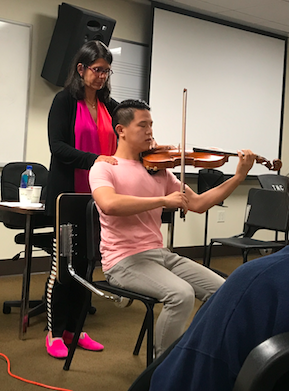
Pamela Frank working with a viola student at USC to find better alignment. The entire class agreed that when his setup was more efficient his sound was even more gorgeous.
Preventative Measures
The following are things you can do to avoid pain.
Warm up – get the heart rate moving to improve circulation in the body before playing. Ex: jumping jacks, light calisthenics, stair climbing, fast walking, etc.
Exercises: Periodically stretch to the opposite directions that you play, Arm raises, daily walking without distraction
Breaks - Begin with 1 minute of good movement for every 20 minutes of bad movement. Ex 1 min of stretching for every 20 or 30 minutes of practicing. Do the same for time spent at the computer. Stretch to opposite side that you play.
I do this using the Pomodoro Method of setting a timer for 25 minutes of practice, followed by 5 minutes of rest. During my 5 minutes of rest, I often stretch and move my body in opposite ways to holding the violin. I find that by inserting well timed and regular breaks in my practice sessions, I can practice more consistently and my endurance throughout the week improves (meaning I can more easily practice 4+ hours per day every day rather than being so fatigued I have to take more days off or extended periods of rest).
In Rests – put the instrument down (on knee, lap, floor)
Carrying your instrument – Use the lightest case possible. Do not keep additional music in your case.
If you use a backpack case, hold the straps in front so there’s less weight directly on your shoulders.
If your case has one strap, switch shoulders periodically.
Avoid static standing with your instrument. Put it down if caught in conversation with a friend/colleague/foe.
When Practicing
“Less is More” Don’t repeat anything without changing something. Practice with 100% expression.
Ex. Think of scales like long beautiful phrases; if you practice them like this, the Beethoven concerto is no longer intimidating, it is merely an extension of what you practice daily.
Simulate performance.
“You get what you train for” – train for freedom of movement in performance by creating stressful situations to get comfortable with the feeling of being on stage or in the high-stress performance environment.
Pro tip: create a nervous situation (at home) to get comfortable with that performance environment so you can learn to let it (the tension) go and feel more free on stage/in the performance.
During Practice, work on what you DON'T do well, for efficiency there is no need to go over the things you already do well just to play them.
And….ACCEPT NERVES AND “MISTAKES” AS PART OF THE PERFORMANCE. THEY HAPPEN TO EVERYONE – PLAYING CAREFULLY AND TRYING TO AVOID MISTAKES CAUSES TENSION
playing carefully is a desire for Control, which creates tension which leads to problems and pain
and finally: EMBRACE RISK.
All information listed here was gathered at the class in September through my own notes, from the handout they created specifically for this event and from referencing the post Laurie Niles created for violinist.com which you can read here.
You can find out more about the collaboration between Pamela Frank and Howard Nelson on their website www.fitasafiddle.nyc
100 Days
I just completed day 6 of my "100 Days of Practice" Challenge! But why 100 days?
This post is all about my musings when creating these charts and challenge for my studio. Join us! Or start your own....or at least read this blog post about it.
You can find the chart, stickers, and certificates in my SHOP.
Happy Practicing!
What can you achieve in 100 days?
According to www.the100dayproject.com, "Creativity is a skill. The more we practice, the more skilled we become. Practice takes time. Practice takes commitment. Practice is a radical act in this speeded up world. Through practice, we develop a creative habit. Through habit, we reconnect with and know ourselves again as a creative being."
Think about that one thing you have always want to improve or the GOOD (or bad, I guess) habit you want to strengthen. What would your life look like if you committed to it for 100 days in a row? The following is a quote from www.lifehacker.com that I think sums up the whole point of a 100-day challenge:
Consistency transforms behaviors into habits. Adopting good daily habits can only happen if you consistently engage in those habits every day. One strategy to make good habits stick... is something called the 100 Day Challenge. Here’s how it works: for 100 days, focus on engaging in one activity for 100 days in a row. By the end of the 100 days that daily activity will become a daily habit. Engaging in an activity for 100 days helps create the neural network infrastructure necessary to forge a habit.
100 days is approximately 3 months. Have you ever consciously committed to doing something every single day for three months (or 100 days)? The 100 days challenge can be applied to so many different habit-forming activities. The use of this concept is wide-ranging and applicable to almost any facet of your life. What if you decided to make dinner at home every night for 100 days? What about if you put a little bit of money in savings every day for 100 days? What if you turned into a bike commuter for 100 days? What if you committed time to reading every single day for 100 days in a row? How would this change your daily life? What about your habits? What type of discipline would it take to follow through with your commitment?
#100daysofpractice
In 2017, violinist Hilary Hahn took on the 100 Days Challenge as an exercise in practicing her instrument. She posted her progress and work on Instagram every single day. It was fascinating! Granted, Hilary Hahn is a top notch, best in the world violinist but what was so interesting was the type of work she documented. It wasn't just flashy passagework. It was thoughtful, careful, and full of personal reflection. She shared her thoughts in Strings Magazine and you can read that article here. The following is an excerpt from that article:
“The concept of the project was to show your process,” Hahn says. “You don’t have to worry about the result; it doesn’t have to be in great shape. You can show working on the same piece of art—you do a little bit of coloring one day, you spend 100 days on the same thing, or you could do sketches every day.” She wondered if there was something she could do for 100 days that would reveal something about her own artistic process. “So it just occurred to me: What do I do every day anyway? I practice.”
Her personal challenge set off a ripple effect in the music community and I found more and more musicians capturing scenes from their own practice and sharing them on social media. Hahn most appreciates how this project builds community in the music world. She notes that practice is often isolating and posting these videos on Instagram really engaged the community in unexpected ways. For those who want to take on the 100 Day Challenge her has a few words of advice:
"...Hahn advises starting as early in the day as possible; embracing the attitude that this project is about process, not perfection; and being ready to accept that 100 days won’t work for everyone, and there’s still value in a shorter period of time. “Things get in the way,” she says. “You do your best as an artist regardless of the circumstances and you just keep moving forward.”
After following Hahn's progress and process I decided to adopt this as a studio-wide challenge that will culminate with our Spring Recital. I am participating in this challenge too (it began for us on February 1st) and will be documenting some of my work on Youtube (yeah, I have a rarely used channel on there just search for Active Violinist) and on this blog. I will also be sharing some images and videos of my students too, so they can see their hard work paying off!
I have a few goals for this project: Improve my orchestra excerpts, learn some new shorter pieces, expand my technique, and conquer my solo Bach anxiety.
Charts and Certificates
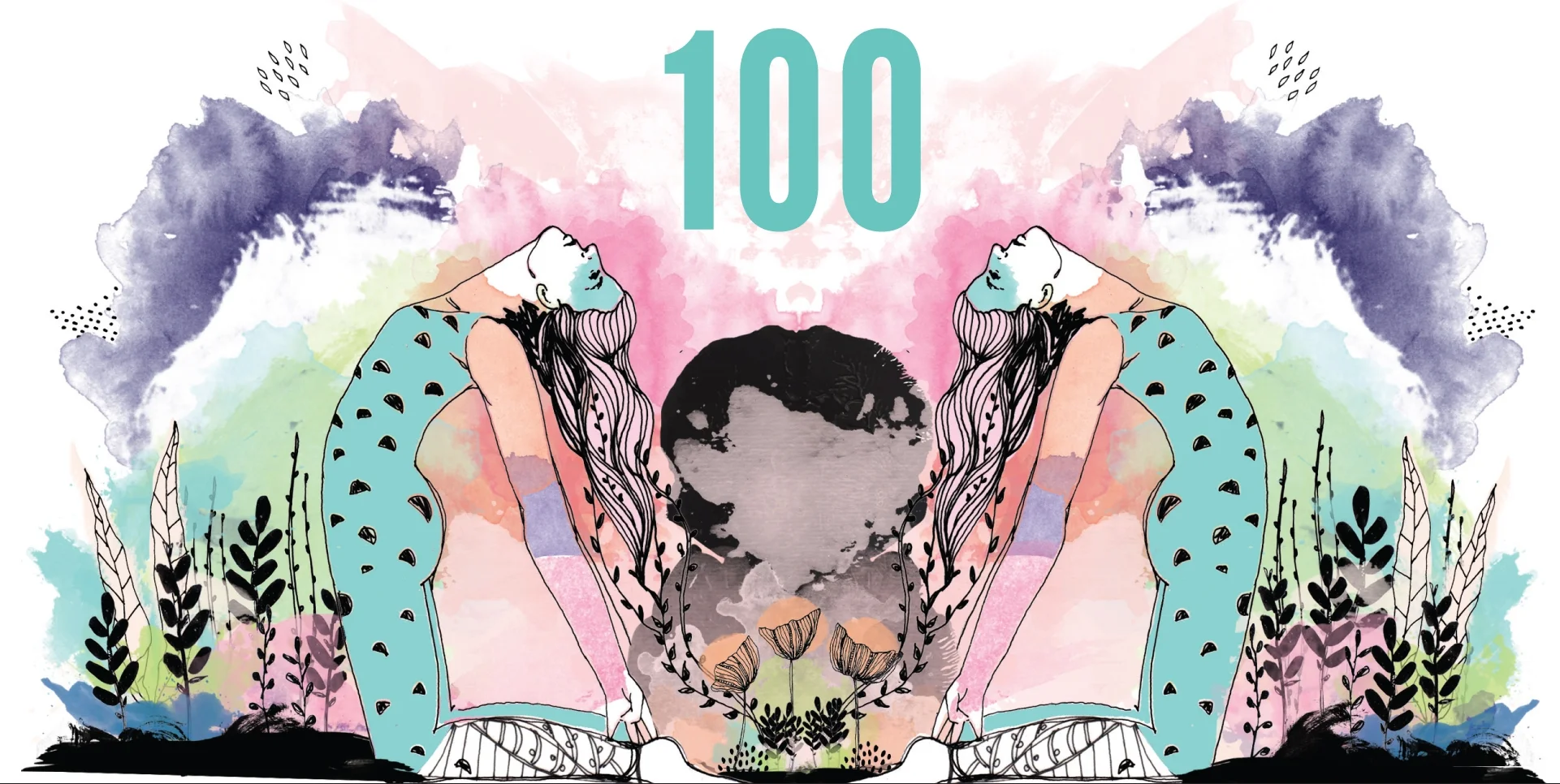
I am a visual person. I like to see and document my progress, so I collaborated with my dear friend, the wildly talented artist, Meghan Irwin to devise a 100 Days of Practice chart for me, my students, your students, fellow teachers, habit formers, and fellow goal crushers to log their practice days. If you're not familiar with Meghan's work I suggest you check it out ASAP! What better place to look than her own website: www.meghanirwin.com

Doesn't this make you want to practice?????
Following Hahn's "warning" that life happens, Meghan also created a set of gorgeous certificates celebrating 30-days, 60-days and 100-days of practice. I cannot stop staring at them. They are perfect and worth all of the effort it takes to earn them.

Certificates are a great way to reward progress along the way, and at the very end. I encourage you to buy the certificates as a set because they are beautiful, but also conquering 1 month, 2 months and 3+ months of work deserves some rewards along the way. If you are a teacher looking for ways to motivate your students I cannot recommend this challenge enough. All of my students are excited, and motivated by different elements of the challenge. Some of them want to beat me, some of them really want to "win," and some can't wait to finish their current music and move on to new songs.

All of these products are available in the Shop on my website. If you are a teacher, or wish to purchase in bulk (5 or more charts, or sets of certificates) drop me a line and I can offer you a better rate.
Happy Practicing!
