
Performance Highlight - Parasite at the Ace
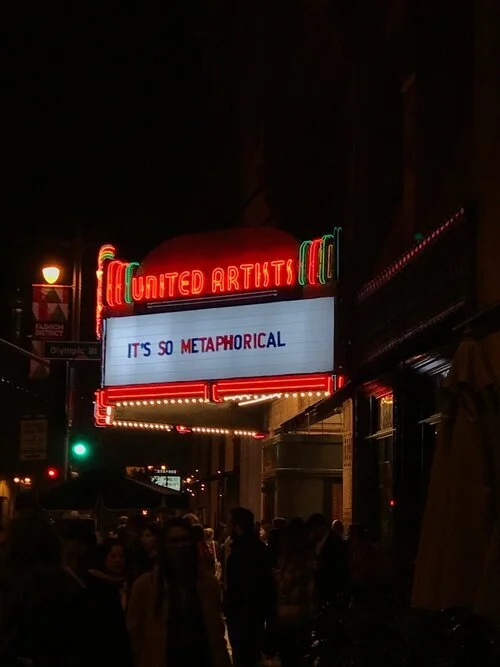
Just a quick Hello! I’ve been a busy bee already in 2020 but one of the coolest things I’ve done so far was a performance of the movie Parasite at the Theatre at the Ace Hotel last month with the director and composer. If you haven’t seen the movie yet, you absolutely should - it is insane! A big thank you to the Hollywood Chamber Orchestra for including me in such an awesome experience - It’s so Metaphorical!
Wow - the beginning of February flew by (actually, pretty much all of 2020 has flown by so far)!

Outside the Theatre after the show. This line means so much more now after Parasite swept the awards this year.
I’ve been trying to plug away at my goals and resolutions while also maintaining a busy performing and teaching schedule, which got much busier this year (for which I am so excited and grateful). I wanted to hop on here quickly and highlight a really cool performance opportunity that I took part in last month and encourage everyone out there who hasn’t seen the movie PARASITE yet to go see it! I’m no movie buff, and I definitely haven’t seen most of the films nominated for Oscars this year - this might be something I should work on especially because of where I currently live - but I did have the incredible opportunity to perform at a screening of the movie at the Theatre at the Ace Hotel in January featuring live orchestra conducted by the composer, Jaeil Jung, with opening remarks by the director, Bong Joon Ho, to a sold out crowd. It was pretty cool.
Prior to rehearsal, I had seen the previews online and thought it looked cool but didn’t actually see the movie until the dress rehearsal and then again during the performance and WOW! It is amazing. I remember turning to another violinist on rehearsal break and saying something like “this movie is so quirky and bizarre” and then watching the rest of the movie with my mouth gaping open the entire time in full disbelief of what I was watching. I don’t want to give anything away, but if you haven’t seen it, go watch it. It takes some unexpected turns, and is equal parts funny and horrifying on so many levels and for so many different reasons.
Parasite won the Oscar for:
Best Picture
Directing
International Feature Film
Original Screenplay.
“It’s so Metaphorical!”

Backstage before the show.
See you soon! I’ll be back on here soon, I promise - there are lots of exciting things happening behind the scenes around here.
The Graceful Ghost
I’ve been putting together a few recital programs and have grown to love this piece. Bolcom’s “Graceful Ghost” is a charming combination of haunting and humorous. There are so many interpretations of this piece, and I’ve included a few here - which one is your favorite?
I haven’t done a post like this in a long time! Truthfully, I meant for this to be a “Music Monday” Post, but I got a little preoccupied practicing my instrument and watching the Lorena docuseries (and eating dinner with a friend) to finish it in time so now it is just an anyday-of-the-week music appreciation post about a new piece I am working on.
Recently, I started putting together a few recital programs worth of music that I’ve always wanted to play. Delving into new solo repertoire has been a really enjoyable endeavor and enhances my love of this instrument. Rather than just practicing repertoire for orchestra concerts and excerpts for auditions, I have added several sonatas and various other solo selections to my regular practice regiment. I spent quite a bit of time researching music and eventually selected several pieces that were either entirely new to me, or that I was fairly unfamiliar with. I realized after some investigation that there are some vastly underrated pieces in the violin world that deserve a little more attention and spotlight. I am dedicating several of my Music Monday posts (even if they don’t get published until Wednesday) to the discoveries I have made, and the selections that I have decided to learn and one day, hopefully quite soon, perform.
The first piece from my chosen Recital Repertoire is “The Graceful Ghost” by William Bolcom.
I first came across this charming piece for violin and piano several years ago when sight-reading through music with my dear friend James Barnett, the creator of the LOFT recital series in Minneapolis.
The piece is titled “Graceful Ghost Rag, Concert Variation for Violin and Piano.” It was written in 1979 and was originally a solo piano piece that the composer arranged for violin and piano. According to allmusic.com
William Bolcom had a strong interest in classic American popular music, especially ragtime. Graceful Ghost, his most popular composition, sprang from that interest. Bolcom’s earlier career was centered on New York City and Yale University. While in New York, he investigated the great compositions of the ragtime era (roughly 1890 to 1925), exemplified by composers such as Joplin, Turpin, Hayden, and others. His investigation into their proper interpretation (especially Joplin's recurring but widely overlooked admonition never to play ragtime fast) led him to becoming a leading pianist in the ragtime revival of the 1960s, along with Paul Jacobs and Joshua Rifkin, among others. Among the items Bolcom recorded was his own set of Three Ghost Rags, a commemoration of his late father. Graceful Ghost, with a stately, benign melody and a wistful sense of loss, was the breakout hit of the album on which it appeared and has remained Bolcom's most widely known composition. (The other two "ghost rags" are Poltergeist and Dream Shadows.)
In 1979, Bolcom prepared the violin version, which he and Sergiu Luca played in 1981. It eschews bravura effects, instead concentrating on the violin's lyrical qualities in sonorities, mainly at mezzo piano and quieter. There appears to be a slight expansion of the piece in this version, including a little more material in the accompaniment to compensate for the lines that are lifted from the original piano piece to the violin. However, the violin does not simply take all the melodic material. Instead, the melodies pass weightlessly from the keyboard to the violin, requiring close interpretive sympathy and each instrumentalist's ability to pick up the other's phrasing and dynamics. Lacking that quality, the music becomes earthbound, preventing the ghost from serenely floating in the violin part.
The Graceful Ghost is performed and recorded quite regularly BUT what I find really interesting is that this piece is a Rag. A Rag is a style of music originally credited to Scott Joplin that became popular around the beginning of the twentieth century. It is classified as a type of jazz ‘that emphasizes a syncopated melody with a heavily accented accompaniment part. Ragtime music is in 2/4.” (from the free dictionary)
The interesting question is “to swing, or not to swing” – in many forms of Jazz the melodic line is “swung” meaning that the rhythm is relaxed so that two eight notes (or sixteenth notes) form a long-short relationship with the first of every pair receiving more impetus/inflection/accent. Ragtime is not typically a style of music that receives this treatment, and if you listen to early recordings of Scott Joplin play his own compositions they are quite strict and in time, especially when compared to more contemporary performers.
Here is a comparison (sometimes the internet is so cool):
When researching this piece and listening to different versions, I heard several different approaches – some swing and some don’t. Some take great liberties with the timing, some play it fast, and others play it slow. So what is correct? Well, I watched a ton of videos, and listened to countless recordings. Below are a few for you to compare. I can’t play all of the videos here, but here are a few of my favorite performances – of the original piano version, as well as the violin and piano version.
I am still coming to my own conclusions about how to interpret this piece, but I think I will reflect on Joplin’s upright rhythmic nature, and refrain from swinging throughout this piece. I love the melodic line of this piece, I also love the sonorities and how this piece is both somber and playful. I think that is the charm of this piece, and most likely why it has remained one of Bolcom’s most popular compositions. I hope you enjoy both versions of this piece. Which is your favorite from this selection? Leave a comment below.
Piano Solo
Violin and Piano
This next one is in the original key of B-flat (the violin version was transcribed to A minor).
Buy Sheet music:
 look inside
|
Graceful Ghost Rag - Concert Variation Violin and Piano. Composed by William Bolcom. Piano. American, Jazz, Ragtime, Classical, Contemporary. 12 pages. Published by Edward B. Marks Music (HL.9430). |
Music Mondays - Noam Faingold + TRQ
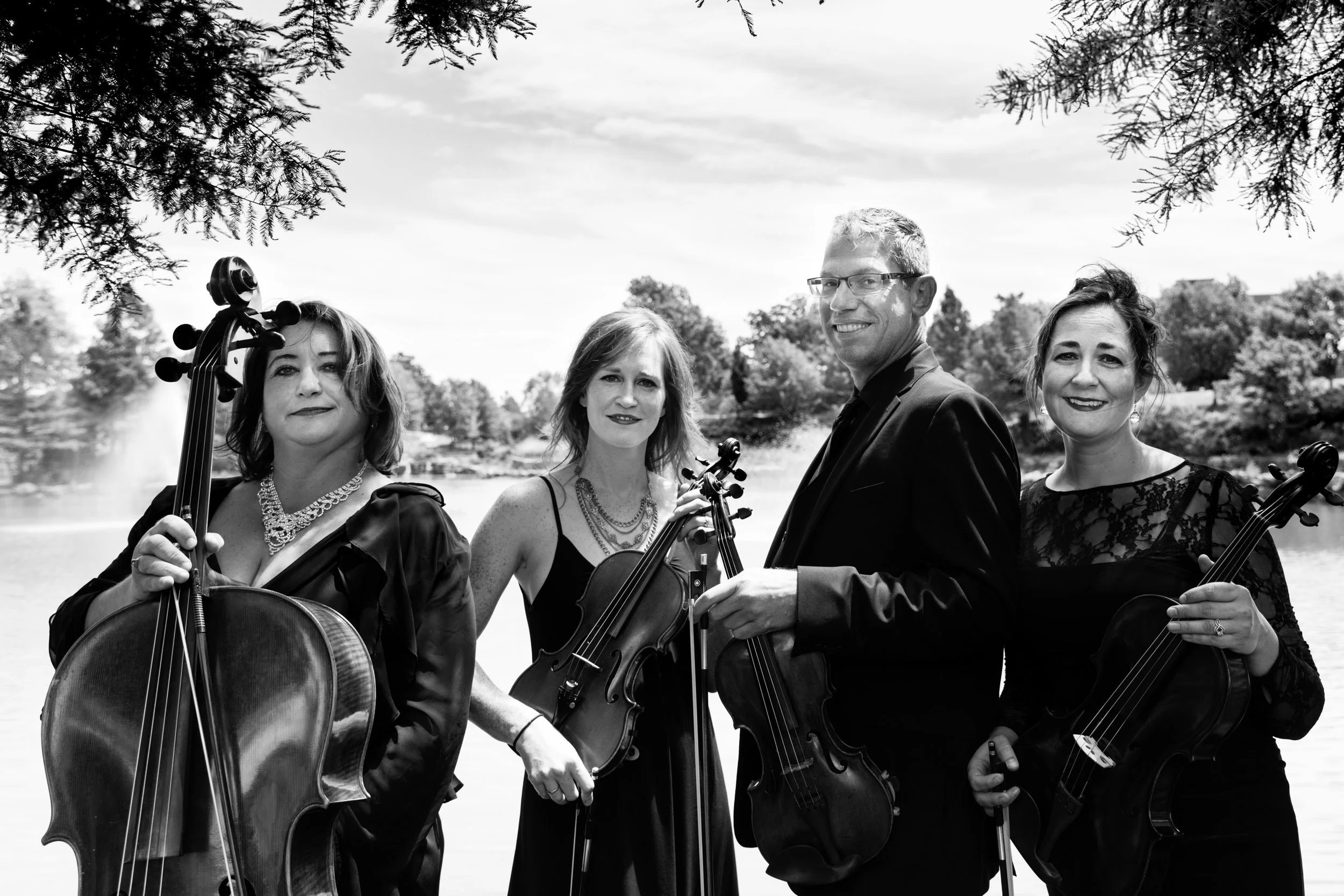
Come check out TRQ with special guest Noam Faingold this Wednesday at the Tulsa Performing Arts Center
Happy Monday!
I hope nobody was too offended that I took Memorial Day weekend off from blogging and escaped to the mountains with my family. It was a much-needed vacation with (conveniently) poor cell phone reception and Wifi connection. What a welcome break from the daily grind!

photo by Andrew Fassbender
Anyways, I'm back now, and I hit the ground running! This week Music Mondays is a shameless plug for TRQ's 'Brown Bag It' concert at the Tulsa Performing Arts Center, this Wednesday at 12:10 pm. For more details check the website at http://tulsapac.com/
This concert will be full of Rock 'n' Roll classics arranged for string quartet. Noam Faingold will also be joining us to perform two of his songs, recorded by his band Burning City Orchestra (BCO), and arranged for string quartet.
Here's a little something about BCO (from their website www.burningcityorchestra.com)

We take orchestral rock song-writing where it's been a long time coming. Praised by Anoushka Shankar for our “gorgeous” strings and “wonderful” lyrics (BBC), Burning City Orchestra celebrates traditional chamber music-style intimacy, while incorporating powerful rock, jazz, and punk influences. BCO is run by composer & singer/songwriter Noam Faingold whose “lyrical” (New York Times) music has been called “A tour de force of Jazz melded with classical,” (Downbeat Magazine), and an “outside-the-box perspective” (Dennis Cook).
WHO
BCO is comprised of renowned contemporary musicians including members of The Royal Ballet Orchestra, the BBC Concert Orchestra, The American Symphony Orchestra, Alarm Will Sound, and the Bang on a Can festival. Members of BCO can be seen performing at venues ranging from The Kennedy Center, Carnegie Hall, to Le Poisson Rouge NYC and The Stone. Our collaborators are among the most accomplished artists and ensembles in NYC and London's contemporary music scenes.
Below is one of the songs we will play on Wednesday.
Enjoy and we hope to see you there!