
My Yoga Journey
Recently, I was reflecting on my Yoga Journey (kind of because it was a phrase jokingly thrown around at Intermission) but also to try to understand how I ended up where I am in my practice, and in my body. From yoga in Hawaii to Bikram to Vinyasa Flow to Iyengar and back again. I've been practicing yoga for over 10 years and in a variety of traditions for a variety of reasons. This is a broad overview of my relationship with the practice. What is your yoga journey? I’m curious, what is your Yoga Journey? Do you have one? Do you want one?
Yoga Yoga Yoga. It is almost annoying how popular it is these days. I mean, yes, it is lovely that so many people practice, and the easily accessible formats, styles, and varieties available to practice. On the other hand, it is hard to keep track of all the new trends and fads in this industry and all the ways it can take your money. Yoga has been part of my life for over a decade - like 13 or 14 years - and it has morphed and evolved many times. My experience includes many trends. While I may sound like I'm rolling my eyes about it now, I know that we all need different things in life and from our yoga practice. Recently, I was reflecting on why yoga has stayed in my life for so long. I sat down and charted my yoga path and practice so far; where I started, where I am, and the significant milestones along the way. I thought I'd share it here mostly because I'm curious about your yoga experience. What does your Yoga Journey look like? Where did it take you?
Hawaii

meditation on the shores
The first time I tried yoga was about thirteen years ago at a music festival in Hawai'i. It was a mandatory option to attend morning yoga two or three times a week before rehearsal. I noticed the benefits immediately. I was clear-headed and focused in rehearsals, my playing felt confident and full of ease, and my body felt refreshed and stronger. This was probably the best introduction to yoga a musician could ask for; morning yoga in Hawaii with a roomful of other musicians and then immediately transitioning to music "work." I was hooked. I think we practiced some type of Iyengar yoga, but my memory is a little hazy, and my knowledge of yoga at the time was practically nonexistent. I remember sun salutations were involved as well as many props (including backless chairs) and use of the wall for alignment purposes. I came home from the festival totally addicted to yoga and spent the rest of the summer attending almost daily classes.
Bikram - Traverse City

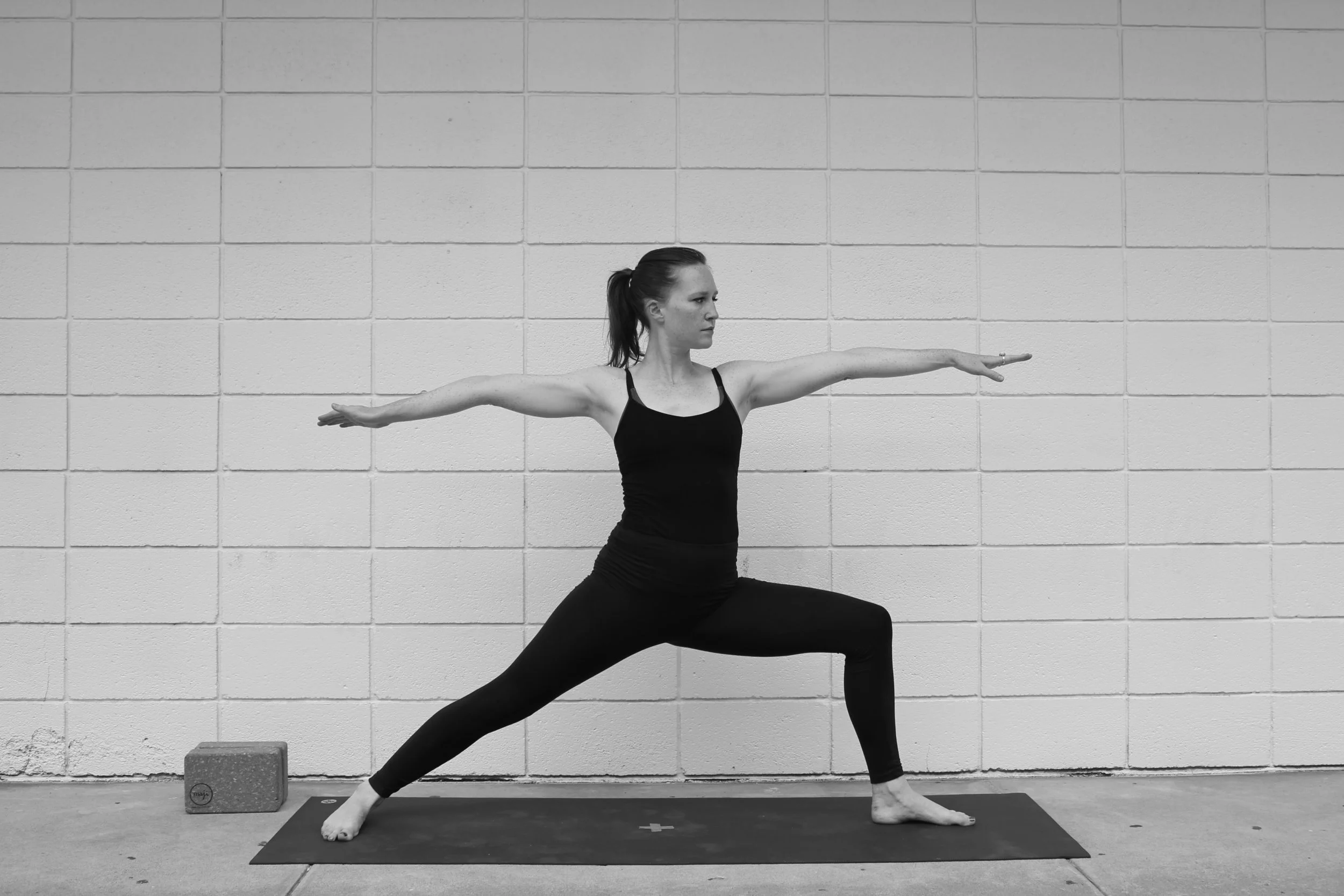
This photo was taken in Tulsa many years later because unfortunately I don’t have any early photos of my yoga journey
The summer of the music festival was the summer after my freshman year of college. I went home for the season and worked at a local restaurant when I wasn't in Hawai'i. In the mornings and on my days off, I would head to the Bikram Yoga studio in town, which had just opened. I started with my mom, who still practices hot yoga. I remember having the most impressive abs I've ever had in my life by the end of the summer. I was in excellent shape and probably accomplished my deepest backbends during this period of my practice. I loved sweating so much that I was drenched by the end. It also meant I was drinking tons and tons of water every day, and I started to really pay attention to my diet. I was working at an upscale hippy-dippy restaurant at the time, and so my food options were mostly farm-to-table organic and very nourishing. There is much to gripe about and dislike about Bikram and the practice, but if you have a good teacher, it is a deeply beneficial practice that emphasizes alignment. I fell in love with the sensations of particular basic (change) asanas like Warrior 2, extended side angle, camel pose, toe stand, rabbit pose, and tortoise. Every time I go home to visit my family, I join my parents for a grueling Bikram class or two.
Corepower - Minneapolis

Crow pose was one of the first fancy balance on my hands poses I ever managed to do successfully.
Corepower Yoga is now a large, multi-city, and online yoga business, but when I went there 13 years ago, there was only one studio in Minneapolis. I started with the Hot 26 class because it was basically a Bikram class with a different name. I liked it because it was familiar, but due to scheduling conflicts, I started attending more Vinyasa Flow classes. Then I tried Yoga Sculpt, and Restorative classes as well. I really liked the workout feel of the hot vinyasa flow classes. The physical benefits of these classes, like increased strength and flexibility, are the most accessible to those not ready for the more "woo woo" yoga styles. By the time I left MN, there were several core power studios in the twin cities, and I went at least 4 or 5 times per week. It was my favorite way to workout. Looking back, I see that my ego was so assertive in these classes. Everything was a challenge that I wanted to conquer. I wanted to be the best asana performer in the class, and I didn't really care how I got my head on the floor or legs into whatever pretzel pose. The mirrors on all the walls allowed me to admire my alignment (aka analyze what I liked and disliked about my body).
Ashtanga - Norman
When I was accepted to grad school in Oklahoma, one of the first things I worried about was where I would take yoga classes. It was the first thing I looked into when checking out apartments and the location of the university. I didn't have a car when I first moved to OK, so I needed to be bicycle riding distance from the studio. Fortunately, I found one (yes, just one) studio and also met some like-minded musicians - mostly singers - who wanted to go a few times per week. The owner of this studio is a widely respected Ashtanga teacher, but I really didn't even know what Ashtanga meant or what it was until later. We met Catie Coon and attended her Tuesday/Thursday morning class, and I think a class on the weekends. Her personality was so graceful and welcoming, and when she opened her own studio, we followed her immediately.
Yoga At Tiffany's - Norman
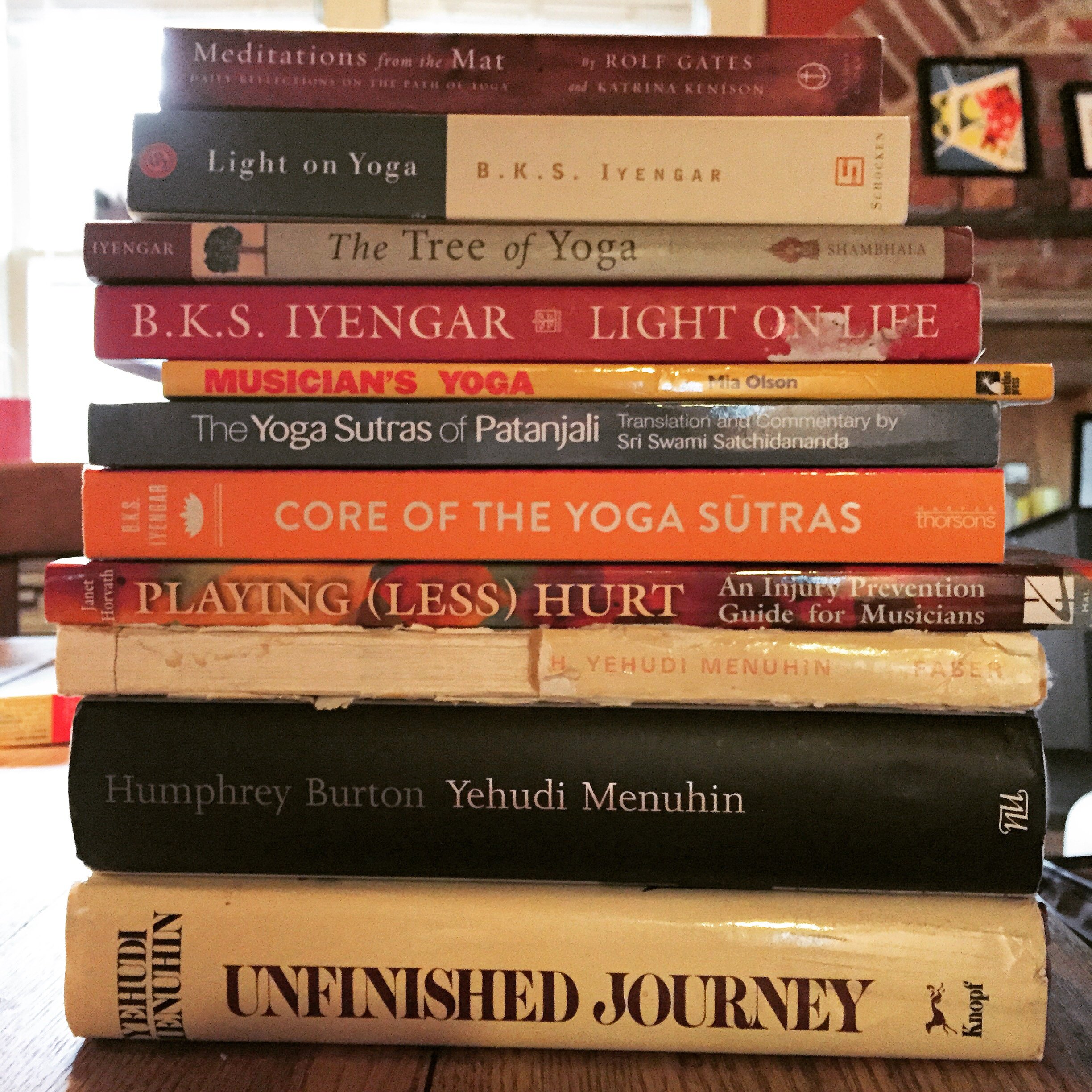
Just some of my yoga and music book collection. Not pictured: All of the anatomy books I have acquired plus so much more.
Catie's studio was primarily a vinyasa flow studio. My practice became quite powerful, and I was at a place where I could incorporate handstands into my sun salutations and flow. I was practicing many times per week and participating in yoga challenges. I had a yoga class friend group of fellow yoga students and teachers and trying to incorporate what I learned in class to my life. It was also a time when I couldn't overcome some of my physical limitations, and I couldn't make sense of my shortcomings. For example, I naturally have tight hamstrings and hips, but I admire Hanumanasana and have always wanted to do the complete version of this pose. I tried and tried and tried, and I could not do it. I was also feeling pain in my shoulders and neck, probably from the combination of handstands, improper proprioception, and hours of violin playing. I knew yoga was supposed to be therapeutic, but it was not easing my discomfort, and I couldn't find a way through the physical barriers.

Natalia Callard introduced me to alignment-based classes and unusual adjustments. In this photo she is helping me discover the (lack of) mobility in my thoracic spine. Norman, OK.
I found a class at Yoga at Tiffany's called "Strength and Alignment" and was totally hooked almost immediately. I felt like I was learning so much about anatomy, asana, tradition, and alignment in every class. The teacher was strict and direct, which I liked instantly, and I bought Light on Yoga, plus anatomy books, and other yoga books like the Yoga Sutras of Patanjali. My study deepened immensely during this time. It was the first time I practiced yoga at home with the same intention and attention that I applied to violin playing. This class propelled me towards Iyengar Yoga and was the impetus for my dissertation topic: violin and yoga.
Alignment based yoga - everywhere
I started going to Iyengar classes whenever I was in any city with an Iyengar studio. I practiced at home and followed mostly sequences that Iyengar outlines in his books. The violinist Yehudi Menuhin was instrumental in bringing Iyengar to the West, and I became obsessed with their relationship. In fact, it became the basis of my dissertation on the violin and yoga. After finding Iyengar yoga and practicing alignment-based yoga for several years, it was hard for me to go back to Vinyasa flow. I could feel the therapeutic and energetic benefits in an Iyengar class and trusted the instruction of my teachers.
Tulsa

I tried acro yoga at Be Love Yoga. This was fun and felt really good for my shoulders, but when I tried going to an acro yoga “jam” I was not as enthused.
Unfortunately, the yoga studios in Tulsa were primarily Vinyasa focused, and I kind of fell out of love with yoga. I tried different yoga classes and studio and was even featured in the Tulsa Guide Book that was in every hotel room in Tulsa for two years but I practiced half-heartedly on my own and took a class whenever I was elsewhere on a trip but felt somewhat disconnected from my yoga practice. I was going twice a week to the 6 am class with a friend, which was an excellent way to wake up, but I didn't feel fully engaged. Every time I attempted to jump through my sun salutations or try a handstand, I would do something funky to my shoulder and feel defeated again. I couldn't find a yoga teacher that felt like MY yoga teacher.
Los Angeles - Iyengar Yoga

What most of my Iyengar books look like.
When Jeff and I moved to LA, I was excited about being so close to the Iyengar Institute that I attended classes and still take classes there whenever I can. But I felt disconnected from the community there. As my schedule started to fill up with work, and I started to work at times that conflicted with class, I again found myself disconnected from my yoga practice. I bought a few Groupons for yoga studios close to my home (Silver Lake area) in the hopes of finding a Vinyasa class or teacher that would inspire me. Sadly, I think my appetite for a regular vinyasa diet is gone. Happily, I stumbled on an Iyengar class about 2 miles from my house with one of the most beautiful teachers I have ever met.
Silver Lake Yoga with Sue Darling

Therapeutic handstand. This makes my neck feel so much better and alleviates so much violin tension.
I go to Sue's class in Silverlake as often as I possibly can and have made her class a priority in my schedule. If I am not out of town, I am in her class. I love the community, and when I found her class 4 months ago, I finally felt like I could call Los Angeles home. I practice at home, I read yoga texts, I am curious about my practice, and I apply principles to my non-yoga commitments. Sue recently transformed Handstands, which years ago took a toll on my body into something I could practice for therapeutic benefits. I was so happy to return to handstand practice again, this time as a way to alleviate neck stiffness. Her class is exceptional. If you ever visit me in Los Angeles, I guarantee that I will try to talk you into going to class with me. She has helped me understand so much about my body and my yoga practice, like why sun salutations and handstands tend to hurt my shoulders, why deep twists sometimes make me feel nauseous, and so much more. She has helped me use it as a tool to alleviate the lopsided tension of playing the violin.
Reignited Love Affair

The yoga room at Intermission in Manchester, VT this summer.
This summer, I went to Intermission, a musicians yoga retreat, and attended 2 yoga classes per day. I was unenthused going into the week about the fact that I assumed the teachers only taught Vinyasa classes. They had expanded their knowledge and practice way beyond the typical 200 hr teacher training program. I learned many movement lessons from them, and I loved the way they reframed many yogic concepts into an accessible and modern format using props, simple exercises, and partner work to guide our learning and understanding (I even enjoyed the vinyasa flow classes).
This summer, I think I fell back in love with yoga and the multitude of benefits it offers. From community to strength, from education to flexibility, from curiosity to adventure. My yoga practice feels fresh again. It is no longer just my favorite work out. It is my ideal way to warm up, calm down, strengthen my mind, condition my body, and find ease in my daily life. The ability and openness to practice it different ways speak volumes to my understanding and learning and process. I needed to find Sue, and I needed to go to yoga camp with a bunch of other musicians to reconnect me with many elements I had cast off or forgotten. There is a zeal for practice that I had several years ago that is reignited. My desire to better my asana practice is matched more evenly with my knowledge and patience for the process. My limitations have been reframed not as failures but as the current place I am working from. My mind is not (usually) so busy judging my body and comparing it to others in the class. I am amazed sometimes by the journey. It does not look more advanced now, but it feels so much better.
Tell me about your journey.
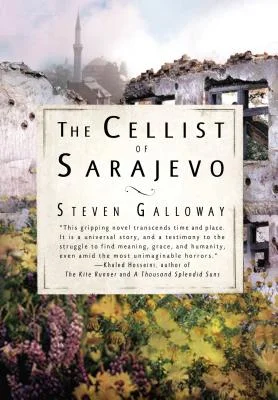
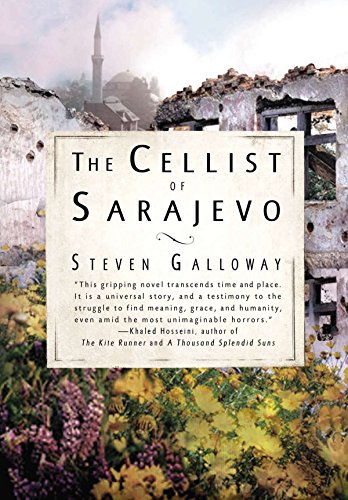
The Cellist of Sarajevo
A brief overview of The Cellist of Sarajevo by Steven Galloway. The music, the context, and the things that really grabbed my heart and twisted it around. I couldn’t shake this book easily, so I thought I would share it with you just in case you’re in need of a compelling read that happens to include the power of music.
I recently read The Cellist of Sarajevo by Steven Galloway. It is a relatively short book set in the 1990s Siege of Sarajevo. The premise pivots on a cellist who plays the Adagio by Albinoni for 22 days in a row to honor the 22 people who died in a bombing while waiting for bread. The book follows 3 separate people through their life at that time, who do not directly interact with the cellist or each other, but who are deeply affected by what he does; a female sniper tasked with keeping him alive, a bread maker whose family has escaped the city, and a father who must travel through the city to get fresh water for his family.
From Goodreads:
This brilliant novel…tells the story of three people trying to survive in a city rife with the extreme fear of desperate times, and of the sorrowing cellist who plays undaunted in their midst.
One day a shell lands in a bread line and kills twenty-two people as the cellist watches from a window in his flat. He vows to sit in the hollow where the mortar fell and play Albinoni’s Adagio once a day for each of the twenty-two victims. The Adagio had been re-created from a fragment after the only extant score was firebombed in the Dresden Music Library, but the fact that it had been rebuilt by a different composer into something new and worthwhile gives the cellist hope.
Meanwhile, Kenan steels himself for his weekly walk through the dangerous streets to collect water for his family on the other side of town, and Dragan, a man Kenan doesn’t know, tries to make his way towards the source of the free meal he knows is waiting. Both men are almost paralyzed with fear, uncertain when the next shot will land on the bridges or streets they must cross, unwilling to talk to their old friends of what life was once like before divisions were unleashed on their city. Then there is “Arrow,” the pseudonymous name of a gifted female sniper, who is asked to protect the cellist from a hidden shooter who is out to kill him as he plays his memorial to the victims.
Perhaps because I was a child when the siege occurred, I was a little (read very) hazy on the details of this tragedy. While reading this book, I had to dig up some of the facts and history of what actually happened in order to make sense of such a travesty.
Owlcation did a pretty good job of summing up some of the facts:
Starting in 1992, the city of Sarajevo, capital of the Republic of Bosnia and Herzegovina, came under siege and was subjected to daily shelling and sniper attacks from Serbian forces in and around the city. The siege lasted from April 6, 1992 to February 29, 1996, the longest siege in modern history-- a year longer even than the Siege of Leningrad during World War Two.
When Yugoslavia's leader Marshal Tito died in 1980, the country's constituent ethnic and religious groups began vying for control. Some wanted independence; some wanted Yugoslavia to continue-- though under their control.
After the Republic of Bosnia and Herzegovina (hereafter referred to as “Bosnia”) declared its independence on March 3, 1992, Serbia, along with Bosnian Serbs and, initially, Croatia, prepared for war and sporadic fighting broke out in parts of Bosnia. As tensions mounted, 40,000 Bosnians, Serbs and Croats from all over Bosnia demonstrated for peace in Sarajevo on April 6, 1992, the same day that members of the European Union recognized Bosnia as an independent state. This show of ethnic unity angered Serb nationalists who fired into the crowd. This was considered the start of the Siege of Sarajevo.
Serbs and Bosnian Serbs held positions inside the city, including the airport, as well as in the surrounding hills. By May 2, the entire city was surrounded. They cut off supplies, including food and medicine, as well as water, electricity and heating fuel. Though equipped with superior weaponry and fully supplied, the Serbs were outnumbered by the city's defenders who were armed with anti-tank weapons and were able to stop the attacking armored columns. Faced with this standoff, the Serbs decided to lay waste to the city with their artillery and terrorize the population with sniper attacks.
Serbs and Bosnian Serbs held positions inside the city, including the airport, as well as in the surrounding hills. By May 2, the entire city was surrounded. They cut off supplies, including food and medicine, as well as water, electricity and heating fuel. Though equipped with superior weaponry and fully supplied, the Serbs were outnumbered by the city's defenders who were armed with anti-tank weapons and were able to stop the attacking armored columns. Faced with this standoff, the Serbs decided to lay waste to the city with their artillery and terrorize the population with sniper attacks.
This fictionalized telling of an actual occurrence painted a horrific scene. Kenan’s trek through the city to get water for his family is harrowing and the dreaming of simple luxuries that we take for granted, like shaving, consistent electricity, running water, being able to laugh carefree and spend time with friends carves such a bleak picture of the reality of the situation. I could not believe, reading this book and reading about the Siege, that this happened during my lifetime (and I’m not THAT old).
The Cellist of Sarajevo
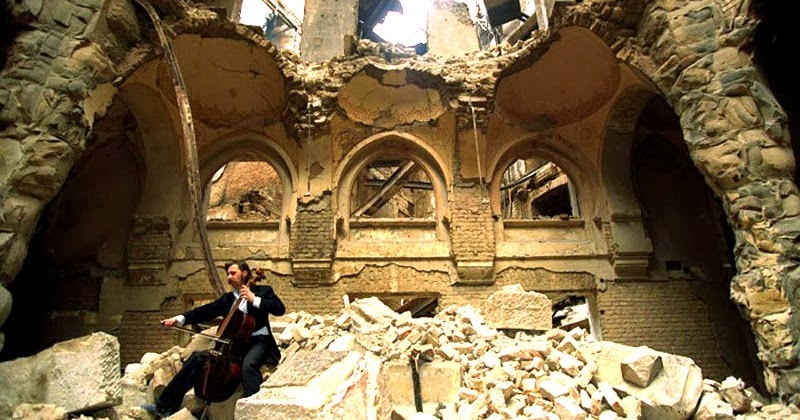
While this is a work of fiction, the book is based on a real cellist, Vedran Smailović, of the Sarajevo Philharmonic Orchestra, who played outdoors in the ruins of the city and at funerals regardless of the constant threat of snipers and shellfire. I did not realize that composer David Wilde wrote a piece for solo cello called The Cellist of Sarajevo in his honor. Steven Galloway notes that Smailović managed to escape Sarajevo in 1993 and now resides in Northern Ireland.
Albinoni’s Adagio in G
Here’s a brief what’s what from Wikipedia:
The Adagio in G minor for violin, strings, and organ continuo is a neo-Baroque composition popularly attributed to the 18th-century Venetian master Tomaso Albinoni, but actually composed by 20th-century musicologist and Albinoni biographer Remo Giazotto, purportedly based on the discovery of a manuscript fragment by Albinoni.
The composition is often referred to as "Albinoni's Adagio" or "Adagio in G minor by Albinoni, arranged by Giazotto." The ascription to Albinoni rests upon Giazotto's purported discovery of a manuscript fragment from a slow second movement of an otherwise unknown Albinoni trio sonata.
According to Giazotto, he obtained the document shortly after the end of World War II from the Saxon State Library in Dresden which had preserved most of its collection, though its buildings were destroyed in the bombing raids of February and March 1945 by the British and American Air Forces. Giazotto concluded that the manuscript fragment was a portion of a church sonata in G minor composed by Albinoni, possibly as part of his Op. 4 set, around 1708.
I lamely wasn’t sure if I knew this piece when I read the title, but when I looked it up it was one of those “oh duh of course I know this piece” moments. If you’re like me, and don’t recognize the title take a listen and I’m pretty confident you’ll recognize it.
Back to the Book
The cellist’s actions are questioned in the book, Arrow, is sent to protect him from assassination, the International media covers the performance, and Smailović is (still) seen as a global humanitarian hero. One of the characters in the book points out how the performance seems frivolous in the face of such danger and bleak conditions, until he witnesses his playing. Smailović plays at 4pm everyday for 22 days in a row and more and more people come to witness his memorial to the city.
I finished this book a few weeks ago and didn’t shed a tear, but it continues to weigh on me. I keep thinking about the living conditions of the residents of the city, losing loved ones and neighbors everyday, living in constant fear and the power of music to express something that is so hard to put into words. Something that captures the attention of the whole world, but touches deeply the people immediately surrounding the bombing and the city. How even the sniper sent to kill him (in the book) cannot help but put his gun down and listen to the performance. How Arrow considers it her most important mission yet, to keep the cellist alive.
I’m not one to wax lyrical about “the power of music” but truly there is something to it. Just like when Rostropovich played at the Berlin Wall, and now Yo Yo Ma is doing at the Mexico border, music does form a bridge that connects disparate parts. You don’t have to analyze the performance, the piece, the historical accuracy, or the acoustics, you just have to be present for the experience. Does it change anything quantifiable? Who knows. But is that really the point? Are you supposed to make a spreadsheet every time you hear something that moves you deeply? (god, I hope not).
This review was written simply because I could not thinking about this book. Below are links to the sheet music and the book If you’re interested in obtaining a copy for yourself.
 look inside
|
Adagio in G Minor Composed by Tomaso Giovanni Albinoni (1671-1751). Edited by Werner Thomas-Mifune. Cello & Piano. Baroque. Instrumental solo book. With bowings and fingerings. 6 pages. Edition Kunzelmann #GM1670. Published by Edition Kunzelmann (PE.GM1670). |
My Timani Lesson
A quick recap of my introduction to Tina Nilssen and Timani. I am so excited about this work and have been thinking about it nonstop for the past month. Working with Tina was the highlight of the whole PAMA weekend. She has such amazing insight into the body of the musician. Enjoy!
This year I (finally) had the good fortune of attending the Performing Arts Medicine Association (PAMA) Symposium. When I discovered that it was going to be held at UCLA this year, I jumped at the chance to be there. I read and reread the schedule and topics presented and planned out my days. The symposium ran from Friday - Monday morning with a certificate course, “The Essentials of Performing Arts Health” scheduled for the Thursday before. I relied heavily on their journal, Medical Problems of Performing Artists(MPPA), for source material when I was researching my dissertation, “Using Iyengar Yoga to Enhance Violin Playing.” It is by far the most comprehensive source for articles about musicians health.
The Workshop
One of the Seminars was lead by Tina Margareta Nilssen, from Norway. Her workshop was titled “How Can We Help to Prevent Repetitive Strain Injury in Music Students While Simultaneously Enhancing Musical Expression,” and took place on Saturday afternoon. I was excited to attend her workshop because Tina and I had connected via social media, and it is not every day you meet someone also invested in Musicians Health and Wellness in person.
Her workshop politely blew my mind. While her workshop title is long and kind of ungainly, she emphasizes “Anatomical knowledge and physical implementation to create freedom and joy of playing.” Her workshop was upbeat and engaging. She has the type of presentation that is compelling and instantly makes you feel like you know her but also that you want to know more. I pretty much rushed the stage afterward to pepper her with more questions, and she (shockingly) asked if I would like to meet outside of the symposium to do more work (so I said yes, duh).
The Lesson
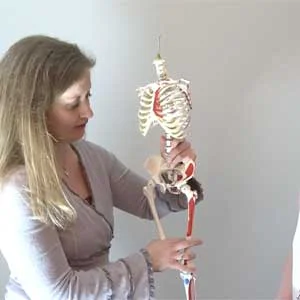
We met at Disney Hall for a private lesson and in true music student fashion (I got nervous beforehand). The first thing we did was discuss the ideal body of a musician (turns out it’s a chocolate-covered caramel – delicious) before I played for her, and she videotaped it. When I watched the footage, I thought my posture looked pretty good, but after 20-30 minutes or so of work together, I could see a subtle but dynamic difference in my playing. It was shocking.
We worked for approximately another hour, going over sitting posture and standing posture, and subtle cues to bring awareness back to areas of my body I was neglecting. After I played, we did not run scales and talk about technique or wrist placement, or anything most violin teachers narrow in on. Instead, we worked on how to breathe 3-dimensionally. We also talked about the appropriate musculature necessary for playing the violin, the function of specific muscles, and which muscles should be holding and supporting versus moving and applying pressure. I have news for you: much of violin pedagogy and what you are/have been taught by violin teachers with no anatomy knowledge or training can be damaging and does not provide optimal motion. This rocked my boat. For years during graduate school I had a teacher who was so “right” about alignment and somatic integration for violinists and being the good student that I was, I tried to do everything he asked by at least 110%. Come to find out that a teacher who is only partially informed and armed with an overabundance of confidence (and an exacting attitude) can do more harm than good. He celebrated my posture but chastised my performance nerves. I felt betrayed when I discussed this with Tina. For years, in an attempt to do what is correct, I was doing what is incorrect.
I always felt reasonably competent when it comes to filling my lungs, particularly in the front and sides. I have worked on this, for seemingly countless yoga hours. What I quickly realized is that I do not breathe into the back of my chest and ribcage. Also, I have always received praise for my great posture when I play. People point it out onstage, and I took pride in my stance, either seated or standing. But very subtly it is not so great. My chest and lower ribs jut forward, and my bottom pops out making it difficult to breathe into my back and also puts a strain on my Psoas muscle (which, incidentally, I learned quite a bit about at a different PAMA Symposium workshop). When I get nervous, which I was, it makes it even more difficult to breathe, make a good sound, and remain calm. It also exacerbates the nerves because again, as I discovered at the symposium, the Psoas muscle is intricately connected to the body’s fight or flight response. So everything I thought I was doing “right” was hindering my internal alignment and putting a considerable strain on my whole system making playing the violin, particularly when nervous even harder! This type of revelation makes me want to turn back the clock and redo all those silly auditions where I was so nervous and desperate to find control, without realizing I’m impeding my body’s natural wellbeing.

Alex Rosales Garcia working with Tina Nilssen on sitting posture at Disney Hall
I stayed after my lesson to observe her work with a bassoon player. Our instruments have different demands, but the improvement in sound with just a small amount of breath and posture work was so profound it was almost hilarious. To the untrained eye, it might appear that not much had changed, but internally, his body was supporting his breath and instrument more fully resulting in a tone that was large, round, and singing. It was beautiful and sounded so natural and free.
I would have stayed even longer to see another violinist have a lesson, but I had to run off to a gig. Tina graciously agreed to meet with us the next day and continue working together. It was fun, and the group setting (there were two of us plus Tina) had a relaxed workshop feel where we could freely ask questions as they arose and learned different applicable exercises or practices. She kept having to remind us that we were skipping around in her typical training but still, we could see and hear results. I was so excited to go home and practice because I LOVED my sound. My violin was singing, and I had a positive full-body experience while playing. How many of my colleagues can relate to that last statement? Sometimes I love to play but am sore afterward. Sometimes I play and feel great but am disconnected from the sound. These two days opened my eyes to the sensation of fully feeling the music pass through me and my instrument. It feels borderline profound, and I wish I could explain it better.

Tina is the first musician I have encountered that synthesizes information in a way that is practical, attainable, easy to understand and apply, and musically focused. I have tried Alexander technique, some body mapping, yoga, etc. but this is the first time I have experienced the results so immediately and thoroughly in a manner that focuses on optimal musical expression by the performer.
I signed up for the Timani community after our work together so I could learn more and keep improving. The last thing I want to do is mismanage my body in the practice room, or even worse – pass on incorrect information to my students. As I internalize some of these points, I want to incorporate them into my own teaching and pass them on to my students. You can check out more about Tina click here and Timani here, and you can sign up for the community (the first month is free and packed full of useful information) here.