
Yoga + Music Series: Dharma and Duty for Musicians
The first installment of my Yoga + Music blog posts. This one is all about Dharma, a topic I’ve been pondering often these days. What is our duty? As musicians, in life, and beyond.

I've been thinking a lot about the yogic concept of Dharma recently. It was something we discussed in my yoga teacher training in the Fall with Noah Mazé and Rocky Heron, and it landed on me like a snowflake that just wouldn't blow away.
It is a tricky term to define precisely, and many people interpret it to mean a variety of different things, so I’ll draw on a few sources to narrow it down to what I've been pondering.
(Also, I use these blog posts are an opportunity to discuss my relationship with music and yoga, so bear that in mind as you read this post).
Definition of Dharma in Merriam Webster
1 Hinduism: an individual's duty fulfilled by observance of custom or law
2Hinduism and Buddhism
a: the basic principles of cosmic or individual existence: divine law
b: conformity to one's duty and nature
In the Bhagavad-gītā, Dharma is used in place of the word duty. It comes up in regards to Arjuna's moral quandary – battle or no battle. Krishna tells him he must fight because it is his duty, his Dharma.
It is an interesting question to ponder; what is my duty? In the context of Arjuna's life, it is his duty based on his class – meaning, he was born into the warrior class, therefore he has no choice but to go to battle. But technically, this type of class system doesn’t exist anymore. Or if it does, it isn’t nearly as strict. So what does one make of Dharma in the modern context? What about as a musician? Is being a musician in the present day some sort of chosen “class” or is it simply a profession?
I often think that creating a life in music begins as a higher calling. You might not know why you enjoy it, but you do. Music, regardless of genre, era, instrumentation, etc., can be so compelling as a listener, creator, collaborator, or performer that it might be challenging to articulate what first drew you to the sound or instrument, but there is a power to it that holds your attention. Being a musician often becomes something of a duty, it can feel like our nature.
In my case, I felt compelled to play the violin when I was four or five years old. From that point on, it became an indelible part of who I am as a person. I didn’t know at that age what kind of violinist I wanted to be; I just loved the sound. But as I pursued a life in music, the path grew narrower as my interests seemed to grow broader. Is my Dharma simply to play violin? Or is it to play violin in a specific ensemble or genre? Is it my duty to be a violin teacher? How did my calling get so intricately bound to a job description?
With the added time to ponder and reflect during Coronavirus and social distancing, I've been wrestling with these questions. I'm finally awakening to the realization that music takes up a bigger space than just a job in my life, and while being a musician might be my duty, it might not always be my job (and sometimes my musical job, is not my dharma). When I admitted that last part to myself, it was terrifying. How could I be a musician and not make music for a living?
I've been sitting with that question daily and have come to this conclusion: collecting payment for work isn’t the same as having a mission or a purpose. If I don't like my musical job, but I am a working musician, am I fulfilling my Dharma? I don’t think so.

So what's missing?
The Why
The why drives everything.
We start everything with the WHY.
Return to the WHY
When I was a kid, I loved playing the violin. I loved the way it sounded, and I loved the repertoire. I loved my teacher, and I was unaware of the mind games or the weird politics of gig life. I wasn’t aware of the total devastation of losing countless auditions and questioning my self-worth. I simply did what I loved.
Often, the journey makes the WHY less clear. We get caught up in the present, in whatever is happening in our environment or how we feel about a specific gig, job, student, or employer. We get distracted by our immediate needs and wants. Often, we question our worth and credibility because we are trying to force our existence into a culture that doesn't care about our individual nature. We forget why we started on this path to begin with, and sometimes we get blown off course. What WAS our duty, is now our occupation but it no longer aligns with our intrinsic nature. Does that make sense?
So how do you reconnect to the WHY?
I don’t have the answer for this but I see glimmers of it all the time.
In a lesson taught with an attentive and engaged five-year-old.
On tour in Europe with non-classical musicians.
In a practice session when nobody is listening but the music seems to come from somewhere deep inside.
While focused on a project I am deeply passionate about.
While I cannot explicitly articulate my duty, I realize that my nature is to be a musician. You may think those are the same thing (see definitions above) but I think there is nuance.
My nature is to be a musician but the HOW is my duty.
HOW I make music and exist as a musician comes from having a clear WHY. Working with a clear vision and path forward is what I believe the essence of Dharma really is in our modern-day society.
I used to wish my Dharma was to be the best violinist; To win. To be the soloist everyone adores or the teacher everyone wants to study with, but I've come to realize my Dharma lives in the shared spaces that surround music. In the friends you make, the joy you bring to others, the transformation you provide to students, the collaborations you share, the community you create, and the stories you tell that create a shared experience through music.
My Dharma has no job description.
So, where is the job market for Dharma that lives in the cracks around a vocation? If music is my nature, and I feel most called to inhabit unspecified spaces, what does my authentic path forward look like, and how do I define success?
How do all of my interests and passions converge to create my duty? How does my nature shape my life?
This is what I’m pondering.
Stay tuned.
How Does Your Garden Grow?
I’ve been thinking about community recently. Who is in it? How do we interact? What do we need? The best analogy I could come up with - and I’ve committed a lot of thought to this - is a garden. Think about all the most beautiful gardens you’ve ever seen in the world. What do they have in common? How can you translate that to your community?
Mary, Mary, quite contrary,
How does your garden grow?
With silver bells, and cockle shells,
And pretty maids all in a row.

Social distancing transformed how we interact with each other and how we define our inner circles, friends, and community. The recent devastating social events instigated by the outrage surrounding #justiceforgeorgefloyd pushed these musings into sharp focus. I’m sharing some of my ponderings here in case you have input, ideas, thoughts, and opinions you would like to share.
This is NOT:
A blog post telling you how to live your life
Me passive-aggressively lecturing you or judging you about your choices.
A political statement condemning or supporting any political candidates.
I know that things are politically heated right now, and I am not trying to fuel that fire, merely to offer my thoughts on MY actions and intentions. At least, how I want to move forward and interact with others.
A little bit about Me:
I am a violin player and teacher
I am not a politician
I am not a gardener or horticulturist
I am not perfect
I have room to grow
So….
I've been thinking about the notion of community. When everything transitioned online, I found myself (like everyone else) suddenly without many in-person interactions. Everything that had been easy about maintaining friendships and relationships suddenly took effort. All of a sudden, I was exhausted by too much screen time, and if I wanted to talk to friends from yoga class or my neighbor – things that used to be easy and practically built into my day - I had to make a concerted effort. I found myself expending so much mental energy fostering relationships that used to happen so organically. That in-person time turned into screen time - both productive and unproductive - and it made me question who is in my community? How do I interact with them? What do I want or need from my community? And how do I fit into their community? (along with many other things).
Now that I can't be lazy about answering these questions, it is actually quite interesting, and I realized that my community is pretty big and includes people I do and don’t know.
Here is a simplified list of my community as I see it right now and in no particular order:
MY family
My private students and their families
My YOLA Students, colleagues and their families
My Harmony Project students, colleagues, and families
Family friends
My friends on social media
My followers on social media (yes, they can be different depending on the platform and your sharing intent)
Readers of my blog
Subscribers to my Newsletter
Local friends
Close friends who live far away
Colleagues from various professional endeavors across the globe
Former Students and their families
Former colleagues
People I follow on social media
Writers and Bloggers that I follow and read
People I watch and follow on Youtube (is this different from social media? I'm not sure, but it feels different for me).
My teachers, current and former
Politicians – national and local - I watch and follow (and if I don't, the ones making decisions that affect me)
Celebrities, musicians, and creators that I admire
My physical neighbors - physically. The ones who live next door to me.
Local businesses I support.
Large companies and brands I use and buy from
Did I leave anyone out? Even if I did, that is a lot of people – and I'm not even that popular. When you look at this list and think about it, there are potentially thousands of people in MY community. Your list would be similar, but it would center around you.
Then there is the question of how can somebody be part of my community if they don’t know who I am? This comes down to the type of relationship you maintain with these people, brands, content. As I'm sure any marketing expert would tell you, there is a multitude of ways to influence and engage with individuals. I define my community generally, as everyone I receive information from or give information to. This changes my perspective on who is "included" in my circle.
Active and Passive Relationships and Interactions.
Think about active and passive interactions. When you scroll through social media, you are taking in information from a multitude of content creators, but you don’t necessarily interact directly with these accounts and people. You might not double tap or comment on every post you see. In fact, some people you follow might now know who you are. How many companies have your email address and advertise to your inbox. How many strangers do you follow on Instagram? How many Youtube videos do you watch? I consider these to be different forms of passive interaction. You are not actively participating in that person's life. Still, you are absorbing their content, opinions, values, aesthetics, information, and how they WANT to present it (and this is important because the HOW can can conjure dramatically different results).

An active interaction, these days at least, is a zoom call, a telephone call, text messages, comments, chats, communications with that person in a direct, and hopefully reciprocated way. You have to actively engage these people and put some effort into the relationship. Some relationships fall under both categories: I follow some people AND arrange zoom calls with them. The same could be said about my community list above. Several of these groups fall under more than one category (friends on social media who are also colleagues, for example).
When you zoom out (get it?) and realize how many people are in your life for all sorts of reasons, do you think you can agree and relate entirely and absolutely with all of them? Of course not. I know that is not possible from personal experience. We are all different, and that should be celebrated.
So when it comes to community, how can we live, grow, AND THRIVE together?
Life is a garden, and you are the gardener.
I've been thinking about this nonstop. Maybe it is the multitude of beautiful blooms that have taken over Los Angeles. These days (since lockdown, really), I walk around in awe of the diversity of foliage in this city. Around every corner, there is a scent or a color that I fall head over heels in love with. Whatever got me started on the garden idea, what I like about the analogy to my human community is the following:


A gardener is judged by the quality and diversity of life in the garden. Nobody celebrates the gardener who only grows a small amount of something reasonably well. Similarly, you are not a successful gardener with a wide variety of dead flowers growing in your patch.
As a gardener, your pride comes from the success of the blooms and life around you. YOU made or at least helped that happen. And this puts the onus and responsibility on the gardener to cultivate growth.
Some plants nourish you in return, but many do not. Either way, you tend to your garden.
Every flower, vegetable, tree, or fruit in your garden requires a different diet of nutrients for success.
The larger and more diverse your garden, the more beautiful and coveted your garden is, and the more successful a gardener you are.
You do not yell at a flower for not growing or failing to bear fruit. Instead, you wonder what you can do differently to elicit growth from this plant.
Some plants are beautiful to look at. Some smell like heaven. Some are delicious to eat, and others provide shade. Some offer benefits to others indirectly and often in a way that you must foster, but will never reap the immediate benefits from. Some do a few of these things, but none (to my knowledge) do all of those things.
Old plants can and do grow harmoniously alongside young life similar to trees and perennials planted in the same garden.
It takes a multitude of different and similar plants growing bountifully to make a successful, beautiful garden. You cannot plant 45 daisies and consider it a success if only one of them grows. Beating the odds in a garden is not success. It means the conditions were wrong.
So, how does your garden grow? Are you tending to your blooms with equal love and attending to their hugely diverse needs? Are you prioritizing their growth? Are you comfortable with the different needs of your garden? What does that even mean to you?

I'll use myself as an example for one small yet very diverse part of my garden. I am a teacher. I spend many hours every week working with students, thinking about them, worrying about them, talking about them, interacting with them, preparing materials for them, and communicating with their families. There is no possible way that I could fully understand the perspective of every student I teach. Yet, it is my responsibility to help them grow and thrive as musicians and as citizens in their communities. How can I do this? Is this even possible?
Simply put, of course, it is possible! As long as I’m not forcing them into a mold that doesn’t fit their growth. When you start working with a beginning student, there is no way to determine where their musical journey will take them, and it is not my job to decide their goals for them. My job is to provide them the musical nutrients and tools to help them on their journey. Sure, I can help them navigate the path. I can help push them towards their goals. But I cannot force a daffodil to be an apple tree. I cannot force a musician to play with a specific shoulder rest, for example, because it is what I use, ESPECIALLY if it causes pain (which would block their growth in some way). I can’t expect them to do something the way I do it because that assumes they want to grow up and be me - and we all know that is impossible.

There are more than just violin student flowers in my garden that need tending…
I am the gardener in my garden, and if that is the case, my job is to help blooms blossom. My job is not to determine how high, or how big, or in what direction they can or should grow. My goal is to keep them from waning, dwindling, or dimming. I cannot yell at a flower to grow. I cannot harass and shame it into bearing fruit. I cannot NOT tend to it and be confident that my garden will be opulent. I can’t plant it in nutrition-less soil and expect it to overcome the odds.

I know that nature is resilient, as are people, and will bloom and grow in the most surprising places, but that is not something you can count on. Not every flower gets that lucky.
Conversely, if I overwater my garden, or mess with it too much, it can have the same effect. In the garden, a certain level of trust for the process, coupled with care and attention, is the best equation for success. But again, I want to remind you that I am not actually a gardener.
How is this reflected in YOUR life? How is this reflected in MY life? How can we foster this type of growth and success in our communities?
I’m not talking about any specific political climate. I’m talking about our daily actions, behaviors, interactions, social media posts, etc. What messages are you spreading to your active and passive communities? Do they elicit growth? Does it help others grow, or does it block them in some way? Are you supporting the businesses in your community? Do you check in with your friends and family? Do you celebrate the successes of others publicly or privately?
I’m not perfect, but I am trying – I’ve been on a journey since my wakeup call with Brene Brown to examine myself, my life, and how I fit into my community. It started with the considerations of what I can and should offer my students and has evolved from there. I get mad. I get furious. I stomp around my apartment and rant about trivial things and historically relevant events that really piss me off. I am human. But when I express these things to my community, I am trying – now more than ever - to be mindful about how I can do that in a way that doesn't enrage others, that doesn't seek to cause harm to anyone but instead aims to help us all grow. If I spark intense feelings in you, ask yourself how you can turn that into your own growth. This is what I try to do. How can I take this sharp pang and turn it into the mirror I need to examine myself and help others?
I don't like it when I feel accused, shamed, or assaulted. It does not help me grow, learn, and evolve. And if we're honest with each other as fellow gardeners tending to our bounty, isn't that what we want? Don't we want to help each other grow? Above all else, aren't we all trying to grow as people, flowers, artists, etc.?
As the gardener of your community, help me.
I’m genuinely asking you. Can you reflect on your own garden and give me tips about how you foster growth in your passive and active communities? What does this type of gardener approach mean to you?
You are welcome to disagree, and I encourage a discourse, but please be mindful – if you are reading this, we are part of the same garden, and if I am in your garden, how, as the gardener, are you going to engage in a dialogue that helps me grow.

Thoughts on Jupiter
While doing a little research recently, I took a walk down memory lane to Maltmans Green, the primary school I attended while living in England as a child. It was a very proper place. This post is about the Hymn from Jupiter by Gustav Holst, the poetry by Cecil Spring Rice, my own memory of the piece, and a few thoughts on applying the message to life at large.
Recently, the quartet I coach at YOLA was asked to put together an online ensemble performance of a string quartet. In the present times, this means each member records their parts separately then some brilliant and brave audio engineer puts them together.
We decided on an arrangement of the Hymn from Jupiter by Gustav Holst. I love this piece and I was happy my group chose it. I was digging around online for a good quartet recording for them to listen to to get a feel for the piece when I stumbled on the lyrics, and down the rabbit hole I went.
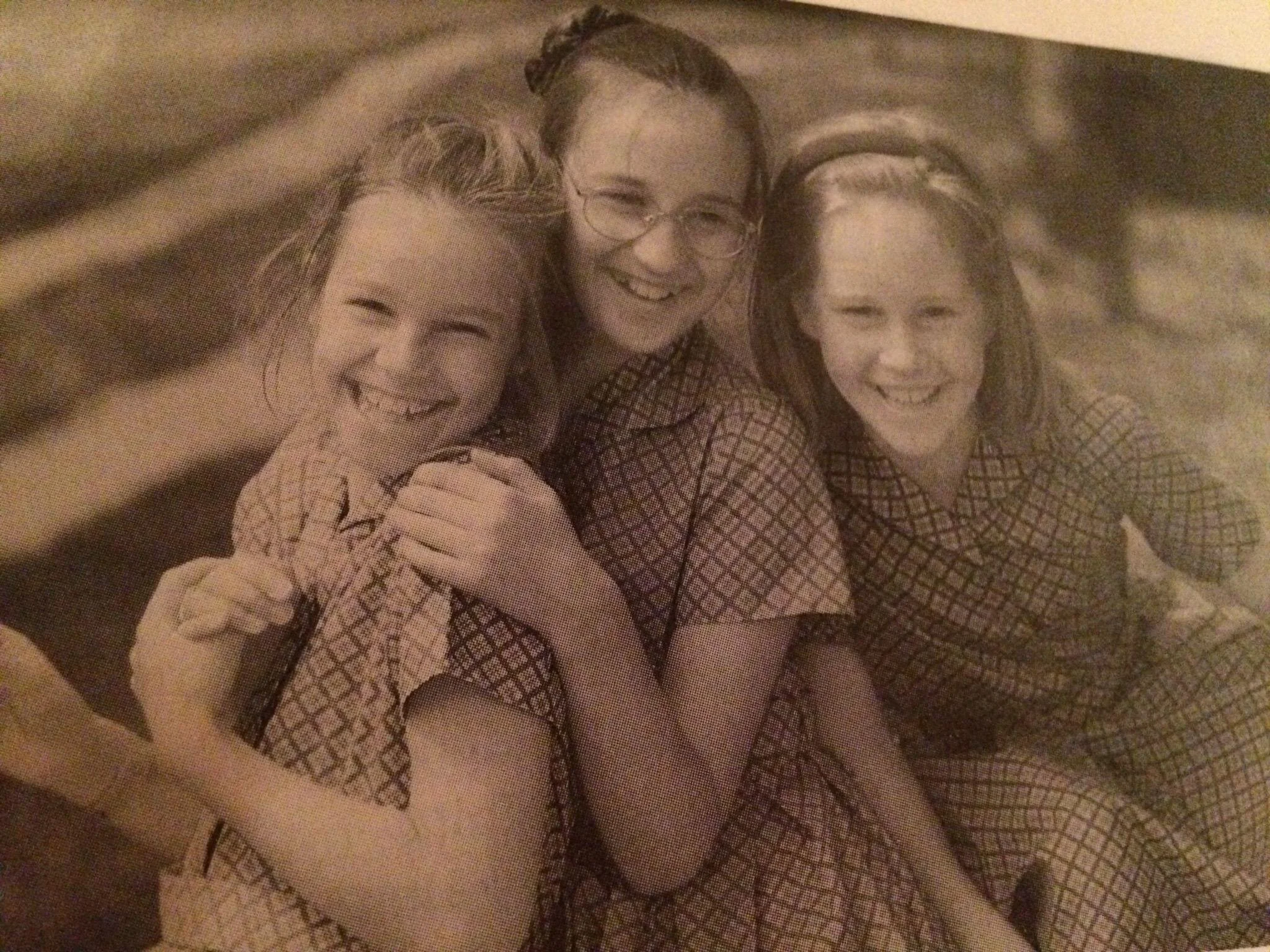
Researching this piece, listening to it, and coaching my students took me back to age 12 when I lived in England and attended Mailman’s Green School for Girls. Every morning, the entire school had assembly together in the gym. Any of my friends from those days or my friends of my parents, who happen to read this, know how traditional school was back then (hint: the 90s), we wore uniforms with HATS, there was a headmistress who we shook hands with every day before leaving for home, we were schooled on our manners in the lunch room…and so many more ridiculous things that are definitely not taught at school in the States, now that I’m thinking about it.

Lindsay Clarke, Samantha Day, and myself age ? in our summer uniforms - they are purple, yellow, and white

The Maltmans Green Logo
Anyways, in morning assembly the older girls sat at the back and the youngest at the front, with the teachers on the stage looking out over all the students. One morning, we were singing this hymn and me and a few of my friends started really hamming it up at the back of the room. Full on fake opera singing, with dramatic facial expressions, wild arm gestures, exaggerated rocking back and forth from foot to foot, and laughing hysterically under our breath. Silly us, we didn’t even stop to think that all of the teachers were staring straight at us.

The main entry at school with Girls in the Summer uniform
At the end of assembly, as the rest of the students filed out to begin their school day, Mrs. Vernon the assistant headmistress (much scarier than Mrs. Evans the Headmistress who called everyone sausage pots or poppets) called us aside and screamed at us for being disrespectful. In true 12-year old fashion we stared at our feet, mumbled our apologies, and then burst into laughter as soon as we got out of the room. That, to this day is my main memory of assembly and singing this hymn.
Here is what I did not know as a snotty 12-year old:
"Thaxted" is a hymn tune by the English composer Gustav Holst, based on the stately theme from the middle section of the Jupiter movement of his orchestral suite The Planets and named after Thaxted, the English village where he lived much of his life. He adapted the theme in 1921 to fit the patriotic poem "I Vow to Thee, My Country" by Cecil Spring Rice It did not appear as a hymn-tune called "Thaxted" until his friend Ralph Vaughan Williams included it in Songs of Praise in 1926.
For Reference, here is the original version:
There were many texts set to this hymn but by far the most remembered and loved is the one listed above by Cecil Spring Rice. Wikipedia says that during the 20th century Songs of Praise was widely used in schools in the UK which is probably what we were using at Maltmans Green.
Side note: It also says that the 1931 edition included the first printing of the hymn “Morning Has Broken,” another classic I remember singing in assembly (much much) more than once.
"I Vow to Thee, My Country" by Cecil Spring Rice, was sung at the wedding of Prince Charles and Diana, Princess of Wales in 1981 and again at the latter's funeral in 1997, and at the funeral of Margaret Thatcher in 2013.
The poetry is beautiful and brought a tear to my eye.
I vow to thee, my country, all earthly things above,
Entire and whole and perfect, the service of my love;
The love that asks no questions, the love that stands the test,
That lays upon the altar the dearest and the best;
The love that never falters, the love that pays the price,
The love that makes undaunted the final sacrifice.
And there's another country, I've heard of long ago,
Most dear to them that love her, most great to them that know;
We may not count her armies, we may not see her King;
Her fortress is a faithful heart, her pride is suffering;
And soul by soul and silently her shining bounds increase,
And her ways are ways of gentleness, and all her paths are peace.
The message of this song is so deeply heartfelt. I understand why it was claimed as a Patriotic song, especially when considered in the context of history at that time (World War I ended in 1918, the music for The Planets was actually composed by Holst during the War).
It seems to me that even though this is a hymn in the traditional sense, the message extends beyond religious sect. The message is global. Can you imagine how you would treat others if you reframed your interactions with the concept of love described above? If our ways were gentle and peaceful, how would the interactions we have with others change? If you take these notions and apply them to human interaction rather than love of country, and the love of _____ (insert your higher power of choice) it makes for a compelling case for kindness as a global motivator above all else.
When prepping materials for my students I became really fixated on these notions. I sang and hummed this tune in the shower, on walks, waiting for zoom meetings to load, as I unpacked my violin, etc. etc. etc. It was written almost 100 years ago and the message is needed just as much now as it was then.
What do you think?