
A Decade in Review
Do you ever take a few moments to take stock on where you’ve been and what you’ve accomplished? I took a little time this month to reflect on the last decade and all of the crazy things that changed. It put so much in perspective for me and I can’t wait to see what happens in the next ten years.
Wow, 10 years. It feels like it simultaneously flew by and limped by. There were periods of the last decade where time felt like it stood still, and months that flew by in the blink of an eye. The last 10 years were big for me. In 2010, I had my undergraduate degree and was freelancing in Minneapolis, playing mostly musical theater and performing and recording with bands. I had a part time job at Apple as the person everyone yelled at when they couldn’t figure out how they screwed up their iPhone. I started last decade feeling a little lost and unsatisfied, and finished the decade with more drive and purpose than I ever imagined I would possess.

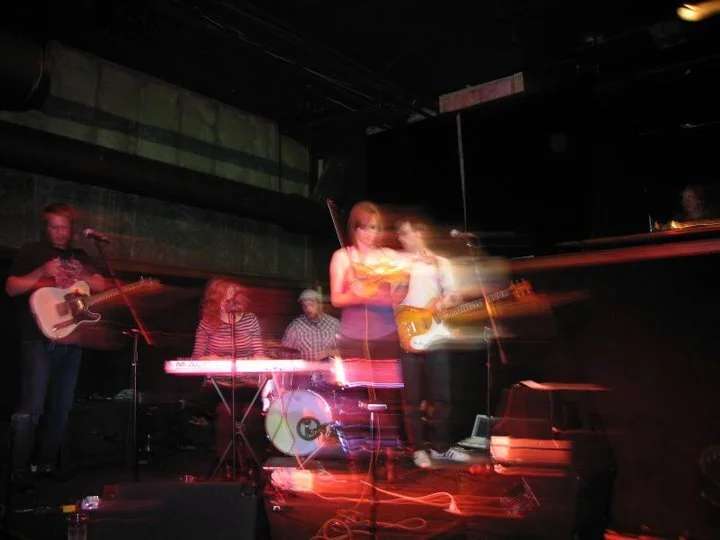
10 years ago. My band WIVE performing at the 501 club in Minneapolis, about 1 week before I moved to Oklahoma (July, 2009).
Its funny how sometimes you feel like you have stalled. Like all of your friends (and social media acquaintances) are whizzing into the future adorned with success and you are just sitting around hoping you’ll get called for a little work, or that you’ll do something productive that day, or that your life even has meaning or purpose. Sometimes I feel like nothing is changing, that everything has stagnated and that I have achieved nothing. Occasionally, I get lost in these periods of life and forget to take stock on how far I’ve come. Taking time to reflect on the past decade gave me some much needed perspective on this journey called life. I laugh at some of the little “fails” that in hindsight are no big deal, or would have led me down a path I realize now that I do not want, but at the time felt life-shatteringly tragic. I’ve grown so much grit and resilience, perspective, drive and passion. I said goodbye to many toxic relationships, and hello to many wonderful people and opportunities. Can you relate to any of this? Do any of these feelings resonate with you?
Below, are a few of the highlights from the past 10 years of my life.
Places I lived:
Minneapolis, MN
Norman, OK
Tulsa, OK
Los Angeles, CA
(a total of 7 different addresses)
Degrees and Training completed:

Proof that I have a DMA
Masters of Music
Doctor of Musical Arts
Suzuki Training
Essentials of Performing Arts Medicine Certificate
Books read:
207+ I started keeping track in 2015 but I definitely read books before then. See my recent blog post about my recommended books from those years).
Races:

at the LA marathon in 2019.
2 marathons
6 ( I think?) half-marathons
at least 10 5Ks
at least 3 10Ks
1 sprint triathlon
The Hood to Coast relay race (2012)
1 dressage show
1 local hunter jumper show at Sonrise Stables in Oklahoma.
Jobs Held:
3 college teaching jobs
1 conservatory prep position
3 different Sistema-program positions
Orchestra positions won:

performing with the Tulsa Symphony in 2016.
5 successful professional auditions (and several unsuccessful auditions) + other freelance orchestra work
Other Work:
Applied for and denied from multiple college jobs and grant opportunities
Worked in a Cheese Shop (and learned a ton about fromage)
Was an Assistant Music Librarian at a professional orchestra
Sat on multiple orchestra and non-profit committees
Sad points:

RIP Papa Larson.
Lost both of my grandfathers
Lost our family dogs Chester and Suzy
Jeff’s father and step father passed away
Forced to upend a long-term musical relationship with a teacher who was inappropriate and borderline abusive.
Highlights (in no particular order):

Met Jeff and made a life together
Adopted Blanche
Started ActiveViolinist.com as a way to start musing on musicians health and violin stuff.
Created corpßonore - sound | body | wellness a podcast and publication for musicians health and wellness
Won the concerto competition twice.
I wrote a dissertation about violin and yoga (you can access it here)
Placed 3rd in the CICA International Concerto Competition.
Played at SXSW twice

with Me and My Arrow at the Pizza Luce Block Party in 2011.
Performed at the Pizza Luce Block party in Minneapolis with Me and My Arrow (6000+ people in attendance)
Traveled abroad to Nigeria, Egypt, Costa Rica, Mexico, England, Wales, Europe for 2 musical tours - 2010 with WIVE, and 2019 reunion shows with A Whisper in the Noise and Ostinato.
Saw some incredible live performances

Bows at the Cacti performance with Tulsa Ballet in 2017.
Discovered Iyengar Yoga
Met some of my closest friends
Started playing at the Oregon Coast Music Festival
Performed Cacti with the Tulsa Ballet
Had a Me Time Monday at the Philbrook Museum
Interviewed by Sidelines Magazine about violin and horse riding.
Wow! When you write it all down, or most of it at least, life really gets put in perspective. I’ve been rejected from so many things, but I’ve also had some incredible experiences. I’ve “lost” many opportunities but also “won” so many. Looking back and taking stock has lit a fresh fire for the future. If that’s what I did last decade, what can I do in the next ten years? I feel so much more strongly about what I want to accomplish in life now than I did then. I’m so excited for the next chapter to unfold.
When you look back on the last decade? What do you see? What patterns pop out for you? What are you most proud of?
Fit as a Fiddle - Workshop with Pamela Frank and Howard Nelson
My review of the “Fit as a Fiddle” class with Pamela Frank and Howard Nelson. This was all about healthy string playing, overcoming injury, and injury prevention primarily for violin and viola players. Frank and Nelson have a 1-year residency at USC this year co-teaching lessons.
This post is just another reason why moving to Los Angeles is pretty awesome. I first saw Pamela Frank give a masterclass several years ago when I was a student in Minnesota and I have been a huge fan ever since. I’ve watched countless videos and masterclasses online but have not had the opportunity to attend anything in person until this Fall when she and Physical Therapist Howard Nelson began a 1-year appointment at USC where they will be teaching collaboratively: Frank coaching the musical elements, Nelson analyzing movement patterns and habits in an effort to enhance the players technical and artistic abilities through freer movement patterns, and proper physical alignment.
This presentation/workshop/masterclass was their introduction to the music school and explained their work together, what brought them together as collaborators, and the importance of this information for other performers. It was held at USC on September 24th and was open to the public.
The presentation loosely consisted of 3 components: Frank’s own case study and the steps Howard took to guide her to a more neutral set up and ease her pain, a masterclass featuring a current USC student, and an informational workshop to acquaint string players with their anatomy and potential risk factors for injury.
Frank and Nelson’s partnership grew out of Pamela’s own issues specifically while preparing for a performance at the Library of Congress in 2012.
Pamela candidly explains that she had intense pain on her left and right sides (particularly in her shoulders and arms), her lower back, and neck; she suffered from regular headaches and was in mild to strong discomfort most of the time. She spoke about the levels of discomfort she endured while preparing her performance and says she quite literally could not play afterward. She went to Howard for help and rehabilitation.
Together, they filmed and captured many of Frank's movements and posture to analyze in detail where she deviated from a neutral position. They even examined the way she walked to see where she was compromising her daily habits and patterns and found weaknesses not just in her playing position, but in her standing, walking, bowing, and sleeping positions as well.
She was shocked at how impaired her movements were, and worked hard to correct and heal some of her faulty patterns (many of which she had been repeating for decades). She changed how she sleeps, adding additional pillows for joint support, she changed her violin case, her purse (now a very swanky fanny pack), her stand height, violin set up, and even the concept of good chamber music. She said it was like becoming a whole new person; She didn't realize how much she moved her head and neck when she should be using her arms and hands (even with seemingly simple movements like putting a shirt on overhead, shampooing her hair, etc.). Frank said it was humbling to realize how some of these faulty movement patterns can define you as a person.
Frank warned the audience that you have to “check your ego at the door” for work like this as you most likely have to relearn things you have been doing incorrectly for years. Howard showed an image of Frank performing with faulty playing posture (from the Library of Congress performance), and even though it sounded terrific, it was not “good.” He was not interested in the sound, only the basic mechanics of how efficiently (anatomically speaking) she could play the violin. He notes that often, your body falls back on what is familiar even if it is a bad habit and one must unlearn these habits and relearn motions with a better setup, a different head position, various accessories, etc. to fix and correct the issues. This can take a long time, and a great deal of work.
Pamela’s “heroic” return to the stage happened at the Verbier Festival in 2014 (nearly 2 years after the Library of Congress performance) with Josh Bell, Nobuko Imai, Steven Isserlis, and Mark-Andre Hamelin playing the Franck Piano Quintet. It was a media-intense performance with cameras, Livestream, and video equipment everywhere, and especially stressful for someone trying only to apply all of the information she had worked so hard on with Howard during therapy.
Frank says that since then she has no pain and that she used to “need” regular massage therapy but that it is no longer required in order to continue playing the violin. She also says she approaches teaching entirely differently looking at posture and playing positions in a whole new light.
I love that a violinist of Frank's caliber speaks so openly and candidly about her physical pain and the steps she took to address it, and overcome it to keep playing and teaching. It is so rare that performers at that level have the confidence to speak about their own struggles, and feel so passionate about sharing this information with other performers and teachers.
The Big Lessons
The following are important points for everyone to learn gleaned from the workshop.
Your daily habits can hurt you and what you do all day ADDS UP!
It is not just the way you play, it is what you do all day that matters the most (sitting, standing, walking, sleeping, everything).
For example, people sleep for approximately 1/3 of their life. If done with poor body positioning, the body is set up for pain and stress during the day regardless of whether one plays an instrument, sits at a computer, is an athlete, etc.
"Don't power through.
just because you can, doesn’t mean you should (playing-wise)
don’t ignore numbness, pain, tingling, or any discomfort as this is generally an indication of a problem or issue that needs to be addressed.
Anatomy and Risk Factors
The following are how basic anatomy (without all of the fancy terms) impacts your body and injuries. These points were mostly from the handout created for the class.
Risk Factors for injuries
Injury and pain come from the concept of "how far out of neutral" are you? You can improve symptoms by adopting a new movement pattern that is closer to "neutral."
Risk factors for “out of neutral”:
Head Position
Side bent to the left too much and too often
In front of the shoulders, so that your ear is forward of your shoulder
Locked, not free
Flexed downward
Right Shoulder and Arm (for violin and viola)
Elbow above shoulder height
Raising right shoulder
The bow arm position is inherently a position that pinches the nerves in and around the rotator cuff so extra care should be taken with the movements and placement of this arm/shoulder/side of the body
Left Shoulder and Arm (for violin and viola)
Raising Left shoulder to secure instrument
this is very common in players that don’t use a shoulder rest and also happens with players who use equipment that doesn’t properly fit their body.
Hugging the left arm into the body.
This was one of the major issues that Pamela Frank struggled with when addressing her pain.
I always teach (thanks to Michael Nicholson for this handy visual) that you should leave room for “one piece of cake” between your ribs and your left elbow.
Bringing Left elbow across the body, while the forearm/hand is rotated outward.
Shoulder blade tilted down and forward
Spine Positions
Excessive Spine movement
Tilting too much at the waist, especially to the left
Spine collapses, or arches backward too often, too far.
Instrument Position
For example, violin or viola points downward towards the ground too far, too often
Risk Factors for Tension:
Holding the breath – are you breathing well? Easily? Never hold your breath!
Excessive facial expressions
Tight mouth and jaw
Excessive use of muscles, more than what is necessary for the job.
Frank says: divorce your body from the music making! What can your HANDS do to make the music exciting NOT your body and your bad habits? The music is already exciting, all you have to do is play it on your instrument, there are no bizarre body contortions (that hinder the quality of performance) required. She lays out a beautifully simple path of music making through your body. It is so straightforward it almost shines with effortless and beauty:
eyes – brain – heart – hands – out of your body to your audience
She also lists a few exciting musical elements that do not include inappropriate body movements. Things like:
rhythm
timing
sound
bow angle, location, speed, stroke
internal dynamics
rubato
She also has a few simple moves and positions that offer relief in the middle of a practice session, or while you’re teaching, or hanging out, or if you need to check in on your levels of tension in the body while playing.
For relief – rest hands on head to prevent dangling and gravity pulling out of alignment. This helps serratus anterior

taken from violinist.com
Talk and play – keep the head straight and look in the mirror, do not hold the instrument with head, keep it free. Your head should be able to move a little bit and should NOT be rigid.
Tips for Playing Healthy and ENJOYING a long career free of aches and pains.
Set-Up: Customize to YOUR body. Every person’s anatomy is different and needs to specific attention. Make sure you have a shoulder rest AND chin rest that work for YOUR BODY.
Set Up size – fill clavicle (collarbone) to chin with support – shoulder rest + chin rest. Have the instrument meet you!
Howard and Pam recommend the SAS chin rest.
I’m definitely going to try one of these. After the class I tried my setup and realized that I have to drop my head quite substantially to keep my violin supported. My shoulder rest feels great so I am going to explore some more chin rest options.
Preventative: have a good, healthy workstation (proper stand height, lighting, etc.)
Music Stand – Have it at the highest height possible that still allows you to see other player/the conductor. At home, the stand MUST be at eye level. Do NOT let your stand height be too low, especially in the playing environment you are in the most (private practice).
Chairs/Sitting – a chair should fit your body, so you have the option to use the backrest. Feet should be firmly planted on the floor (not tucked underneath, out in front, crossed at the ankles, etc.)
This reminded me of the Starker quote my teacher Sally O’Reilly, always used to say about our sitting posture: you should sit in a way that if suddenly your chair burst into flames you could easily stand up and walk away.
Self-Videotaping: Helps look for a neutral position. Important to playback without sound so you can see your body mechanics with an unbiased eye. Also playback without looking to see if you can HEAR the difference between 2 different ways of playing (posture specific).
Interestingly, Nelson and Frank found that most performers prefer the way a good set up sounds when comparing blind recordings.

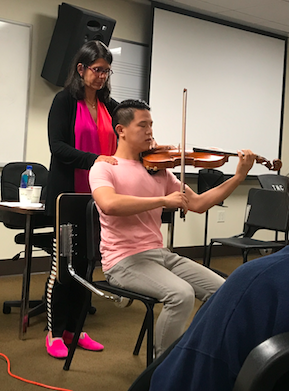
Pamela Frank working with a viola student at USC to find better alignment. The entire class agreed that when his setup was more efficient his sound was even more gorgeous.
Preventative Measures
The following are things you can do to avoid pain.
Warm up – get the heart rate moving to improve circulation in the body before playing. Ex: jumping jacks, light calisthenics, stair climbing, fast walking, etc.
Exercises: Periodically stretch to the opposite directions that you play, Arm raises, daily walking without distraction
Breaks - Begin with 1 minute of good movement for every 20 minutes of bad movement. Ex 1 min of stretching for every 20 or 30 minutes of practicing. Do the same for time spent at the computer. Stretch to opposite side that you play.
I do this using the Pomodoro Method of setting a timer for 25 minutes of practice, followed by 5 minutes of rest. During my 5 minutes of rest, I often stretch and move my body in opposite ways to holding the violin. I find that by inserting well timed and regular breaks in my practice sessions, I can practice more consistently and my endurance throughout the week improves (meaning I can more easily practice 4+ hours per day every day rather than being so fatigued I have to take more days off or extended periods of rest).
In Rests – put the instrument down (on knee, lap, floor)
Carrying your instrument – Use the lightest case possible. Do not keep additional music in your case.
If you use a backpack case, hold the straps in front so there’s less weight directly on your shoulders.
If your case has one strap, switch shoulders periodically.
Avoid static standing with your instrument. Put it down if caught in conversation with a friend/colleague/foe.
When Practicing
“Less is More” Don’t repeat anything without changing something. Practice with 100% expression.
Ex. Think of scales like long beautiful phrases; if you practice them like this, the Beethoven concerto is no longer intimidating, it is merely an extension of what you practice daily.
Simulate performance.
“You get what you train for” – train for freedom of movement in performance by creating stressful situations to get comfortable with the feeling of being on stage or in the high-stress performance environment.
Pro tip: create a nervous situation (at home) to get comfortable with that performance environment so you can learn to let it (the tension) go and feel more free on stage/in the performance.
During Practice, work on what you DON'T do well, for efficiency there is no need to go over the things you already do well just to play them.
And….ACCEPT NERVES AND “MISTAKES” AS PART OF THE PERFORMANCE. THEY HAPPEN TO EVERYONE – PLAYING CAREFULLY AND TRYING TO AVOID MISTAKES CAUSES TENSION
playing carefully is a desire for Control, which creates tension which leads to problems and pain
and finally: EMBRACE RISK.
All information listed here was gathered at the class in September through my own notes, from the handout they created specifically for this event and from referencing the post Laurie Niles created for violinist.com which you can read here.
You can find out more about the collaboration between Pamela Frank and Howard Nelson on their website www.fitasafiddle.nyc
Big Announcement!
There are big things happening at Active Violinist! Check out the first ever product created specifically for this website now available in the brand new Active Violinist SHOP!
Parents, Students, Teachers, Music Lovers, and Challenge Crushers order your chart now and see what you can accomplish in 100 days.
Dear friends and readers (future friends, perhaps?),
There is some big news here at Active Violinist. You may notice a new tab in the navigation menu. There is now a SHOP option, which includes 2, yes TWO options to peruse.
Yes, that is correct.
I have a store now and I am so excited about it! You can now buy really cool things on my website. Yay!
Adding a shop to my website has been a secret goal of mine for quite some time and I have schemed (and am still scheming) for probably close to a year about products to create and release to the public and those outside of my private studio.
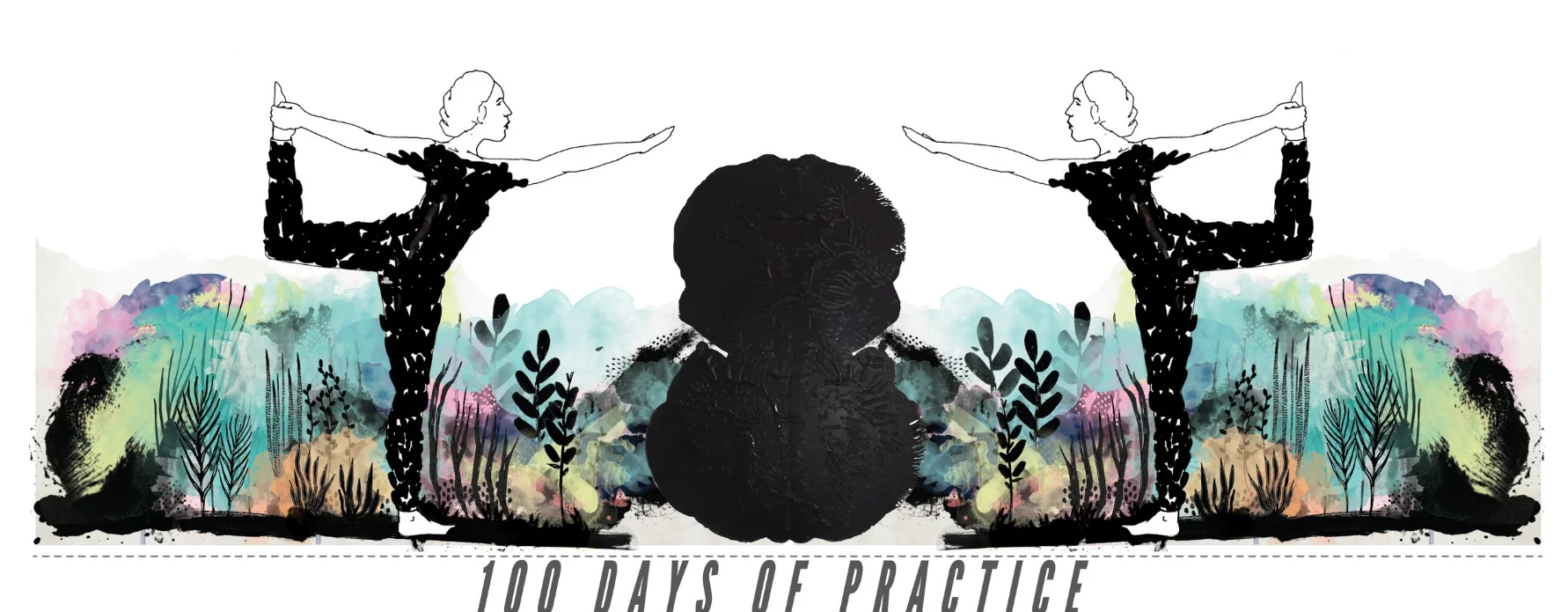
My very first SHOP item, designed specifically for Active Violinist by the supremely talented artist Meghan Irwin, is a "100 Days of Practice" chart. I worked closely with Meghan to create something beautiful that inspires, motivates, and encourages everyone and anyone. This chart makes progress and success both visual and tangible and includes 105 stickers designed specifically for this challenge.
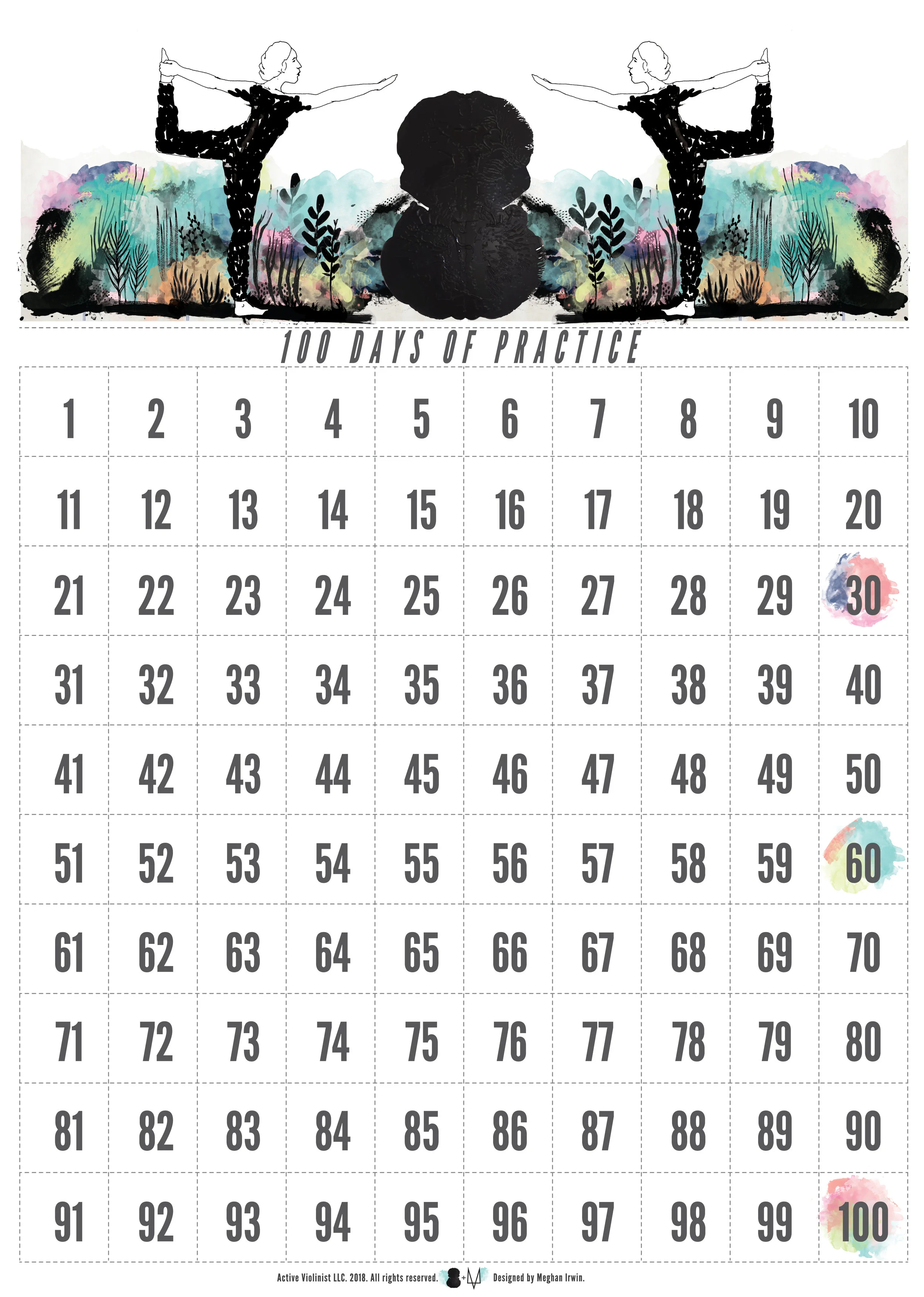
Freaking Beautiful, right? Meghan is incredible!
I am using this challenge as a way to nurture community in my private studio. I hope other teachers will consider this as well. The Active Violinist studio practice challenge begins February 1st, 2018 and I hope you will consider joining my students and me on this adventure. Check the blog for regular updates on our progress. If this sounds fun, thrilling, (or even terrifying) there is still time to order your chart and do the challenge alongside us - we can build a beautiful, supportive community this way!
...and for all of you non-musicians out there, the "100 Days of Practice" is not limited to playing your instrument every day. It is such a great way to commit to something you've always wanted to do more regularly, or a goal you want to complete. In fact, I would LOVE to know what you commit to for 100 days. The options are endless.I have so many thoughts and ideas about this that I have a completely separate blog post in the works.
Coming soon! Three beautiful certificates to acknowledge the diligence, perseverance, and hard work that practicing every single day requires. The certificates reward 30+, 60+, and 100 days of practice and will be available individually, and as a set (in case you want to reward those milestones along the way). Stay tuned for those. They will hit the SHOP this week.
Finally, you can now buy all of your sheet music directly from my website. There are direct links to some of my favorite skill building repertoire and technique books (especially for younger violinists), and you can also search the entire Sheet Music Plus inventory directly from my website! How cool is that!? Now there is no excuse to not have your music in time for your lesson (insert evil teacher laugh).
Subscribe to the blog to stay up to date on our progress and get the latest news and updates about new inventory in the SHOP.
Lastly, for more information about Meghan, and to view more of her work - trust me, you want...no you NEED to do this - check out www.meghanirwin.com and support talented artists!
Happy Practicing!