

The Violin Music of East Germany Part VI: Ottmar Gerster
This month, the spotlight is on composer Ottmar Gerstner. He is difficult to learn much about BUT I’m excited to share a rough recording of myself playing a movement of his violin trio. He was a Nazi sympathizer during his lifetime which put him in a precarious political position after the war and he chose to move to Soviet German (later the GDR) which better aligned with his ideals and politics.
This month, the spotlight is on composer Ottmar Gerster, another composer who is difficult to learn much about these days beyond Wikipedia. This is a relatively short post BUT I’m excited to share a rough recording of myself playing a movement of his violin trio.

About
Ottmar Gerster was born on the 29thof June, 1897 in Braunfels, Germany and died August 31, 1969 in Borsdorf (near Leipzig). He was a German viola player, conductor and composer.

His mother was a pianist and so he learned piano and also violin from an early age. In 1913 he moved to Frankfurt/Main to study violin with Ferdinand Kaufmann and music theory with Bernhard Sekles.
Between 1916 and 1918 his music education was interrupted when he was called up for military service. He completed his music studies in 1920 and began working with the Frankfurt Symphony Orchestra in 1921. Initially, he was the Concertmaster and then between 1923 and 1927 he was the solo viola player. During the 1920s Gerster also joined the labor movement and organized Workers' Choral Groups. In addition, from 1927 till 1947 he taught violin, viola, chamber music, music theory and composition at the Folkwang University of the Arts in Essen.
In January 1933 the NSDAP (Nazi Party) took power and quickly set about creating a one-party state out of Germany. During the ensuing twelve years, Gerster's relationship with the Hitler regime was often collaborative, but at other times problematic. He composed a "Consecration piece" for the regime in 1933 as well as a "battle hymn" for (Nazi) German Christian organization entitled "You should burn," setting a text by Baldur von Schirach. In 1936 there was a popular song entitled "The stranger bride" and a choral song "German airmen". In 1939, he was briefly required to undertake "army service" as a "Road construction soldier".
During the closing period of the war, Hitler included him on the official schedule of "Divinely gifted artists", produced in August/September 1944. This listed more than 1,000 people from the arts establishment who on account of their cultural value should be kept away from involvement in fighting even, as the enemy armies advanced, on the home front. Around this time Gerster returned to Essen where he lived until 1947.
When the war ended, Gerster found himself on the blacklist of the occupying American army but he continued to lecture in Essen till 1947 when he relocated from the British occupation zone to the Soviet occupation zone which was in the process of being transformed into the German Democratic Republic (East Germany). He became a member of the Socialist Unity Party in 1946 and was a distinguished and important composer for the GDR and accepted a professorship in composition and music theory at the Franz Liszt Music Academy in Weimar, where he served as the rector between 1948 and 1951. His composition "Festouvertüre 1948" - a work to commemorate the 100th anniversary of the revolution in 1848 - was one of the most performed pieces in the GDR.In 1950, he was a founding member of the East German Cultural Academy (the central Arts Academy in the GDR. It existed under several different names between 1951 and 1993 when it merged with another art school and became the Academy of Arts, Berlin. In 1951 Gerster left Weimar and took a position at what was then called the Mendelssohn Music Academy (now the University of Music and Theatre) in Leipzig, where he remained until his retirement in 1962.
Between 1951 and 1968 Gerster was also the Chairman of the country's Association of Composers and Musicologists.
Style
Gerster was a relatively traditional composer. He stuck to the framework of conventional extended tonality, often using church music modes, building chord structures on fourths and fifths. His works were mostly classical in their architecture and like many composers at this time, he felt an affinity with folk songs, from which his music sometimes incorporates melodies. There is also a stress on a "hand-crafted" element in his tonality.
Gerster was an early exponent of music for the masses and had no difficulty in accommodating his work to the guidelines of Socialist realism – music and art that portrayed the working lives of the socialist regime as ideal which at least during the early 1950s, was the preferred artistic style of the state. Sometimes his style resembles that of his student contemporary, Paul Hindemith.
Music I’m looking for:
(for someone who is hard to find out about, his violin music was relatively easy to purchase and find online from multiple publishers.
Violin concerto (1939)
String quartet Nr.1 in D (1920/21)
String quartet Nr.2 in C (1954)
String trio op.42 (ca. 1922)
Sonata for Violin and Piano (1950/51) ACQUIRED
Divertimento für Violine und Viola ACQUIRED
Kleine Musik zu Festlichen Tag für drei Violinen (1950) ACQUIRED
Drei musikalische Spielzeuge for violin and piano ACQUIRED
Sources:
https://www.tobias-broeker.de/rare-manuscripts/g-l/gerster-ottmar/
https://en.wikipedia.org/wiki/Ottmar_Gerster

The Timani Post I've meant to write for months.
I’ve been making Timani hints for month now and alluding to the training I did this summer for months now. You can finally read a little bit more about why I signed up for the training and about how magical this stuff really is. Timani is a game changer for all musicians!
I’ve been talking about my Timani Training since June (maybe May?). I’m excited to finally share why I signed up for something virtually unheard of in the United States. I'll do my best to explain a tiny bit of the magical powers of Timani.
Brief Recap:
I wrote a post last summer (you can read it here) about my very first Timani experience and lessons with Tina Margareta Nilssen, the creator of Timani. Tina came to LA to present at the PAMA conference, and lucky me, I managed to sneak in 2 lessons, one private session and one joint class with a colleague. I also observed a session with a bassoonist. I joined the Timani Community, which provides emails with more information and exercises and access to a private group on Facebook. I kept in touch with Tina and had another lesson with her a few months later. It was all so fascinating, and I fell in love, and I knew I had to do the training. The post link above articulates my honeymoon phase and early enthusiasm well.

Our incredible teacher Lotta - explaining some core principles of Timani.
Fast forward to this summer. Every morning for about 2 weeks, I sat at my kitchen table with a fresh cup of coffee, ready to start class at 6am. My classmates logged in from the Netherlands, England, Sweden, Norway, and beyond. I can't explain it, but by the end of those two weeks, I felt like these were some of my closest friends, and I haven't met any of them in person yet.
I knew it was a 3-year training to become a master teacher. I signed up for the first year with the idea that I didn't have to continue if I did't like it, but knowing it would still be a good experience. Now, level 2 can't come soon enough. If you get me started on the topic, it is tough to make me stop gushing about how incredible it is and how everyone needs this information. If you're not careful, I will probably beg you to schedule a zoom call with me just so I can keep talking about it. (Take this as your warning).
Before I say more about Timani, you should know, I probably have an above-average enthusiasm for musician's health and movement.
I've done lots of reading and research.
I wrote my dissertation about using Iyengar yoga to enhance violin playing.
I co-founded corpSonore – sound | body | wellness, a platform for musician's health and wellness.
I've attended yoga retreats for musicians.
I attended the PAMA conference.
I'm on the PAMA Young Professionals committee.
I'm working on a Yoga Teacher Certificate.
I’ve taken Alexander Technique and Body Mapping classes.
You name it, I’ve dipped at least a toe in it.
But none of these answer my questions the way Timani does.
Timani does something no other method does. It synthesizes information, research, exercises, training, and movement from a wide variety of modalities and applies it specifically to the needs of musicians…in extreme detail. It draws on a considerable wealth of resources and knowledge to suit precisely what musicians need. It is a method of muscle differentiation that optimizes musical performance. And what a difference it makes.
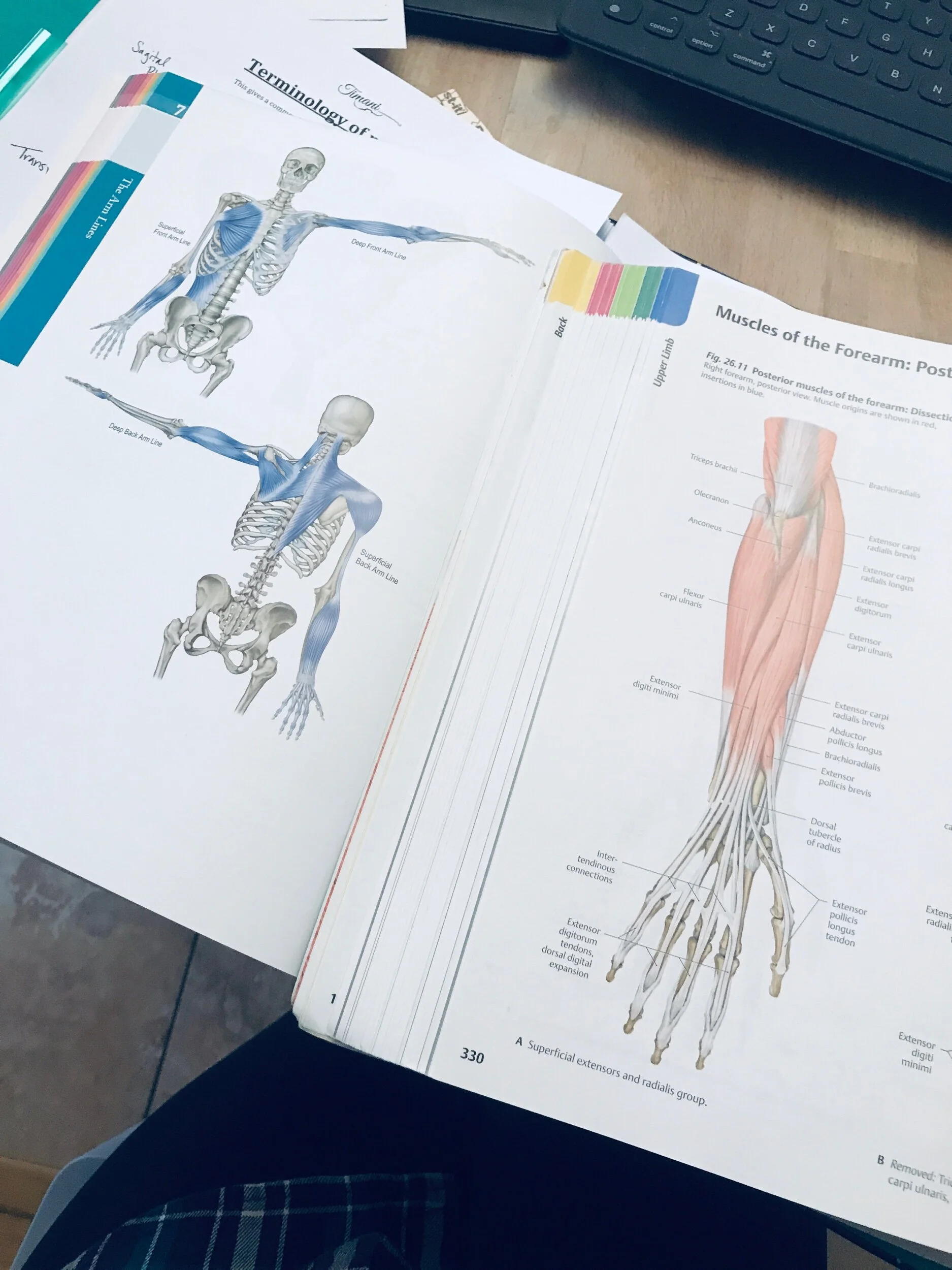
It is all connected.
The fun thing is, you don’t have to spend hours at the gym or do yoga to feel these effects. You don’t have to have rocking abs to develop a strong Timani core. The notion that we HAD to work out to play music used to be appealing to me – because I like to sweat – but at some point, it stopped making much sense. It didn't add up when I thought about my favorite musicians and how much yoga they didn't and don't do. I'm not sure I've ever heard Itzhak Perlman talk about his workout routine. If I missed it, please send me that article/podcast/video. It begs the question: How come his body is working in his favor, and the rest of us have to hit the gym? Turns out, maybe we don't. Unless you want to, of course. I am certainly not advocating for an inactive lifestyle. I love moving my body. I just don't think you should have to be in marathon shape to play a violin concerto.
Let me explain.
Sometimes we get so distracted and excited about tight, weak, or injured muscles that we forget or don’t consider what muscle should or could be doing a specific task. For example, as a violinist, I need to stabilize my instrument AND move the bow (and left hand). Ideally, I need to recruit different muscles to do these jobs. I need my stabilizers to stabilize so my movers can move. The problem is, we musicians often recruit movers to stabilize. In doing so, we set up compensation patterns that can cause fatigue, pain, discomfort, and a whole host of other issues and ailments. Fortunately, our bodies are perfectly capable of making music with optimal muscle engagement as long as we don't get in the way. Timani, among other things, provides a series of exercises to retrain the musical body to recruit muscles more efficiently and effectively.
Sounds easy and obvious, right? So why haven't we all been taught this in our musical training?
Let me tell you a little about my frustrations with musical training at this point. I apologize for this next bit because it really gets me fired up and tends to turn into a rant.

The hand of a violinist (with a watch tan/freckle line)
What I learned in level 1 Timani training this summer broke my heart. It broke my heart because it made me realize how much we trust our music teachers with our bodies. Still, rarely can our music educators tell us very much about how the body works. For example, it wasn’t until this summer that I finally learned about the muscles in the hands.… AND I PLAY VIOLIN!!!! When you think about it, doesn’t that just seem wrong?
For decades, I've had violin teachers tell me what I "should" be doing with my hands and fingers based on what they've been told, or based on some bygone teaching guru. We've been upholding these “rules” without questioning them. Until very recently, I included myself in this category, by the way. But the information provided by music teachers is usually not based on the anatomical principles of how the hands actually work. Even if we have teachers who "know," they typically don't really have any idea at all. So as good students, we slave for hours to squeeze our bodies into shapes that are ultimately inefficient and can even cause damage and injury. Simply because that’s what our teachers told us to do and our teachers don't know any better.
How is it that our music education system thinks this is okay? How did it happen that our highest-paid, most sought-after teachers assign intricate repertoire to practice every week, but they can't explain how the fingers bend? Does this seem right to you? Essentially, our current musical training system works if you’re lucky. The dogma of elite training is stacked against the human body's natural functions and shapes. It needs to stop.
Thank you, body, for getting the job done, now let's do it well.
Since the course ended, I've been doing my Timani exercises regularly since then. Already, I can hear the change in my sound. Some of the Timani exercises are for the feet. You spend 15 minutes exercising your toes, then pick up your instrument, and boom! This huge new sound comes barreling out of the F-holes. To traditional music training, this seems to make no sense. But Timani turns music-making into a full-body experience. Everything is vibrating, everything is working, nothing feels fatigued, and you create sound more effortlessly than you could ever imagine.
How is that possible?
You're simply using the right muscles for the right jobs.
That big sound?
That's your body saying thank you and rewarding you for working smarter.
Aren’t you intrigued? Don’t you want to feel that too? The incredible thing is that you don’t have to be injured or in pain to feel and experience the benefits of Timani. It optimizes what is already working well AND improves what might be holding you back. As musicians, we are accustomed to working hard and practicing for our entire careers. It comes with the job. So why not learn how to do it effectively and efficiently? Why not take your beautiful tone and use your whole body to make it better? Do you need to warm up for hours before a performance? Perhaps there is a way to activate some of those much-needed stabilizing muscles without breaking a pre-concert sweat.
The answer is Timani.
If you want to know more, please send me a message, drop me a line, leave a comment, etc. I love talking about this stuff and want to share it with you.

The Violin Music of East Germany Part V: Fidelio Finke
Installment number 5 in my exploration of East German composers features Fidelio Finke who sadly seems to have slipped into oblivion and has very much been forgotten, even though he wrote plenty for strings and the violin. Read on to find out a little bit about him and his music.
Fidelio Finke is the East German composer of the month.
Born Fidelio Friedrich “Fritz” Finke on October 22, 1891 in Josefsthal, Austria-Hungary (now Josefův Důl, Czech Republic - not far from the German border), died June 12, 1968 in Dresden, East Germany.

I spent months perusing the internet looking up Finke on the internet but apart from a Wikipedia article about him, very little can be found about the composer. I looked for recordings, videos, reference material and beyond. In a New Yorker article published in 1983, Andre Previn, after discovering, playing and enjoying the music of Finke is quoted to have said, “Fidelio Finke, where are you now?”
And it still feels pretty true…
About Fidelio
I feel like an academic sham to rely so heavily on Wikipedia but here it goes… Finke received organ, piano and violin lessons. From 1908 to 1911, he studied at the Prague Conservatory, where he studied piano and composition. From 1911, he worked as a private music teacher and in 1915 he became a music theory teacher at the Prague Conservatory. In 1920, he moved to the German Academy of Music and Performing Arts (confusing, but also located in Prague), where he taught music theory and composition. He became a professor in 1926, and worked as the rector from 1927 to 1945.
During the German occupation of Czechoslovakia(1938–1945), and while serving as the Rector of the German Academy of Music, Finke opportunistically attempted to ingratiate himself with the Nazis by creating arrangements of Sudeten German folksongs and the choral works Deutsche Kantate: Der neue Tag and O Herzland Böhmens (1942) for mixed chorus, brass and organ. His application for membership within the Nazi party was denied in 1942 because of his political unreliability.
After imprisonment and expropriation as a result of the Bene decrees* as well as a suicide attempt in 1945, Finke was brought to Dresden by the Soviet occupation forces. There, he founded the State Academy of Music and Dresden Theatre, and was the rector until 1951. He was a professor of sound recordings at the Leipzig Academy of Music until 1958. His total works comprise about 170 compositions.
Finke was a member of the SED (The Socialist Unity Party of Germany) from 1946 until his death in 1968 in Dresden. He was buried in Heidenfriedhof Cemetery in Hamburg (which seems confusing to me, because it doesn’t really seem like he spent much time there) and his estate is preserved by the Academy of Arts in Berlin.
Repertoire:
· String Quartet No. 1 (1914); dedicated to Arnold Schoenberg
· String Trio (1923)
· Piano Trio (1923)
· 8 Musiken for 2 violins and viola (1923)
· Sonata for violin and piano (1924)
· String Quartet No. 2 „Der zerstörte Tasso“ (with soprano solo) (1925)
· Ciacona nach Vitali for violin and piano (1925) ACQUIRED
· String Quartet No. 3 (1926, lost)
· Transcriptions of Wagner Opera Overtures for violin and piano ACQUIRED
I can say, after spending some time with the overture arrangements, his style is fun - very romantic - and perhaps not as “envelope pushing” as some of the other composers working in East Germany, or already featured in my little series. Perhaps his memory did not persevere for many reasons, endearing yourself to the Nazis, in retrospect, was perhaps not the smoothest move to pull for one’s artistic legacy.
*a series of laws drafted by the Czechoslovak government-in-exile in the absence of the Czechoslovak parliament during the German occupation of Czechoslovakia in World War II. The decrees dealt with various aspects of the restoration of Czechoslovakia and its legal system, denazification, and reconstruction of the country. In journalism and political history, the term "Beneš decrees" refer to the status of ethnic Germans, Hungarians and others in postwar Czechoslovakia.
As a result, almost all ethnic Germans and Hungarians whose ancestors had lived in Czechoslovakia for centuries prior to World War II or those who had settled there during the German occupation of Czechoslovakia lost their Czechoslovakian citizenship and property and were expelled from their homes. Some of them died during the expulsion process, which took place during the late 1940s).
Sources:
https://en.wikipedia.org/wiki/Fidelio_F._Finke
https://slippedisc.com/2019/03/nazi-composer-gets-his-name-taken-off-school/