
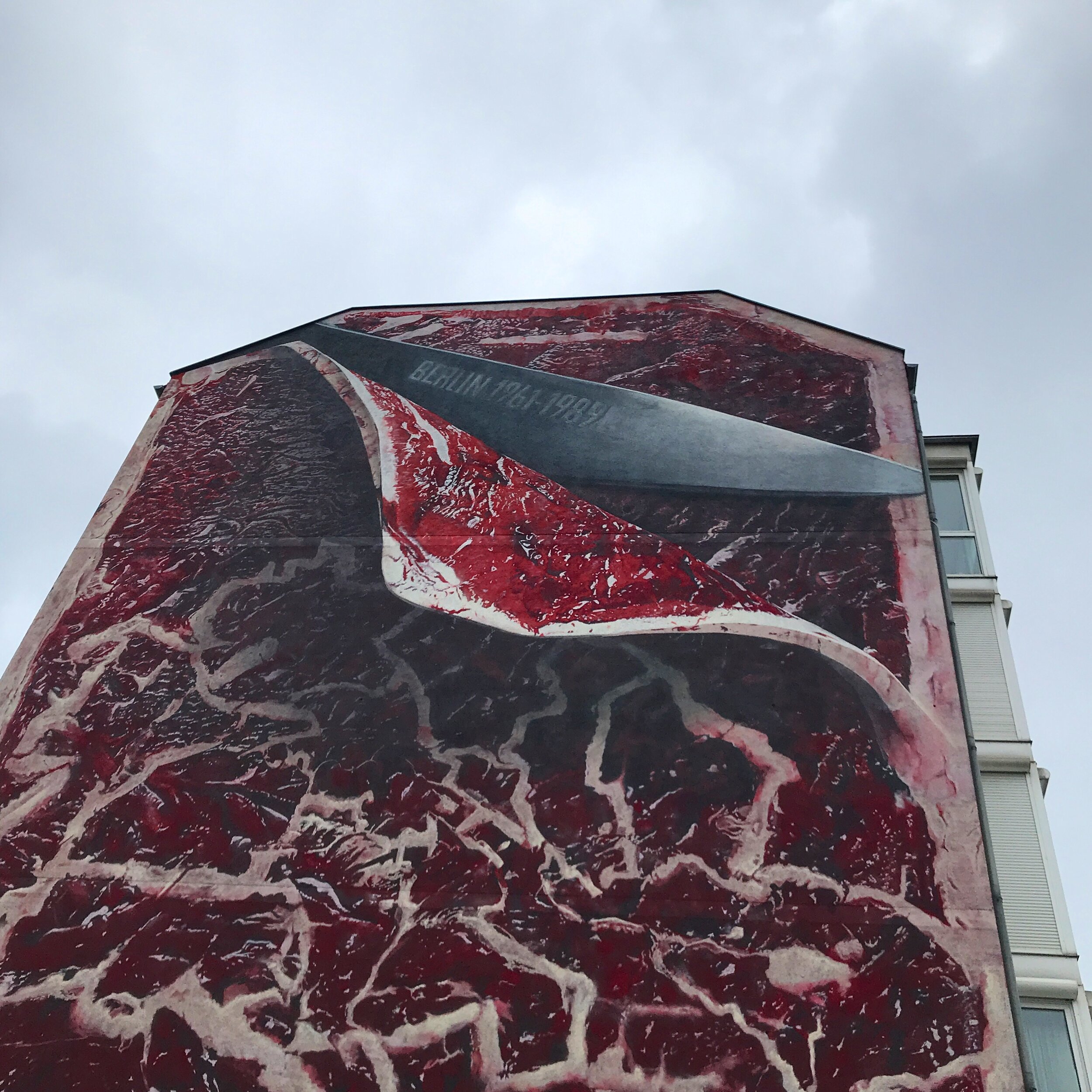
GDR Music Research - A little extra History
The music of East Germany is particularly fascinating because of the rich history full of notable and significant composers and performers. The divide that occurred after World War II did not foster wide-spread acclaim or acceptance of musicians living and working behind the wall even though plenty of music was written and performed. You can learn more about the region and political climate of East Germany in my most recent blog post.

The Brandenburg Gate, Berlin
Hi Friends,
Now that I've shared my goals and resolutions for the new year, I'm diving back into my Violin Music of East Germany project and research. It occurred to me that I need to back up a little bit and dive into some of the general history and facts about East Germany before and after World War II. This land has been the home to some of Classical Music's most beloved composers and performers throughout history, so it is crucial to understand this project's context beyond the forgotten composers of an era.
I've compiled a few YouTube videos that highlight different elements of East Germany, including Rick Steve's overview of some important monuments and history in Leipzig and Dresden, to a walking music tour of Berlin. It also includes a playlist of East German Music, a discussion of the Wall, propaganda footage, and historical documentation of life on the "other" side. All this to paint a picture of the musical climate that has captured my attention.
I've begun exploring music from decades before East Germany became the GDR (or DDR) and will be weaving together programs that intertwine the vast and immense history of a region with the voices of forgotten musical creators.
Enjoy! I hope you find this both interesting and informative.
1. As much as his cheesiness makes me want to roll my eyes sometimes, Rick Steves points out some of the reasons why two of my favorite cities in Germany are so culturally significant, iconic, and beloved throughout time. These cities and their musical significance were the impetus for me to start wondering why there were no famous and iconic composers from this region after World War II
2. Check out this Musical walking Tour of Berlin. This film was recorded at the beginning of coronavirus and geographically organized musically significant city locations. It is incredible how close together some of these important places and musical performances happened to one another. Fascinating and worthwhile. There isn't much about East Germany specifically, but you learn so much about the city and Germany's music and geopolitical environment at large.
3. A brief animated history of Life in East Germany
4. Fascinating footage of East Germany, propaganda, and more
5. The rise and fall of the Wall
I love this quote, "Any barriers we put up to impede freedom, we can also take down."
6. A fascinating cultural documentary about life in East Germany with historical footage
7. Life Behind the Berlin Wall, from The Economist
8. I've been to this place on the Wall. The Berlin Wall Museum is now housed there on the West Berlin side. We also walked through the cemetery and into the Church of Reconciliation (which looks very different now). Can you imagine seeing this every day? This is haunting and eye-opening
9. Last but not least, an hour of East German (GDR/DDR) Music – but NOT violin music…because that's the project I'm working on right now.
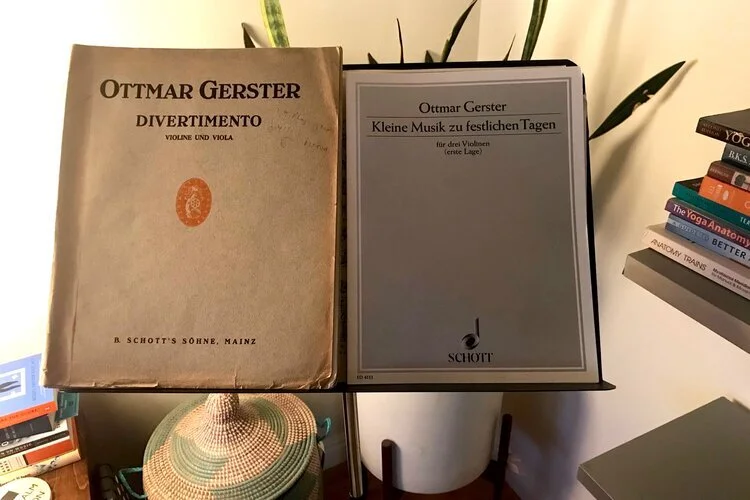
The Violin Music of East Germany Part VI: Ottmar Gerster
This month, the spotlight is on composer Ottmar Gerstner. He is difficult to learn much about BUT I’m excited to share a rough recording of myself playing a movement of his violin trio. He was a Nazi sympathizer during his lifetime which put him in a precarious political position after the war and he chose to move to Soviet German (later the GDR) which better aligned with his ideals and politics.
This month, the spotlight is on composer Ottmar Gerster, another composer who is difficult to learn much about these days beyond Wikipedia. This is a relatively short post BUT I’m excited to share a rough recording of myself playing a movement of his violin trio.

About
Ottmar Gerster was born on the 29thof June, 1897 in Braunfels, Germany and died August 31, 1969 in Borsdorf (near Leipzig). He was a German viola player, conductor and composer.

His mother was a pianist and so he learned piano and also violin from an early age. In 1913 he moved to Frankfurt/Main to study violin with Ferdinand Kaufmann and music theory with Bernhard Sekles.
Between 1916 and 1918 his music education was interrupted when he was called up for military service. He completed his music studies in 1920 and began working with the Frankfurt Symphony Orchestra in 1921. Initially, he was the Concertmaster and then between 1923 and 1927 he was the solo viola player. During the 1920s Gerster also joined the labor movement and organized Workers' Choral Groups. In addition, from 1927 till 1947 he taught violin, viola, chamber music, music theory and composition at the Folkwang University of the Arts in Essen.
In January 1933 the NSDAP (Nazi Party) took power and quickly set about creating a one-party state out of Germany. During the ensuing twelve years, Gerster's relationship with the Hitler regime was often collaborative, but at other times problematic. He composed a "Consecration piece" for the regime in 1933 as well as a "battle hymn" for (Nazi) German Christian organization entitled "You should burn," setting a text by Baldur von Schirach. In 1936 there was a popular song entitled "The stranger bride" and a choral song "German airmen". In 1939, he was briefly required to undertake "army service" as a "Road construction soldier".
During the closing period of the war, Hitler included him on the official schedule of "Divinely gifted artists", produced in August/September 1944. This listed more than 1,000 people from the arts establishment who on account of their cultural value should be kept away from involvement in fighting even, as the enemy armies advanced, on the home front. Around this time Gerster returned to Essen where he lived until 1947.
When the war ended, Gerster found himself on the blacklist of the occupying American army but he continued to lecture in Essen till 1947 when he relocated from the British occupation zone to the Soviet occupation zone which was in the process of being transformed into the German Democratic Republic (East Germany). He became a member of the Socialist Unity Party in 1946 and was a distinguished and important composer for the GDR and accepted a professorship in composition and music theory at the Franz Liszt Music Academy in Weimar, where he served as the rector between 1948 and 1951. His composition "Festouvertüre 1948" - a work to commemorate the 100th anniversary of the revolution in 1848 - was one of the most performed pieces in the GDR.In 1950, he was a founding member of the East German Cultural Academy (the central Arts Academy in the GDR. It existed under several different names between 1951 and 1993 when it merged with another art school and became the Academy of Arts, Berlin. In 1951 Gerster left Weimar and took a position at what was then called the Mendelssohn Music Academy (now the University of Music and Theatre) in Leipzig, where he remained until his retirement in 1962.
Between 1951 and 1968 Gerster was also the Chairman of the country's Association of Composers and Musicologists.
Style
Gerster was a relatively traditional composer. He stuck to the framework of conventional extended tonality, often using church music modes, building chord structures on fourths and fifths. His works were mostly classical in their architecture and like many composers at this time, he felt an affinity with folk songs, from which his music sometimes incorporates melodies. There is also a stress on a "hand-crafted" element in his tonality.
Gerster was an early exponent of music for the masses and had no difficulty in accommodating his work to the guidelines of Socialist realism – music and art that portrayed the working lives of the socialist regime as ideal which at least during the early 1950s, was the preferred artistic style of the state. Sometimes his style resembles that of his student contemporary, Paul Hindemith.
Music I’m looking for:
(for someone who is hard to find out about, his violin music was relatively easy to purchase and find online from multiple publishers.
Violin concerto (1939)
String quartet Nr.1 in D (1920/21)
String quartet Nr.2 in C (1954)
String trio op.42 (ca. 1922)
Sonata for Violin and Piano (1950/51) ACQUIRED
Divertimento für Violine und Viola ACQUIRED
Kleine Musik zu Festlichen Tag für drei Violinen (1950) ACQUIRED
Drei musikalische Spielzeuge for violin and piano ACQUIRED
Sources:
https://www.tobias-broeker.de/rare-manuscripts/g-l/gerster-ottmar/
https://en.wikipedia.org/wiki/Ottmar_Gerster
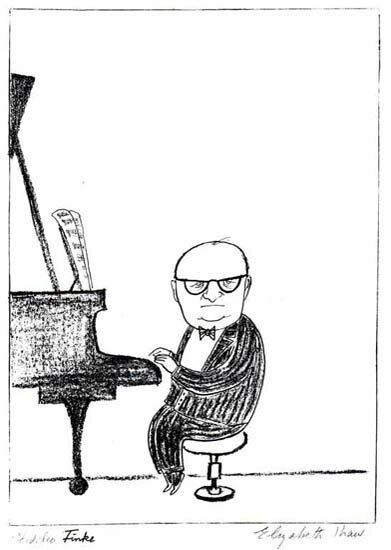
The Violin Music of East Germany Part V: Fidelio Finke
Installment number 5 in my exploration of East German composers features Fidelio Finke who sadly seems to have slipped into oblivion and has very much been forgotten, even though he wrote plenty for strings and the violin. Read on to find out a little bit about him and his music.
Fidelio Finke is the East German composer of the month.
Born Fidelio Friedrich “Fritz” Finke on October 22, 1891 in Josefsthal, Austria-Hungary (now Josefův Důl, Czech Republic - not far from the German border), died June 12, 1968 in Dresden, East Germany.

I spent months perusing the internet looking up Finke on the internet but apart from a Wikipedia article about him, very little can be found about the composer. I looked for recordings, videos, reference material and beyond. In a New Yorker article published in 1983, Andre Previn, after discovering, playing and enjoying the music of Finke is quoted to have said, “Fidelio Finke, where are you now?”
And it still feels pretty true…
About Fidelio
I feel like an academic sham to rely so heavily on Wikipedia but here it goes… Finke received organ, piano and violin lessons. From 1908 to 1911, he studied at the Prague Conservatory, where he studied piano and composition. From 1911, he worked as a private music teacher and in 1915 he became a music theory teacher at the Prague Conservatory. In 1920, he moved to the German Academy of Music and Performing Arts (confusing, but also located in Prague), where he taught music theory and composition. He became a professor in 1926, and worked as the rector from 1927 to 1945.
During the German occupation of Czechoslovakia(1938–1945), and while serving as the Rector of the German Academy of Music, Finke opportunistically attempted to ingratiate himself with the Nazis by creating arrangements of Sudeten German folksongs and the choral works Deutsche Kantate: Der neue Tag and O Herzland Böhmens (1942) for mixed chorus, brass and organ. His application for membership within the Nazi party was denied in 1942 because of his political unreliability.
After imprisonment and expropriation as a result of the Bene decrees* as well as a suicide attempt in 1945, Finke was brought to Dresden by the Soviet occupation forces. There, he founded the State Academy of Music and Dresden Theatre, and was the rector until 1951. He was a professor of sound recordings at the Leipzig Academy of Music until 1958. His total works comprise about 170 compositions.
Finke was a member of the SED (The Socialist Unity Party of Germany) from 1946 until his death in 1968 in Dresden. He was buried in Heidenfriedhof Cemetery in Hamburg (which seems confusing to me, because it doesn’t really seem like he spent much time there) and his estate is preserved by the Academy of Arts in Berlin.
Repertoire:
· String Quartet No. 1 (1914); dedicated to Arnold Schoenberg
· String Trio (1923)
· Piano Trio (1923)
· 8 Musiken for 2 violins and viola (1923)
· Sonata for violin and piano (1924)
· String Quartet No. 2 „Der zerstörte Tasso“ (with soprano solo) (1925)
· Ciacona nach Vitali for violin and piano (1925) ACQUIRED
· String Quartet No. 3 (1926, lost)
· Transcriptions of Wagner Opera Overtures for violin and piano ACQUIRED
I can say, after spending some time with the overture arrangements, his style is fun - very romantic - and perhaps not as “envelope pushing” as some of the other composers working in East Germany, or already featured in my little series. Perhaps his memory did not persevere for many reasons, endearing yourself to the Nazis, in retrospect, was perhaps not the smoothest move to pull for one’s artistic legacy.
*a series of laws drafted by the Czechoslovak government-in-exile in the absence of the Czechoslovak parliament during the German occupation of Czechoslovakia in World War II. The decrees dealt with various aspects of the restoration of Czechoslovakia and its legal system, denazification, and reconstruction of the country. In journalism and political history, the term "Beneš decrees" refer to the status of ethnic Germans, Hungarians and others in postwar Czechoslovakia.
As a result, almost all ethnic Germans and Hungarians whose ancestors had lived in Czechoslovakia for centuries prior to World War II or those who had settled there during the German occupation of Czechoslovakia lost their Czechoslovakian citizenship and property and were expelled from their homes. Some of them died during the expulsion process, which took place during the late 1940s).
Sources:
https://en.wikipedia.org/wiki/Fidelio_F._Finke
https://slippedisc.com/2019/03/nazi-composer-gets-his-name-taken-off-school/