

The Violin Music of East Germany Part II: Kurt Schwaen
Spotlight on the life and music of Kurt Schwaen, a composer who lived and worked in East Germany and wrote many pieces for violin, and string chamber ensemble. This is the second installment in my Violin Music of East Germany series. I am writing about the people and music I uncover as I pursue this research and performance endeavor. Enjoy!
This post is the 2nd installment of my GDR music project research. Over the past few months, during this era of social distancing, I have done quite a bit of research and score collection for this project. I have found many names and scores, many rabbit holes to jump down and treasure to hunt. As always, with research, you uncover more questions than you do answers, but that's just part of the game. I haven't come out completely empty-handed, though. Thankfully, some scores are not impossible to find, and I will be highlighting some of those people and their work here.
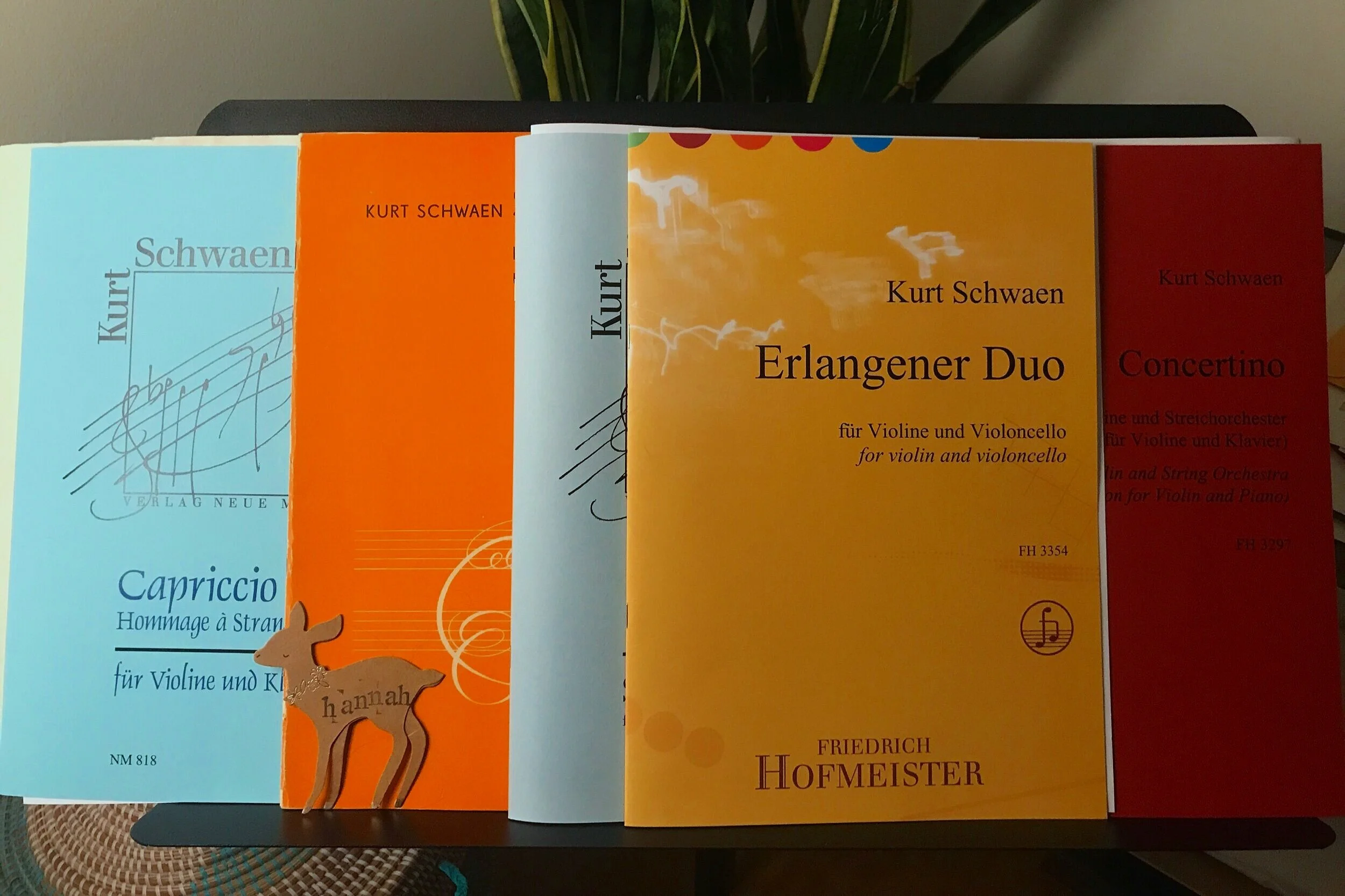
In my preliminary research about the composers and pieces written in East Germany, Kurt Schwaen's name is one of the most readily available. Before starting this project, I didn't know the name at all, and I'm guessing several of you are equally as unaware (but bravo if his name is already in your library). There is a website devoted to Schwaen's musical career that is updated and curated by Dr. Ina Iske-Schwaen, but this is certainly not the case for most East German composers. It has added to the ease and simplicity of finding and collecting some of his scores.
To clarify: I'm most interested in finding violin music written between 1949-1989, including solo works, concerti, sonatas, and works for small chamber ensembles (quartets, piano trios, duos, etc.). Many composers wrote works before and after this period, and I will probably end up collecting many of these scores too. Below, you will find a list of compositions found on various sources online. I have noted which ones I have successfully obtained at the time of writing this.
The following is a little bit about Kurt Schwaen and his music.
b. June 21, 1909, in Katowice, Poland (under Nazi occupation during WWII)
d. October 9, 2007, Berlin, Germany
From 1929 to 1933, Schwaen studied musicology, art history, philosophy, and German at the universities in Breslau, Poland, and Berlin, Germany.
In 1930 he met Hanns Eisler (more on him later) who greatly influenced his compositional style. After becoming active in an anti-fascist student group, he joined the Communist Party of Germany, and from 1935 to 1938, and he spent time in prison because of his political views. After his release, Schwaen found enduring inspiration from his work as a pianist with renowned dance soloists in a studio for expressive dance in Berlin.
After the war, he returned to Berlin. He spent much of his time working to rebuild the musical culture of that city by writing compositions for amateur music groups, choirs, music schools, and chamber ensembles. After the end of World War II, which Schwaen survived in the Penal Division 999, he found ample work in the rebuilding of the public music schools and as musical advisor to the German Volksbühne Theatre.
Between 1953 and 1956, he worked with Bertolt Brecht, who had a profound impact on his future compositions. He worked with Brecht from 1953-1956. In 1961 he became a member of the DDR Akademie der Künste, where he was head of the music department from 1965 to 1970. From 1962 to 1978, he was president of the East German National Folk Music committee. Between 1973 and 1981, he directed the children's musical theatre in Leipzig.
Schwaen has held numerous honorary positions, including being named an official member of the Association of Composers and Musicologists, the Academy of Arts in 1961. In 1983 he was awarded an honorary doctorate from Leipzig University and received several other state awards. His compositional output, which spans seven and a half decades, contains more than 600 works in every genre, from song and chanson to choral music, piano works, chamber music, and orchestral works, and includes opera and works for the ballet.
Schwaen later settled in Berlin-Mahlsdorf, where he died at the age of 98. His widow, Dr. Ina Iske-Schwaen, maintains an archive dedicated to his works in his Mahlsdorf home.
There are a couple of great quotes from Schwaen on his website that I enjoy:
Everything easy is unusual.
Everything easy is unusually difficult.
I am for shortness.
But shortness because you choose no length, not because you are not able to.
Compositions applicable to my project:
· Piano Trio No. 3 for violin, violoncello, and piano (1982)
· Suite Classique (Classical Suite) for violin and piano (1980) ACQUIRED
· Piano Trio No. 4 for violin, violoncello, and piano (1983)
· Capriccio. Hommage à Strawinsky for violin and piano (1986) ACQUIRED
· Sequences in Es-flat. Four movements for violin and piano (1996)
· Piano Trio No. 5 – »en miniature« for violin, violoncello, and piano (1987)
· Serenade for Solo Violin and 3 Solo or Tutti Violins (1998)
· Violin Concerto KSV 433 (1979)
Pieces Not listed online, but (somehow) acquired:
· Concertino for Violin and String Orchestra (1971) ACQUIRED
· Sonatine for Violin and Piano (1951) ACQUIRED
· Erlangener Duo for Violin and Cello ACQUIRED
A little about some of the music listed above:
In the Suite Classique (Classical Suite) for violin and piano, Schwaen consciously employs traditional form to organize this piece. Of course, he uses this model for his unique purposes in the formation of different movement characters. The outer movements are determined and virtuosic, whereas the inner ring, which frames the unrestrained third movement, are more »cantabile«. Whether calm or active, tense or relaxed, powerful or floating and light, complicated or simple – Schwaen writes with a compelling musicality.
These traits also apply in the case of the Capriccio for violin and piano. Written for the same instrumental combination, Schwaen here channels his intention toward the presentation of a particular genre, an »Hommage à Stravinsky«. The role model function of this master is well-known. Schwaen even spoke of influence. This work is built on formula-like circular, short repetitive motions. It presents itself dancingly light, even playful. A melodic, at times improvisatory sounding middle section allows the »capriccioso« to come to the fore, especially clearly.
Surprisingly, considering how easy – relatively speaking – his violin music was to obtain, there are very few recordings of his music available online. I checked Youtube, Vimeo, Spotify (there is only one album of simple pieces with German introductions), Amazon Music, Apple Music, and Soundcloud. One recording that I did find and enjoy is this recording on youtube of his Concerto Grosso for String Quartet and chamber orchestra.

The Menuhin Tour of San Francisco Part 1
I know many random facts about Yehudi Menuhin, including where he lived (like his actual address) at various stages of his life. I’ve been musing on my yoga journey recently and Menuhin plays a significant role in where I am today. Last year, on a trip to San Francisco I took a trip to one of his earliest residences. Here it is, ta da!
Not to keep going on my yoga journey, BUT I've been thinking about the different places yoga has taken me, how it has intertwined with music-making, and the many lessons I have learned, am learning and must eventually relearn. One of the most significant points on my journey was the dissertation I wrote about Violin and Yoga titled “Using Iyengar Yoga to Enhance Violin Playing.”

That whole research portion of writing an academic anything made me borderline obsessed with Yehudi Menuhin (and BKS Iyengar, but that is for a different day). At one point, I probably knew more about Menuhin than most other people. I have read (I think) every one of his books, autobiographies, and biographies. I have compared videos and recordings from different stages of his career. I've watched BBC specials featuring him, and about him. I know about his school, the festival in Switzerland, his siblings, who he married, what he did during World War II, his feelings about airplanes, his work with UNESCO, his recommended yoga poses, diet when touring for concerts, and where he lived and when.
Menuhin was born in New York City, but his family moved to San Francisco when he was very young. While reading Yehudi Menuhin, A Life by Humphrey Burton, I came across one of Menuhin's first addresses in San Francisco: 732 Hayes Street. I texted my friend in San Francisco and asked if she ever passed by this address or knew where it was, and it turns out it is right down the street from her. She snapped a picture the next day on her way to work. Last year, I was in the Bay Area for a visit and requested a walk past it to see for myself.
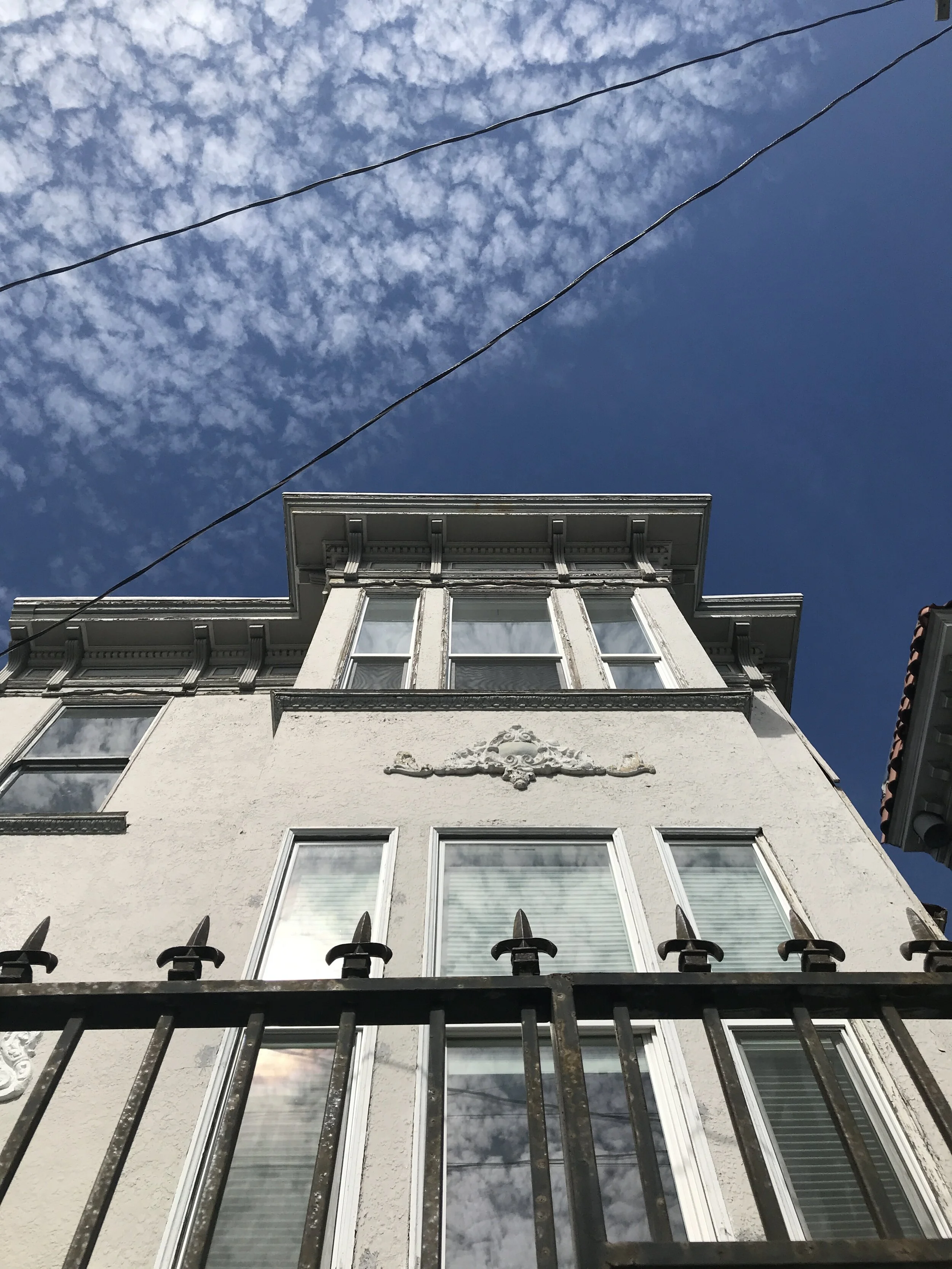
Turns out, I might be the only person who cares that a very important violinist who changed the world’s perception and appreciation of yoga and many other things in ways we still don’t fully appreciate because it is not particularly well-kept. It lacks any sort of commemorative markings and appears (because, yes, I definitely peered through the windows in the middle of the day like a stalker with no shame) to be just an ordinary rental building that any person could live in without even having to audition. This kind of blows my mind. Maybe I'm too much of a fangirl, but I was stunned that the world keeps turning without some Trust or Musical Society making more of a commotion about this. The apartments don't look fancy, but they probably cost an arm and a leg in rent. At least it has charm and history.
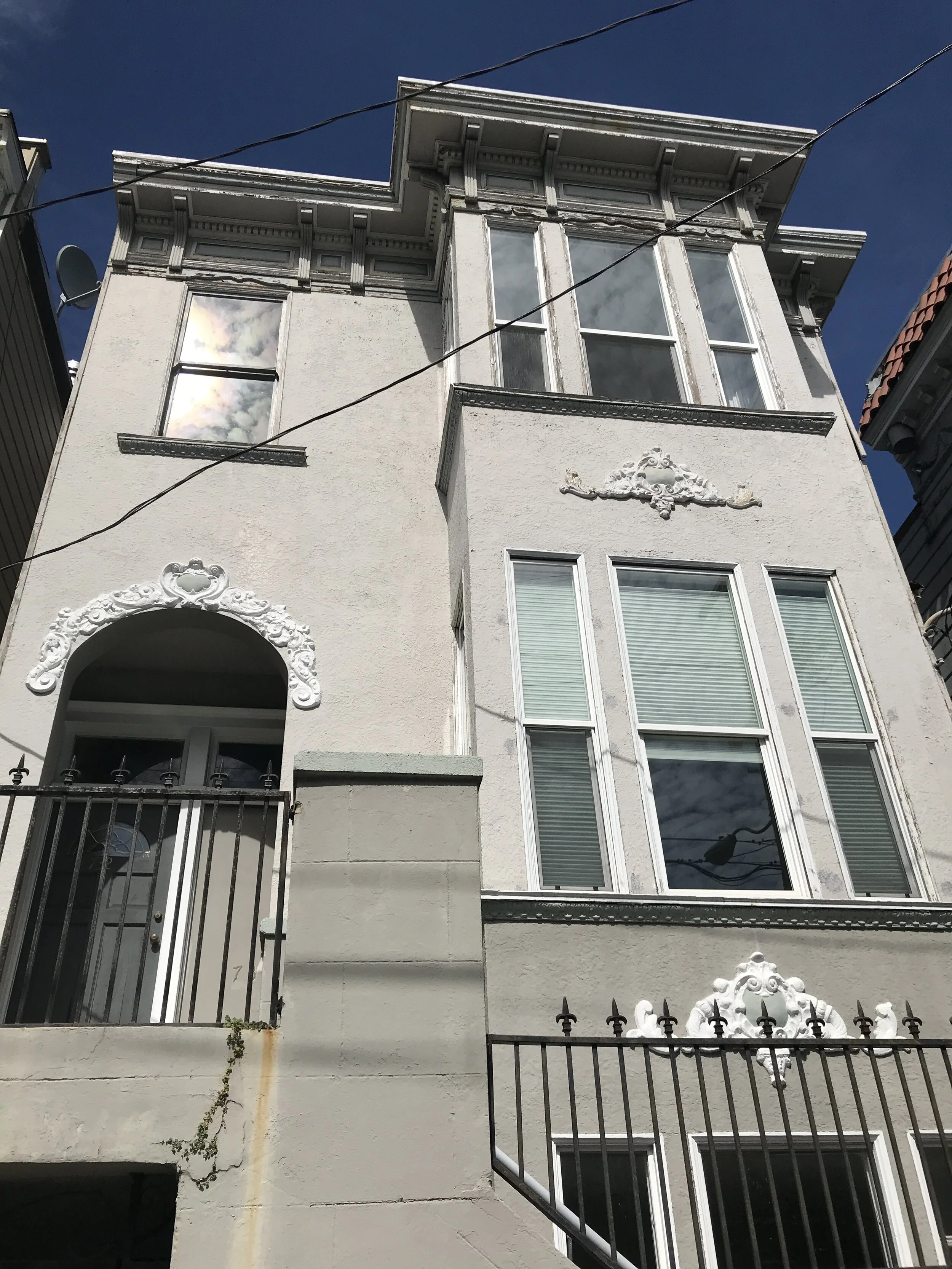
The Menuhin family lived at 732 Hayes Street from around 1918 or 1919 until Autumn of 1923 when the expanding family moved into a larger home at 1043 Steiner Street. Menuhin's biographer, Humphrey Burton, wrote that the Steiner St. house boasted, "a double living room, normally divided by sliding doors into dining and living rooms but capable when opened up of seating sixty guests at an informal concert – an astonishingly grandiose concept for a young couple of limited means with three very small children." (24)
Frustratingly, I can't believe that I didn't remember this address last year when I was in San Francisco. If I could make an excuse for myself, it would be that Hayes is a much more famous street than Steiner in San Francisco history. Fortunately, I will be back in Northern California in a few weeks, and you can bet your bottom dollar that I will walk over to Steiner Street and take a photo or 2 of the house…and probably stare through the windows of this place too. Maybe that one has a plaque?
Stay tuned…
References:
Humphrey Burton, Yehudi Menuhin, A Life. Northeastern University Press: Boston, 2000.

Mini Series Part I: Joshua Bell
The first installment of Violin performance reviews is up!
What a way to begin - Joshua Bell and the Tulsa Symphony.
Be prepared for some professional gushing!

Joshua Bell with the Tulsa Symphony, and Maestro Dan Hege
This past Saturday Joshua Bell performed at the Tulsa Symphony Gala event. I can tell you that at least EVERY violinist in the orchestra was excited for his performance not to mention all of the music lovers of Tulsa and the surrounding area.
A little background:
Joshua Bell was a child prodigy – as in he’s been performing as a soloist since roughly Middle School age. Some people in the orchestra remember his early performances, when he was just a young boy. My teacher, Sally O’Reilly, remembers seeing him perform in Josef Gingold’s studio class at Indiana University when he was just a child.
On a more personal note, his was the first real violin CD I ever owned. I used to listen to it over and over again when I was around 9 years old. It was my first introduction to some of the standard virtuosic violin repertoire and obviously it had a lasting effect (hello – I still play the violin)
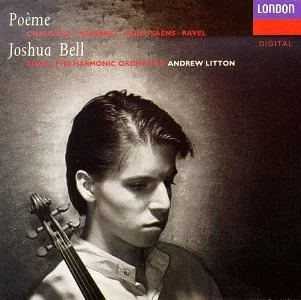
this was released in 1991. So many of my favorite violin hits are on this album. I wonder if I love them so much because of this CD?
Since then Joshua Bell has just gotten bigger and better. I’m pretty sure he’s done just about everything you can think to do as a soloist.
When I lived in Minnesota, I worked where the St. Paul Chamber Orchestra played. My time there overlapped with Bell’s time as an artistic partner meaning I was fortunate enough to watch him perform 3 or 4 times every season. He even signed that very first CD for me. My boss, knowing that I was a violinist, used to schedule me to sell CDs for him (at his signing table!!!) at those events and I can’t even describe how excited I used to get. This was pretty much as close as I thought I would ever come to him. He was always nice to everyone and it was interesting to see the same people come through his line night after night (typically 3 times per weekend). He would greet them so graciously and sometimes remembered other recent performances they had attended (aka he knew who his stalkers were and was still nice to them – a feat I’m sure).
That was about 8-10 years ago and I was content to assume this would be as close to ‘working with Joshua Bell’ as I would ever get. I never EVER would have hoped to share the stage with him. I mean, obviously every violinists wants to be employed and hear great music, and be involved from time to time but it comes with the understanding of how competitive this gig is and how high the odds are stacked against you. I always hoped to see him perform again but never from my front row seat.
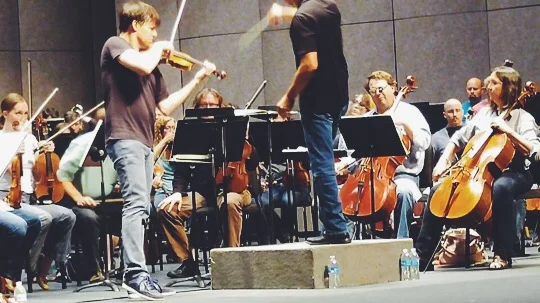
do you see me staring in amazement?
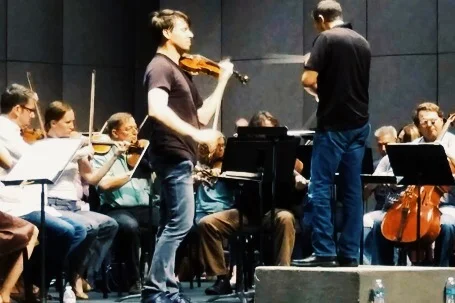
When the Tulsa Symphony announced his performance I think we all jumped for joy! It is not often we get guest artists of that caliber in this area. And a violinist – Woohoo!
Bell played Tchaikovsky’s Violin Concerto in D major: One of ‘the big ones’ in violin repertoire. Being the general badass that he is he couldn’t make it to Tulsa until the morning of the performance (a performance in Lubbock, Texas the night before had him a bit held up it seems). When he arrived at the dress rehearsal it was a different beast. We all sat up a little straighter, watched the Maestro a little closer, and took much more detailed notes. He arrived on our scene as a demanding musical force. I wasn’t ready for it. Part of me just wanted to sit back and watch in blind amazement and the other part wanted to dive in and make some music.
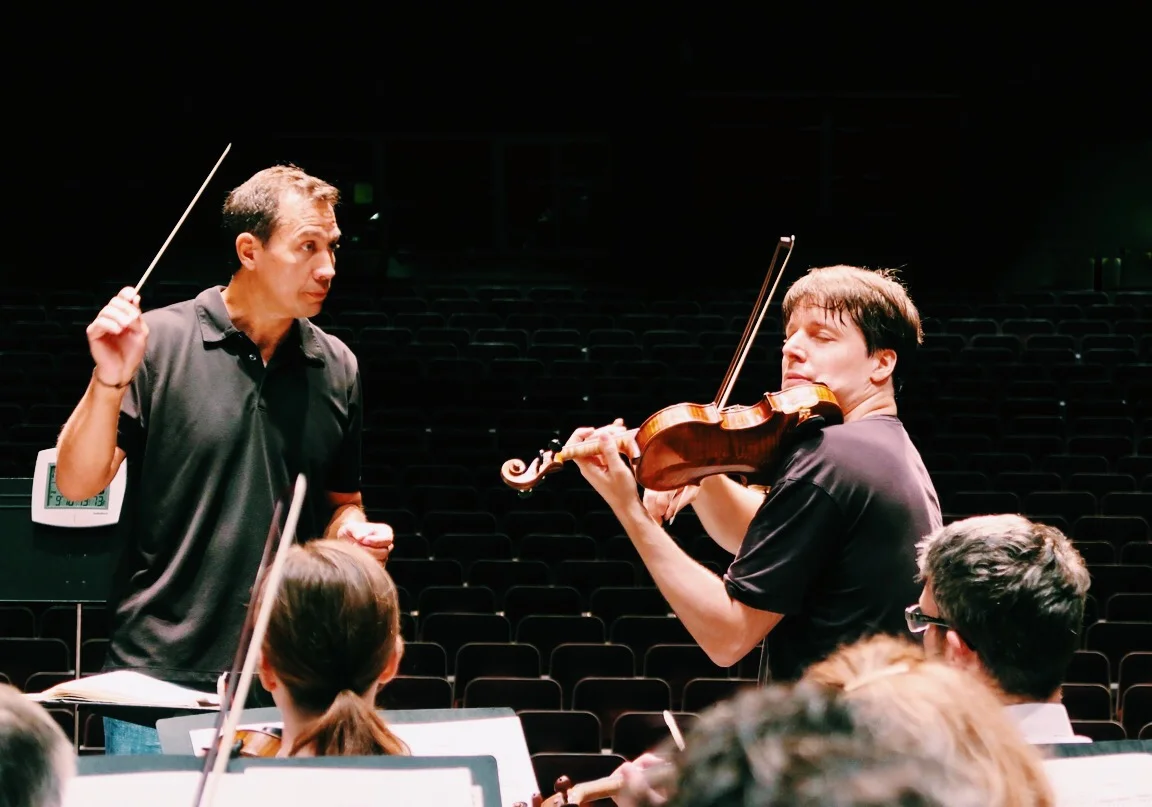
A pretty great view, right? That's my ponytail - pretty cool!
It is pretty amazing how expressive he is both physically and musically. His body language portrays exactly what he wants the orchestra to do, where he wants the music to follow him, what notes he wants to emphasize, and the excitement he wants to instill in the music. I guess his time as a music director, artistic partner (he often ‘conducted’ the SPCO from the concertmaster’s seat), soloist, and chamber musician really taught him how to use his entire body as a tool for expression. When he wanted something different he was very courteous and polite with both the conductor and orchestra. His feedback and requests were more about the mood and feel he wanted to conjure and the articulation he found worked best.
After rehearsal many of us lined up to take photos and greet him. I always get so nervous to talk to famous people I admire (I was also a wreck with the famous runner, Bart Yasso) and have all of these things I probably SHOULD say –if only for my own sake- but never end up saying it because I get so flustered and self-conscious standing in line with other fans whom also want to share a special moment with the star. I didn’t even introduce myself – he had to ask for my name. Whoops! – add photo-
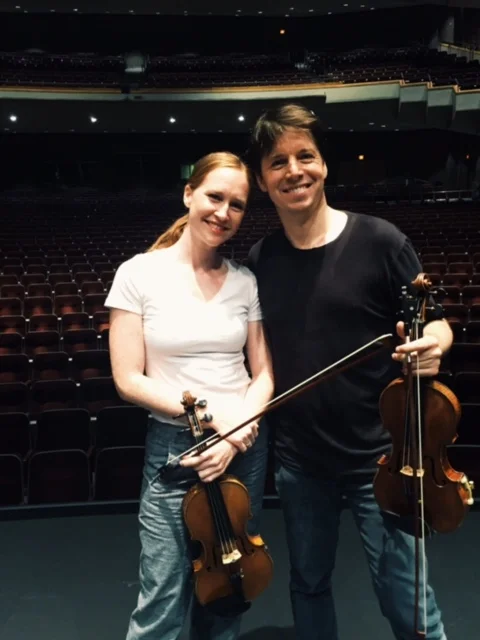
trying not to look too star struck
Anyways, he was so gracious and kind to each of us, waiting patiently for each of us to take photos, listening to us gush about our admiration for him, catching up with orchestra members he knew previously, and chatting with kids. It was nice enough of him to show up for a rehearsal and blow our musical brains but he’s kind, respectful, approachable, and funny. Who is this guy!? He certainly was under no pressure to be a real person – we were all content to stand awkwardly with a non-human superstar!
The concert began with a pre concert performance by the Harmony Project. I just started working with this afterschool program and am a huge fan of what they do. These kids are so cute and enthusiastic! They came to rehearsal and saw Joshua Bell play and were totally blown away. What a great way to conjure enthusiasm in young students! Their little bios can now include ‘performed on the same concert as Joshua Bell’ – not bad for just a few years of training! It took me decades (literally) to cross this off my bucket list.
Some of the most advanced students from the program joined the orchestra on stage for the National Anthem. They are way cuter than we are so I think the audience and orchestra were very appreciative of their inclusion in the festivities.
The Program
I thought the musical program was excellent.
The night kicked off with Richard Strauss’ tone poem Don Juan– a virtuosic piece for full orchestra jam-packed full of fireworks. If you’re a violinist you are probably a little too familiar with the first page of this piece as it is included in probably every single orchestra audition in the country.
It is hard, no doubt about it, but much more manageable as part of an ensemble than alone behind a screen with overwhelming nerves, and an intense desire to run away. The slower, romantic love themes are gorgeous and it truly shows the range and sensitivity of the ensemble. A pretty darn impressive way to start the season!
The Three Cornered Hat, Suite No.2 by Manuel De Falla was up next. It was originally composed for the ballet but was arranged for orchestral performance. The three dances in the second suite are really fun, for both the orchestra and audience, and full of Spanish flavor. They are a funny mix of ‘very difficult to play if trying to read the music exactly as written’ and ‘if you get into the groove it makes much more sense.’
After intermission it was the Joshua Bell show. Obviously we had to save the best for last.
Joshua Bell wore a simple, all black ensemble consisting of waistcoat, dress pants, and black shirt. It was tasteful and discreet and not flashy whatsoever. He even did a twirl to really show off his outfit (just kidding).
The virtuosity of the violin concerto is first hinted at in Don Juan by the entire ensemble and the Spanish feel and dancing energy of the De Falla foreshadow Tchaikovsky’s exhilarating violin concerto (interesting to note that Tchaikovsky admired Édouard Lalo’s violin concerto Symphonie Espagnole written a few year previously because of the Spanish themes and melodies. Another popular Spanish piece from around the same time is Carmen by Georges Bizet). You can hear a little bit of the every so trendy Spanish influence sprinkled throughout Tchaikovsky’s grueling violin concerto.
Back to Bell
Joshua Bell moves quite a bit but tends to stay close to the second violins. I’d like to pat myself on the back and say it is due to our flawless and musical playing but most likely because it is easier to hear the winds and see the different sections. Whatever the reason it was particularly exciting for my stand partner and I manning the front stand of the seconds. I could have sworn I locked eyes with our soloist a few times throughout the performance.
His performance was awesome. Not in the typical overused sense of the word, more in the astounding, otherworldly sense. He plays so furiously it dazzles and not a rough edge was heard in his entire performance. Nothing but a beautiful sweet sound no matter what articulation, phrasing, theme or flashy passagework was at hand. As violinists, it is easy to play too aggressively on the G string we all would have excused a crunch or two (just to cinfirm that he is in fact human) but not a single scratch, crunch, non-gorgeous sound could be found.
His first movement cadenza elicited an audible inhale of wonder from the audience when he hit the first harmonic. The cadenza was flat out fantastic and breath taking (and crazy!). What a treat to see it from so close up. I just love when a crowd of 2000+ is completely silent and totally absorbed watching a performer. The energy in the room is so alive and tangible.
The audience gave his first movement a standing ovation before they allowed him to continue with the 2nd and 3rd movements. His finale was so quick it had many of us tripping to keep up with him in rehearsal. But holy moly was it exciting! The transition from beautiful Canzonetta to Allegro Vivacissimo definitely made everyone wake up.
He closed with the theme from Ladies in Lavender, composed by Nigel Hess a film starring Dame Judy Dench and Maggie Smith. It is charming and very reminiscent of Meditation by Massenet: Tasteful and elegant (and not overplayed), beautifully melodic, nostalgic, lyrical, and lush. This relatively short piece was a great way to offer a bit more music without adding any additional fireworks to the program.
I think every musician onstage was impressed and proud of this performance. It was a great way to start the season. I feel so inspired and motivated to be a better musician and violinist. Without sounding like a cheesy #hashtag I feel pretty darn grateful for the opportunity to take part in this performance and determined to work harder and get better so I can be part of performances of this caliber more often, or dare I say it, all the time.
Leave any comments below. I hope you enjoyed this!