
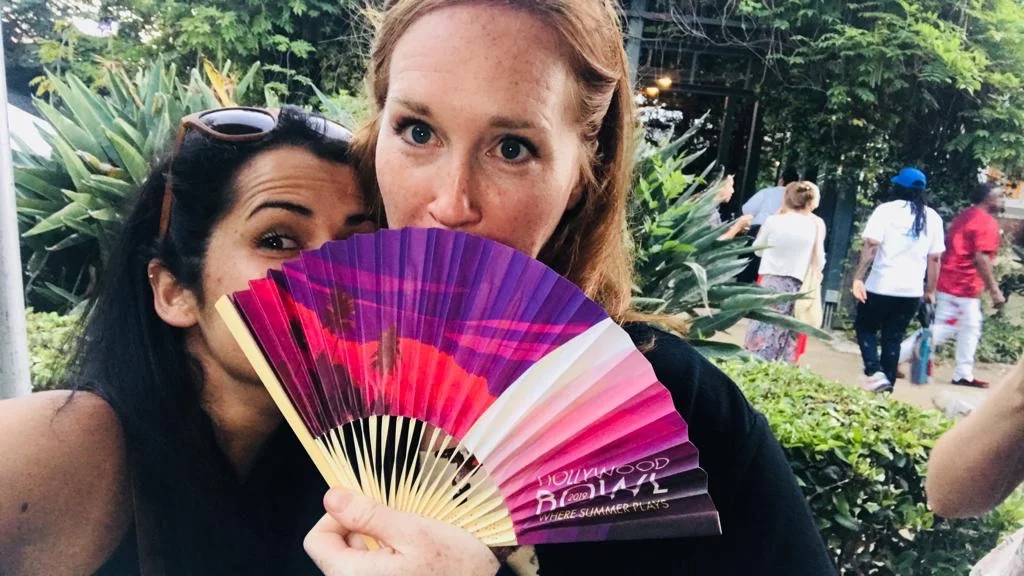
My Favorite Summer Tradition
Going to the Hollywood bowl is one of my absolute favorite things to do on a summer night in Los Angeles. What about you?
***Are you interested in free tickets to the Bowl this summer? Follow me on Instagram @activeviolinist for opportunities to win tickets to upcoming performances like Yuja Wang next week!***
Now that I've lived in Los Angeles for a year, I feel sure that going to the Hollywood Bowl is my favorite summer tradition.
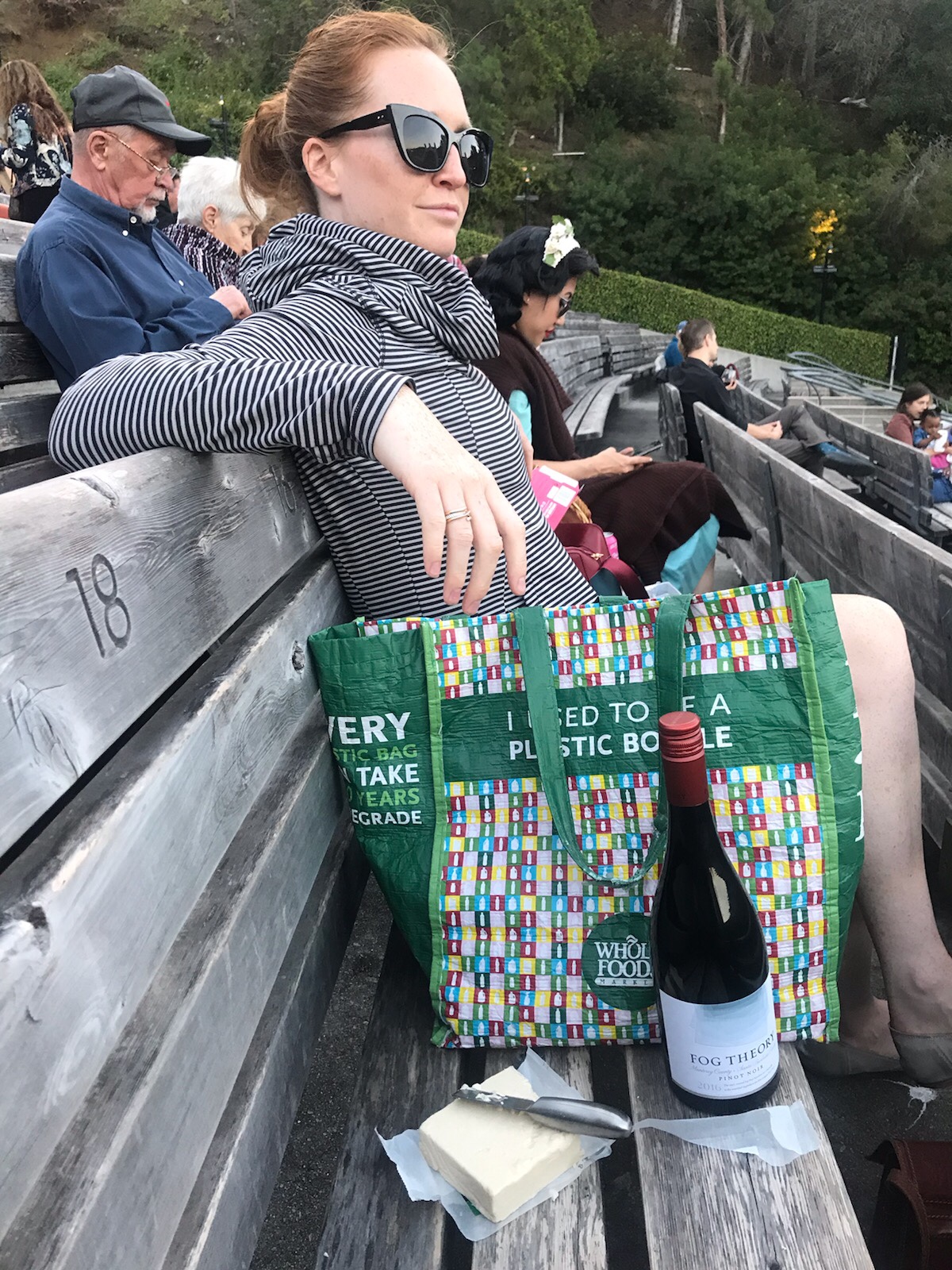
Jeff and I went twice last year, and in the past two weeks, I've gone three times. I love it! So far, I stick to the LA Phil concerts and have yet to see one of the pop performances, but the Bowl is easily one of my favorite places in LA. Jeff and I pack a picnic, and a bottle of wine or a few beers and typically sit in the cheap seats at the back. I don't go there for the acoustics, or the incredible sightlines –– but I adore the ambiance. Feeling the cool summer breeze, being in a relaxed environment, enjoying some snacks and beverages, and hanging out with friends, takes some of the snobbery out of orchestra attendance. Musical connoisseurs sit next to people who came for a chance to be outside, season ticket holders are side-by-side with first-time orchestra concert-goers, and people who want to socialize share a row with those who wish to enjoy an evening of beautiful music. And I bet that everyone is having a fantastic time. If I could go every week, I probably would.
Last week, Jeff and I packed a bottle of wine, some cheese and crackers, and a blanket and headed to the Bowl to watch the Carnival of the Animals by Saint Saëns, and Symphonie Fantastique by Berlioz. Typically, I might skip this concert, but the ladies of Sounding Point gave me tickets, and I have never seen Carnival live (plus I will take any excuse to get to the Bowl), so off we went. The show featured the Labèque Sisters on piano and the actor Sean Hayes as narrator. Hayes made his entry in a cage, and I chuckled throughout his performance, PARTICULARLY when he sat down at one of the pianos and performed part of a movement. It was hilarious. He played up the flamboyance and stage antics of a concert pianist and then "critiqued" one of the sisters while out of breath, sweating, and dramatically recovering from his performance. It was excellent.
Then, on the following Thursday, I was invited to the Falla and Flamenco performance featuring Siudy Flamenco Dance Theater performing El Amor Brujo – or Spell-bound Love. I was entranced, spellbound, and mesmerized by the music, singer, and especially the dancers. If I wasn't a fan before, I certainly am now! I could not get over the choreography, costumes, and footwork. I love how rhythmic flamenco is; how sometimes the feet are moving incredibly fast while the rest of the body is very fluid or even still, and how it fits with and enhances the sound of the orchestra. I don't know anything about flamenco, but I know that I want to see and hear more. This was one of the best "classical" concerts I have seen in a while. I've never felt more inspired to jump to my feet and scream encore at the end of a show. Before this concert, I was unfamiliar with this piece, as it is not performed very often, to my knowledge. The synopsis (thank you Wikipedia) is:
El Amor Brujo is the story of an Andalusian gypsy woman called Candela. Although her affection is for a man named Carmelo, as a girl, she was promised to be married to another man (then a boy). After many years Candela's husband has died (at the hands of the husband of a woman named Lucia), but he continues to haunt his wife.
The entire village knows about the haunting, but still brands Candela as crazy because she dances every night with her husband's ghost. Candela, now a widow, is free to establish a relationship with Carmelo but continues to be haunted by her husband's ghost.
After a conversation with other women of the village, Candela finally comes to realize that her husband was unfaithful to her, despite all her efforts to make their marriage work; her husband's lover is revealed to have been Lucia.
Candela and Carmelo get advice that a ritual dance is necessary to cast the ghost off, but it does not work. The ghost is still obsessed with Candela's soul.
Candela manages to trick Lucía to come that night, with the excuse of hooking her up with Carmelo. As she turns up, the nightly ritual of Candela's dance with her husband's ghost begins, but at the last moment Candela moves away from her husband and Lucía is taken away by her now dead lover.
Dawn breaks, Candela and Carmelo are now truly free to enjoy their love.
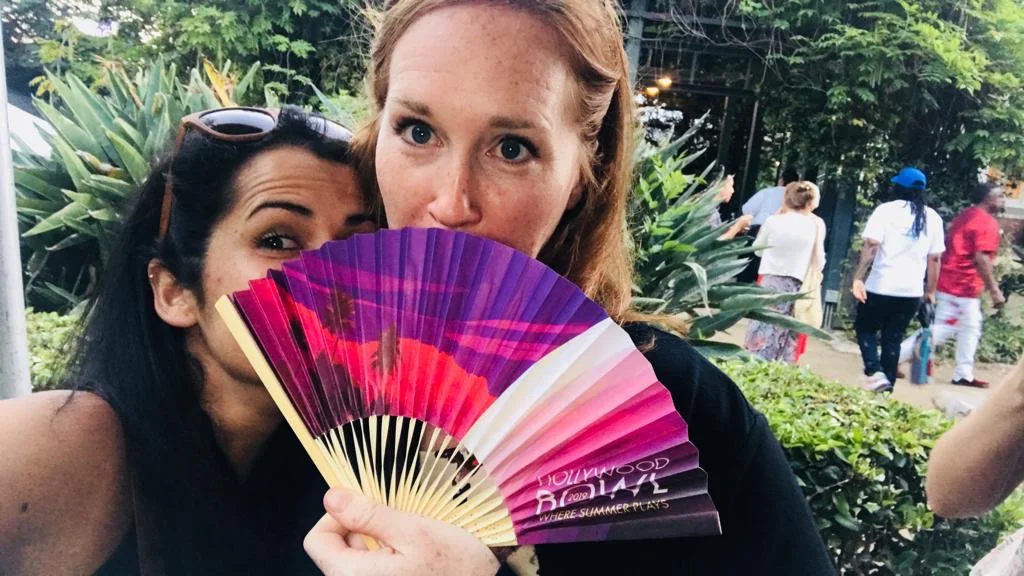
Before the concert, we attended a special picnic catered by the James Beard Award-winning chefs Suzanne Goin and Caroline Styne (of celebrated local restaurants Lucques, a.o.c., Tavern, and The Larder). The food was incredible. The octopus tacos still haunt my dreams, and I think about the Tuna every day. I have yet to visit these restaurants, but the flavor compels me.
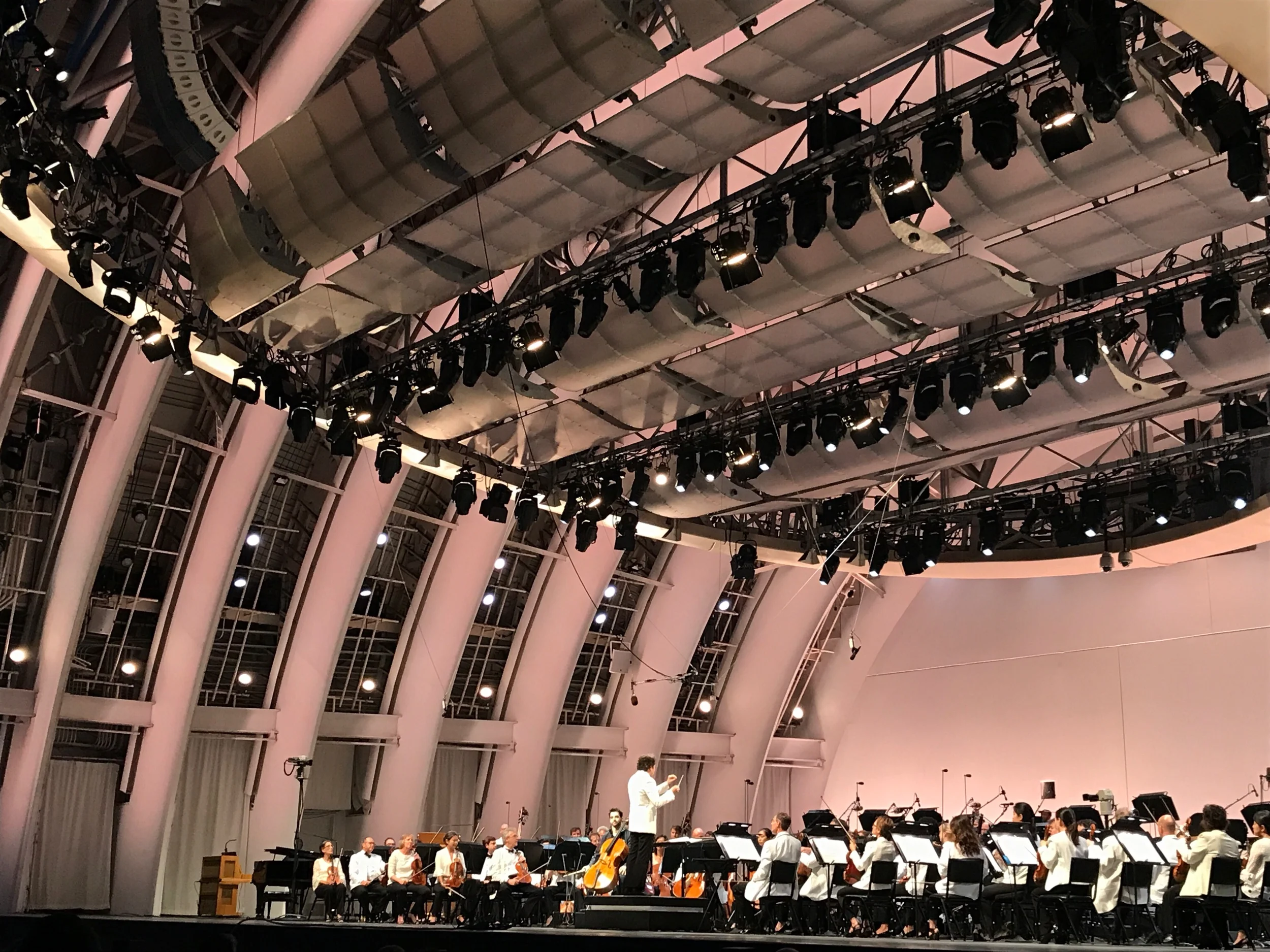
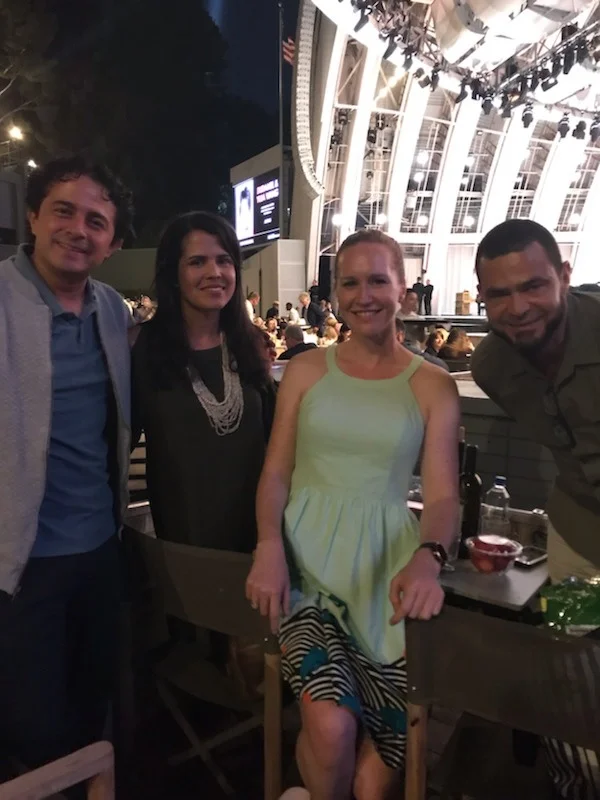
This week, unexpectedly, Maestro Juan Felipe of YOLA invited me and Caroline to join him in box seats to see the Dvorák Cello Concerto and Prokofiev's Romeo and Juliet featuring Gustavo Dudamel, cellist Pablo Ferrández, and Benjamin Millepied's choreography. I was so excited to sit close enough to see the soloist interact with Dudamel. I loved how the choreography took over the entire Bowl with fight scenes in the aisles, balcony scenes in the "lobby" areas, and party scenes in backstage storage rooms. Millepied was the cameraman (which I did not realize until later), and he made the camera work feel like part of the choreography. You watch the screens and feel intimately engaged in the drama that is taking place all around you, then turn your head and watch the action happen right beside you, then two minutes later, and it is back on the stage. While the focus was not on the orchestra, they played exquisitely – I could hear every not of those ferocious violin passages. In the words of Mark Swed from the LA Times, "This should be the future of virtual reality — not those silly headsets, pixilated video, cheapo headphones, and compressed audio." It was such a treat.
Are you interested in free tickets to the Bowl this summer? Follow me on Instagram @activeviolinist for opportunities to win tickets to upcoming performances like Yuja Wang next week!
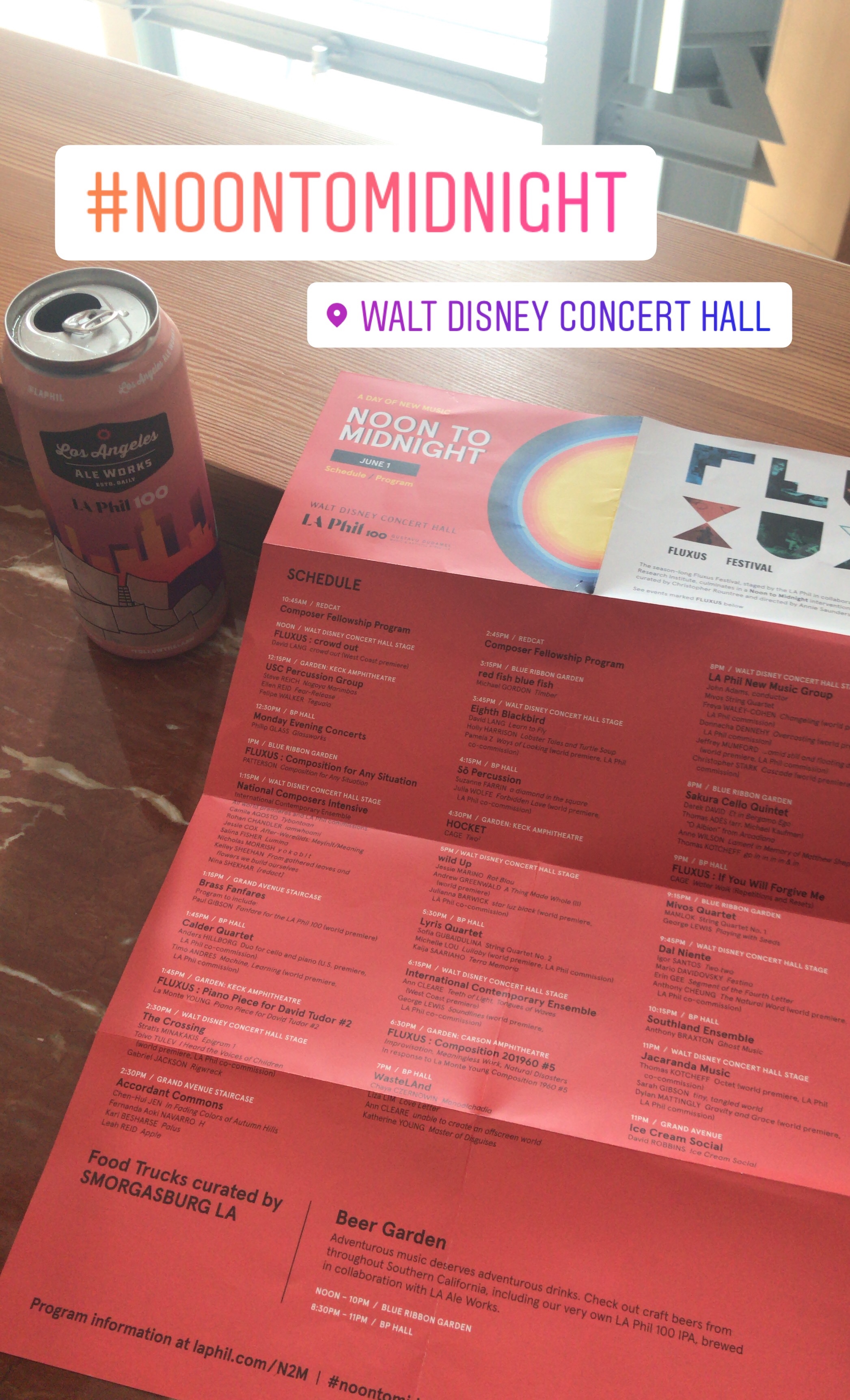
Roughly 3 Hours at Noon to Midnight
Three hours at the final FLUXUS celebration at Walt Disney Concert Hall. I wish I was there for all 12 hours of #noontomidnight it was that good!
On Saturday, June 1st, I went down to Disney Hall to check out the final event of the FLUXUS Festival. The Noon to Midnight event was a day, 12 hours to be exact, of pop-up performances throughout Walt Disney Concert Hall including the garden, BP Hall, the two amphitheatres, on the steps of the hall, and of course on stage. There were also food trucks on Grand Ave, and a beer garden in the Blue Ribbon Garden. According to the schedule, poster, calendar, “The season-long Fluxus Festival, staged by the LA Phil in collaboration with the Getty Research Institute, culminates in a Noon to Midnight intervention – five performances curated by Christopher Rountree and directed by Annie Saunders.”
We showed up right around 3 and I was sad that we missed some of the remarkable early performances like David Lang's Crowd Out, National Composer's Intensive featuring the International Contemporary Ensemble, and The Crossing, but sadly work obligations ate up the morning and early afternoon.

red fish blue fish in the Blue Ribbon Garden
Our first experience was Timber by Michael Gordon, performed by red fish blue fish in the Blue Ribbon Garden. Looking back on the performances and performers we caught, I feel confident that this was a fantastic first event. We sipped our beers outside in the not too hot, not too cold weather and sat on the ground watching the five performers of red fish blue fish stand in a circle facing one another and play saw horses with mallets. When we first walked outside, it was hard to hear or distinguish what we were hearing, and it wasn't until we stepped within the range of the speakers, each placed several yards behind a performer, that we started to experience the music. I moved around a little bit before settling on the ground with a view of the hall behind the "stage." The audience had a subtle, but different experience based on which speaker was closest. Acoustically, I think the best seat in the house was probably right in the middle of the performers because at that point, you get the most balanced output from the surrounding speakers.
The piece itself conjured a meditative effect, and on the one hand, you feel totally absorbed watching the calmness of each performer and on the other pulled in the subtle different directions of the changes of the beat and subdivisions within the piece. Granted, we did not catch the very beginning of the piece, but there is a timbre to the saw horses that almost sounds like voices, making soft articulations. The piece never reaches a deafening climax, but I don’t think that was really the point, it carries you around like waves on a beach, sometimes overlapping seamlessly, sometimes running into each other, sometimes totally in sync. I almost felt like I was floating through this experience.
We left a few minutes early because I am a fangirl of Eighth Blackbird and I wanted to make sure we had seats in the hall for that performance. I’ve seen them play once before, at the Eaux Claires Music Festival in the woods of Wisconsin. They played Murder Ballades by Bryce Dessner on a wooden stage like it was the talent show at summer camp, so I was pretty excited to see them on a "proper" stage.

Eighth Blackbird onstage at Disney Hall
They started the set with learn to fly by David Lang, and it was AWESOME. I love this piece! In the program notes, Lang says "With learn to fly I wanted to make a music that danced and pushed forward, in the hope that it would encourage the musicians to do so as well." Lisa Kaplan, the pianist of Eighth Blackbird, definitely danced from her bench. I made a note during this performance that how a performer or ensemble moves directly influences how I experience and understand the music. Without reading Lang’s words previous to making that note, I now reflect on it feeling validated in my desire to groove with Kaplan and feel the energy that permeated the music and performers.
Their set ended with a world premiere of Ways of Looking by Pamela Z. The composer, a “pioneering composer/performer and media artist who works primarily with voice, live electronic processing, sampled sound, and video,” was onstage running electronics and contributing live vocals to this performance. This piece was so cool. It included live and previously recorded vocal tracks from each performer and in the program notes, Pamela writes:
"I have long been fascinated by the musicality of speech sounds, mining sampled fragments of spoken text for melodic, rhythmic, and textural content. For this work, I interviewed all six members of Eighth Blackbird and then meticulously selected sentences, phrases, words, syllables, and phonemes to create sonic building blocks. For "Looking," I chose to have the ensemble speak their own words live. "Name" is all about describing and identifying people. "Um" is a cloud of sound built around the sonorous, nonverbal, filler sounds we all make during speech. Finally, “Very” celebrates the ubiquitous intensifier.”
This performance was dynamic, funny, clever, beautiful, and in the words of Marie Kondo, “sparked joy.” In my notes, I wrote that Pamela Z brings out the beauty of ummm and the nonsense between thoughts. But she also begged the mind to ponder the pitch and timbre of your thoughts, which is a really enjoyable and amusing thing to think about. Some of the vocal tracks were mimicked on instruments, and passed around, re-tuned, and uttered elsewhere in the ensemble, placing the voice within the ensemble, above it, and sometimes subtly below the other instruments onstage. When blended together, what pitch does a choir of speakers create? I loved the combination of live and recorded vocals with Eighth Blackbird's instrumentation. All four movements of this piece were a pure delight!

Sō Percussion in BP Hall performing Forbidden Love
Next, we moved on to Sō Percussion in BP Hall. Due to the overlap with Eighth Blackbird, we missed the first piece, a diamond in the square by Suzanne Farrin but caught the entire performance, and world premiere, of perhaps my new favorite string quartet of all time, Forbidden Love, by Julia Wolfe. This last statement may seem confusing to many of you who know Sō percussion to be a PERCUSSION ensemble, but Forbidden Love calls for the use of the four instruments of a traditional string quartet to be played but using, as Wolfe says, “all the things you aren't supposed to do to string instruments." According to the program, Sō Percussion asked Wolfe to use the four instruments of a string quartet, and together they discovered and created some fantastic sounds. Some of them sounded like a low bass a la doom metal, some of it like wind passing through chimes, and when the performers through away their sticks and started rubbing the back of the instruments, it felt strangely intimate and loving, like a bedroom scene? Or a forbidden love? Sometimes they created rhythmic grooves that were really fun and "cool" and other times they made sound effects with yarn or string (I don't know what it was) pulled through the instruments like dental floss. I was so into it, and no instrument appeared to lose its life during this performance.
I think at this point in the day I should have taken a sonic time out and grabbed another beer from the beer garden, and maybe a snack, but the problem with a really awesome festival like this is that you want to absorb so much, that perhaps you overdo it and then it backfires a little bit. I really wanted to catch HOCKET in the ampitheatre, but missed it in favor of Sō Percussion so moved right along to Wild Up on the concert stage.

Wild Up and Julianna Barwick performing Star Luz Black
I should have skipped the first two pieces. Rot Blau by Jessie Marino was silly and fun but the dark time between movements felt a little awkward and too long, and this felt more like a performance suited for a different stage or experience. The second piece, A Thing Made Whole by Andrew Greenwald, was overall very quiet and probably beautiful had this not been performed at a festival where there was extraneous noise from audience members coming in and out. I was not in the right space to appreciate this piece, and that feels particularly shameful because the performers were clearly working hard to create the correct effects and play their parts. The saving grace of this set was Star Luz Black, another world premiere featuring the composer, Julianna Barwick, on piano and voice and a string ensemble of 5 violins, 3 violas, 2 cellos, upright bass, and conductor. It was captivating. The string parts were simple in that Arvo Pärt repetitive way that makes you feel things in a deep and mournful way, coupled with the soaring beauty of the vocals and the twinkling quality of the piano. It was so compelling and wiped the slate of what had happened before. I think my frustration with this Wild Up set comes more from the lack of continuity between the pieces. It felt like such a jumble and the pieces were too disparate to leave the audience impressed. If the whole set had been more in accordance with Barwick’ s piece and presence, Wild Up would have gotten my vote for Los Angeles contemporary ensemble of the year.
After this one, I needed a break. We grabbed another beer and meandered outside for a little while. Being semi-new to Los Angeles, I had no idea that there are two amphitheatres at Disney Hall, so we wandered up to the Carson Amphitheatre to check out the venue for FLUXUS: Composition 201960 #5. By this point we were a little worn out and distracted and not in the right place to observe and appreciate another performance, so we made our way to the food trucks and sampled some of the food from 8E8 Thai Street Food whose delicious smells were permeating the outdoor performance areas. It was delicious, and we needed a snack.
After Thai, we were filled with a mild yet persistent guilt for leaving our dog home alone (past her dinner time) and called it a night with every intention of making a comeback. I really wanted to catch the Dal Niente performance later in the evening but fell asleep immediately upon returning home. I will say that this festival blew my mind, I was so impressed with the international acts that came to perform, the local talent, the different sounds and environments, the enthusiasm for new music from the people of Los Angeles (the concert hall was completely full for the Eighth Blackbird performance), and the tangible enjoyment and curiosity from other attendees. I ran into several friends from different musical walks of life who were all excited about different acts or performing in different ensembles, or who knew people playing. I was so happy to catch Sō Percussion and Eighth Blackbird again and experience Red Fish Blue Fish and Julianna Barwick for the first time. Bravo to everyone who had a hand in this incredible day. I would do it again every month.
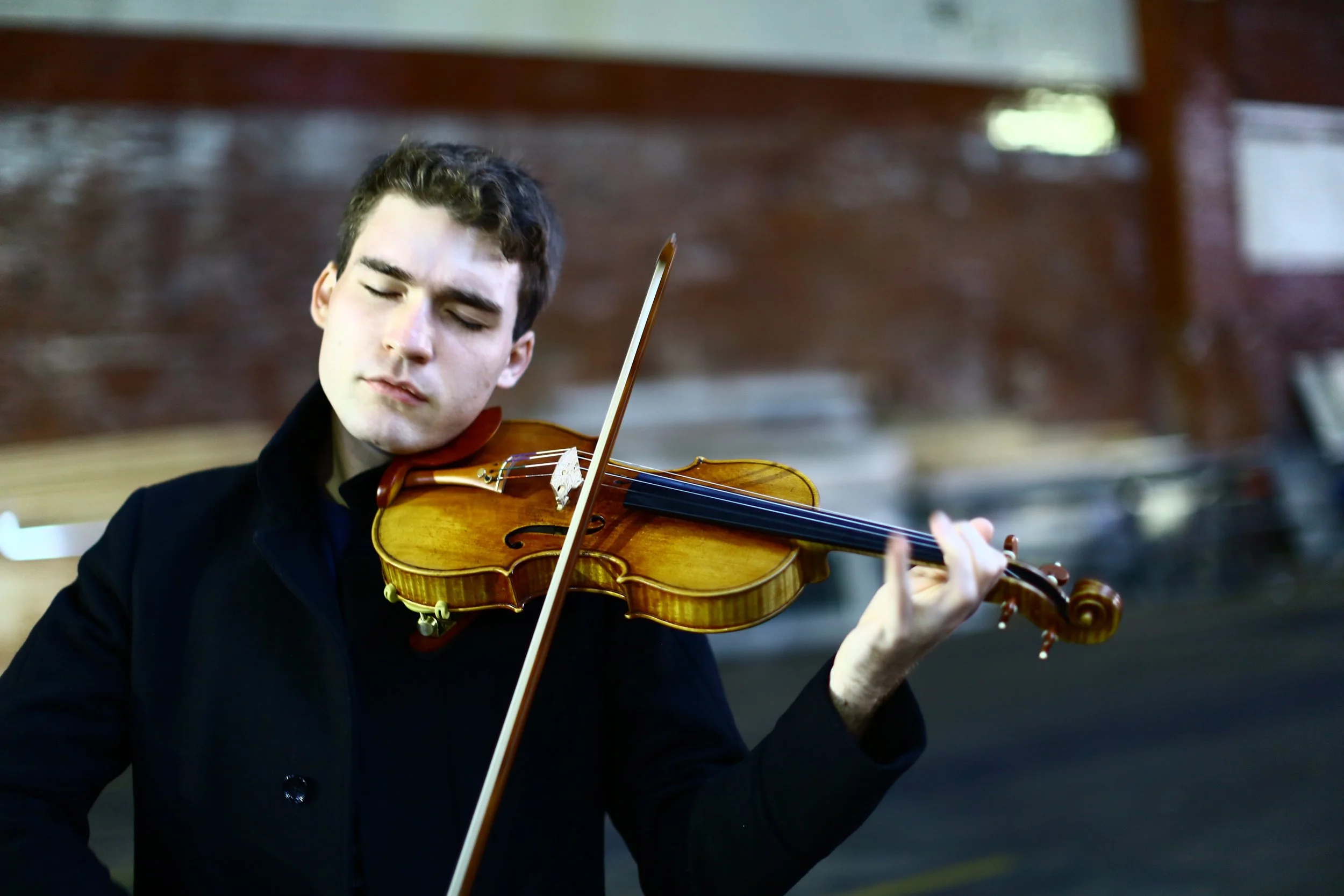
Mini-Series Part V: Alexi Kenney
The final installment of my Mini Series is here. Featuring Alexi Kenney with SoNA and Maestro Paul Haas.
This (final) installment in my season-long series is a few weeks late. Oops! Sorry about that!
The first weekend in March, Alexi Kenney performed the Sibelius Violin Concerto with the Symphony of Northwest Arkansas (SoNA) and Maestro Paul Haas.
I was super excited about this concert. The program included The Sibelius Violin Concerto, Beethoven Symphony #5, and Fratres by Arvo Pärt. I adore all of these pieces, and until the week we received our music I was jumping with excitement assuming we would play the solo violin version of Fratres (see my fairly recent Music Mondays Blog Post titled Fratres).
The Sibelius Concerto has long been one of my absolute favorites, and incidentally, the only instrumental concerto that Sibelius ever wrote.
Here is what the ever so scholarly Wikipedia has to say:
The Violin Concerto in D minor, Op. 47, was written by Jean Sibelius in 1904, revised in 1905. It is his only concerto. It is symphonic in scope, with the solo violin and all sections of the orchestra being equal voices. An extended cadenza for the soloist takes on the role of the development section in the first movement.
Sibelius originally dedicated the concerto to the noted violinist Willy Burmester, who promised to play the concerto in Berlin. For financial reasons, however, Sibelius decided to premiere it in Helsinki, and since Burmester was unavailable to travel to Finland, Sibelius engaged Victor Nováček (1873–1914), a Hungarian violin pedagogue of Czech origin who was then teaching at the Helsinki Institute of Music (now the Sibelius Academy). The initial version of the concerto premiered on 8 February 1904, with Sibelius conducting. Sibelius had barely finished the work in time for the premiere, giving Nováček precious little time to prepare, and the piece was of such difficulty that it would have sorely tested even a player of much greater skill. Given these factors, it was unwise of Sibelius to choose Nováček, who was a teacher and not a recognized soloist, and it is not surprising that the premiere was a disaster. However, Nováček was not the poor player he is sometimes painted as. He was the first violinist hired by Martin Wegelius for the Helsinki Institute, and in 1910 he participated in the premiere of Sibelius's string quartet Voces intimae, which received favorable reviews.
Sibelius withheld this version from publication and made substantial revisions. He deleted much material he felt did not work. The new version premiered on 19 October 1905 with Richard Strauss conducting the Berlin Court Orchestra. Sibelius was not in attendance. Willy Burmester was again asked to be the soloist, but he was again unavailable, so the performance went ahead without him, the orchestra's leader Karel Halíř stepping into the soloist's shoes. Burmester was so offended that he refused ever to play the concerto, and Sibelius re-dedicated it to the Hungarian "wunderkind" Ferenc von Vecsey, who was aged only 12 at the time. Vecsey championed the work, first performing it when he was only 13, although he could not adequately cope with the extraordinary technical demands of the work. The first time Sibelius himself conducted the revised version was in 1924, in Stockholm, at the same concert as the premiere of his Seventh Symphony.
The initial version was noticeably more demanding on the advanced skills of the soloist. It was unknown to the world at large until 1991, when Sibelius's heirs permitted one live performance and one recording, on the BIS record label; both were played by Leonidas Kavakos and conducted by Osmo Vänskä. The revised version still requires a high level of technical facility on the part of the soloist. The original is somewhat longer than the revised, including themes that did not survive the revision. Certain parts, like the very beginning, most of the third movement, and parts of the second, have not changed at all. The cadenza in the first movement is exactly the same for the violin part.
Pretty interesting stuff!
The first interpretation of this concerto I remember listening to regularly was recorded by Anne Sophie Mutter. That was many (many) moons ago. When I hear that performance now, it feels so nostalgic - like the first time you did anything with enthusiasm, it forever holds a special place in your heart but these days, even though I don't turn to this recording first, I still listen to it on occasion.

Back to Alexi...
When SoNA first announced the 2016/17, I was unfamiliar with the name Alexi Kenney. So in preparation, I did a little research (aka internet stalking).
Here is a slightly abbreviated bio from his website www.alexikenney.com

The recipient of a 2016 Avery Fisher Career Grant, violinist Alexi Kenney has been praised by the New York Times for “…immediately drawing listeners in with his beautifully phrased and delicate playing.” His win at the 2013 Concert Artists Guild Competition at the age of nineteen led to his critically acclaimed Carnegie Hall debut recital at Weill Hall.
He has given recitals at the Kennedy Center in Washington, D.C., Jordan Hall and the Isabella Stewart Gardner Museum in Boston, Napa’s Festival del Sole, Chicago’s Dame Myra Hess series, and the Mondavi Center for the Performing Arts, and he has been featured on Performance Today, WQXR-NY’s Young Artists Showcase, WFMT-Chicago, and NPR’s From the Top. Recent concerto engagements include the Santa Fe Symphony, Las Vegas Philharmonic and Roswell Symphony in New Mexico, the Hofheim Academy Orchestra in Bad Soden, Germany, and the NEC Philharmonia at Symphony Hall in Boston in a performance of John Adams's Violin Concerto with Hugh Wolff.
Chamber music continues to be a focus of Alexi"s life, touring with Musicians from Marlboro and Musicians from Ravinia's Steans Music Institute and regularly performing at festivals including Caramoor, “Chamber Music Connects the World” at the Kronberg Academy (Germany), ChamberFest Cleveland, the Lake Champlain Chamber Music Festival, Marlboro, Music@Menlo, Open Chamber Music at Prussia Cove (UK), Ravinia, and Yellow Barn. He has collaborated with artists including Pamela Frank, Miriam Fried, Gary Graffman, Steven Isserlis, Kim Kashkashian, Gidon Kremer, and Christian Tetzlaff.
He is the recipient of top prizes at the 2012 Yehudi Menuhin International Competition, the 2010 Mondavi Center Competition, and the 2013 Kronberg Academy master classes. He was praised by Strings magazine for his “beautiful, aching tone” for a performance of the Sibelius Concerto with the China Philharmonic Orchestra in Beijing during the Menuhin Competition.
Born in Palo Alto, California in 1994 and currently residing in New York, Alexi Kenney received his Bachelor’s of Music degree from the New England Conservatory of Music in Boston, where he is currently the only violinist in its selective Artist Diploma program. At NEC he studies with Donald Weilerstein and Miriam Fried on the Charlotte F. Rabb Presidential Scholarship. Former teachers include Wei He, Jenny Rudin, and Natasha Fong.
In layman's terms, Alexi is a young and rising star with a massive career ahead of him.
What struck me as particularly interesting was the performance excerpts he includes on his website. I had just been listening to one of my favorite podcasts, Meet The Composer, hosted by Nadia Sirota, where she interviews Kaija Saariaho, and it sent me on a quest to acquaint myself with more of her music. I ran into her piece for violin and electronics called Frises. It is so cool - I even went so far as to look up some images of the score - yikes it is hard! You can read more about the piece here OR Saariaho's own program notes here. All this to say that Alexi Kenney includes recordings of 2 movements of this piece on his website, along with a few other contemporary, and 20th-century works. I increasingly admire performers who choose to perform and endorse contemporary composers. A Champion of the Present, is often how I think of them, and I admire their investment in the music that is shaping the future. I recommend exploring the recordings on Alexi's website.
http://www.alexikenney.com/listen/
I ended up running into him at a local coffee shop in Fayetteville, and we chatted for a little bit. It turns out that the week before, he was serving as guest concertmaster of the Pittsburgh Symphony, where -small world- the assistant conductor, Andres Franko, also happens to be the music director of the Signature Symphony in Tulsa where I am the Associate Concertmaster. Sometimes the music world is crazy small! It was fun to share that little connection and chat about the differences and challenges of performing as an orchestral musician, chamber musician, and soloist, life in Brooklyn and on the road (he travels to perform almost constantly), cheap tickets at the Met and Carnegie Hall, good coffee, and yummy food around town.
I really loved Alexi's interpretation of the Sibelius. The guy has bow control for days! I was so relieved NOT to be on the front stand for this performance so I could relax a little bit and watch him perform. On his website, Kenney includes a performance quote from the New York Times that reads;
"a spellbinding, thoroughly honest performance that revealed his architect’s eye for structure and space and a tone that ranges from the achingly fragile to full-bodied robustness”.
This is spot on. His musical pacing is exact: effortlessly exciting, and convincingly unique. I loved his 3rd movement, which, all of a sudden seemed to be infused with an almost Latin groove. I had never even thought that could be a thing with this piece. A war horse of the violin repertoire, I heard Kenney's performance and just couldn't believe how it danced and grooved in a completely new and refreshing way. Donald Tovey refers to the third movement as a "polonaise for polar bears" but this had something a little more sizzling about it.
The video above is a few years old, and I think his tone is much more blazing now but unfortunately I could not find a more recent performance of the Sibelius. The 3rd movement starts roughly 10 mins from the end, but I recommend savoring the entire performance.
As a perfect compliment, Alexi performed Piazzolla's Tango Etude #3 as an encore. Oh man was it fun!
Not to sound biased, BUT, this may have been my favorite violin performance of the season. What a treat to hear, and meet a violinist at the beginning of an exciting career, playing one of the greatest pieces in the repertoire.
I can't wait to see where Alexi's Career takes him.