
EOM20
I just returned home from Germany. Read all about the EOM Festival and the AWITN reunion.
Love.Noise.Freedom!
Hallo! I am back from a beautiful musical celebration/reunion/adventure in Germany and want to share my thoughts and feelings about what took me across the pond.

For those of you who met me during my time in Oklahoma (or later), you might not know that many moons ago I used to play in bands, and toured all over the United States and Europe performing non-classical music. It really feels like a different lifetime, and sometimes I find myself thinking “Did I really do that? Did I really play there?” Those were the days before graduate school and orchestra auditions, and dissertation writing, when I was wild, young, and free without a care in the world or a smartphone anchoring me to virtual reality. How I miss those days sometimes.
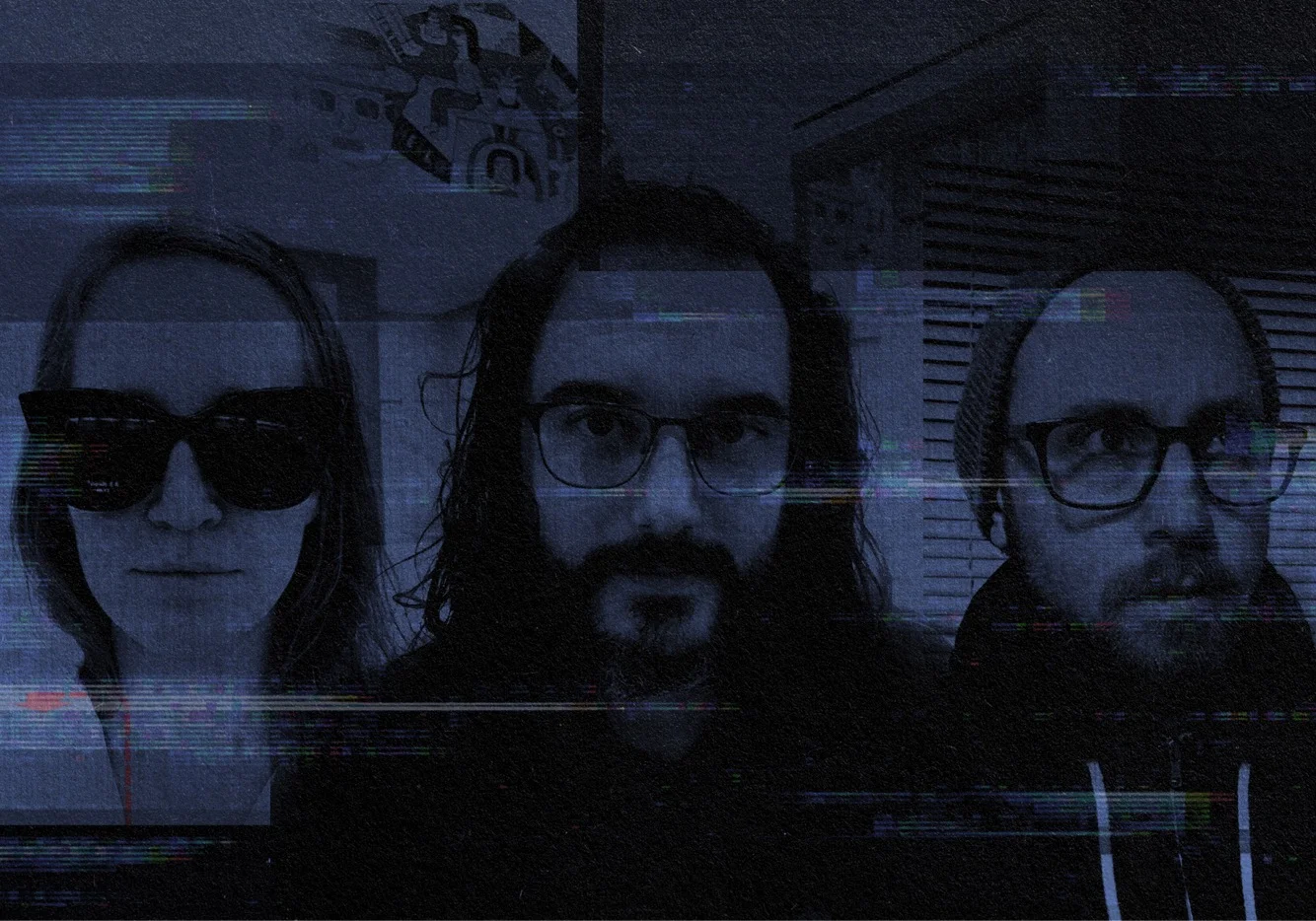
The first band I ever worked with was called A Whisper in the Noise. It was not your typical “band” set up. The group went through many instrumental mutations, but by the time I joined, it was me (violin), Matt (drums), and West (vocals, keyboard, guitar), and electronic sounds that came from somewhere - maybe Matt? Maybe West? Who knows? We also performed occasionally with a bass player, although that was mostly programmed into backing tracks, and we also had a video that was synced to the music. Looking back, it was an exceptional time in my musical development, and working with Matt and West when I was just a little undergraduate music baby shaped me in ways I am just now starting to unravel.

A Whisper in the Noise had the good fortune of being uncovered or discovered or liked, or some odd combination of those things plus a little extra sorcery I’m sure, by a record label based in the town of Borkheide (just outside of Berlin) Germany called Exile on Mainstream Records. Exile put out 2 records for AWITN, “Dryland” in 2007 and “To Forget” in 2012. “Dryland” as far as I can remember was an unexpected success in Europe and fostered a fan base for us to do an 8-week tour in 2008 that took us far and wide across the EU and included some of the most hilarious and bizarre stories of my life.
Exile on Mainstream, it is important to remember, upholds a beautiful and specific artistic vision that celebrates uniqueness, small pressings, boutique packaging, and sounds that are not mainstream but come from fantastically talented and creative individuals and ensembles. In fact, the landing page of the website reads
“Beware the lollipop of mediocrity; lick it once, and you’ll suck forever.” ~Brian Wilson
And that pretty much sums up the label. Every person I have ever met who is associated with Exile has a specific tangible energy. Not all the same type of energy, but something you can feel or hear humming at different speeds and frequencies.
Back to the performance...
We decided not to play the hits at this show. Nobody really felt like dusting off old songs and doing what we did 10 years ago. So much has changed in all of our lives and it didn’t seem like a fair representation to do that to ourselves. Instead, we put together a live performance of new sounds interwoven haunted by the ghosts of old songs. We (I should say West and Matt because I really didn’t play a significant role in all of this until the actual performance) created sound beds that were manipulated in real time. We referenced songs from the past, as well music from West’s most recent film score for the movie “Glass” while leaving space for me to improvise over the top and create new sounds only for that moment at that performance. Matt also created some incredible video art for this performance to enhance the show. We rehearsed once, 6 weeks before the concert. This is not my typical performance preparation process these days, and I was pretty nervous leading up to showtime (and I mean for about 2 weeks before the show). We talked and texted about everything regularly. West sent me sheet music from the Glass score to look at, I practiced with my cool new loop pedal at home, but this felt like a giant leap of faith for me, and mostly I didn’t want to let Andreas down.
EOM20 took place over four days in Leipzig, at UT Connewitz and Paul Gerhardt Church (where we played). The festival was a celebration of 20 years of Exile which means bands and performers from every era of the label showed up to perform. April 4-7 were filled with music and reunions both musically and social, with old musical family members and new friendships. There were some very familiar faces to me, like Ostinato, Bulbul, the Antikaroshi, and the Winchester Club who I’ve had the pleasure of touring and performing with in the past, as well as totally new sounds to my ears like Darsombra, Dalek, Bell Rope, Kristian Harting and many more. Several bands reunited specifically for this occasion, like A Whisper in the Noise, Ostinato, and the legendary VOLT who I am so happy I finally witnessed live.

I hadn’t seen some of these people in nearly 10 years and returning to Germany and sharing the stage with these beautiful people was an honor and a privilege. It was also a great reminder that following an artistic urge or direction that is deeper than commercial success brings great satisfaction. That what you excel at, and how you express yourself may not be something that everyone can relate to, and that is incredible and beautiful. Resonating at a unique artistic frequency is something to cherish more than a paycheck.
Maybe it is the move to Los Angeles, or perhaps it is just the season of life that I currently find myself in, but preparing for and taking part in this festival jolted my system awake in a way that I have been in desperate need of for a long time. I forgot about the musical strengths I have that rarely get flexed. I forgot how important working with people I respect and admire is, and how much I need these relationships. I forgot what it means to close your eyes and trust that you can create something extraordinary onstage for yourself and the audience. I forgot how satisfying it is to just play, create, and perform and not constantly analyze. I forgot that the creative process cannot be summed up on social media (or a blog). I forgot that being marketable really doesn’t matter when you offer something genuine. I forgot, I forgot, I forgot.
...and now I remember.
Upon returning home, all I can really say is “thank you” - to everyone who was there. To those who witnessed the AWITN reunion, to those I met and re-met, who helped me order a vegan burger or a beer (or both), to my fellow musicians, and most importantly, to Andreas who had the idea to call us out of the blue and invite us to reunite for this one-off special event. He knew. He always knows.
Love. Noise. Freedom.
Music Mondays - Noam Faingold + TRQ
Come check out TRQ with special guest Noam Faingold this Wednesday at the Tulsa Performing Arts Center
Happy Monday!
I hope nobody was too offended that I took Memorial Day weekend off from blogging and escaped to the mountains with my family. It was a much-needed vacation with (conveniently) poor cell phone reception and Wifi connection. What a welcome break from the daily grind!

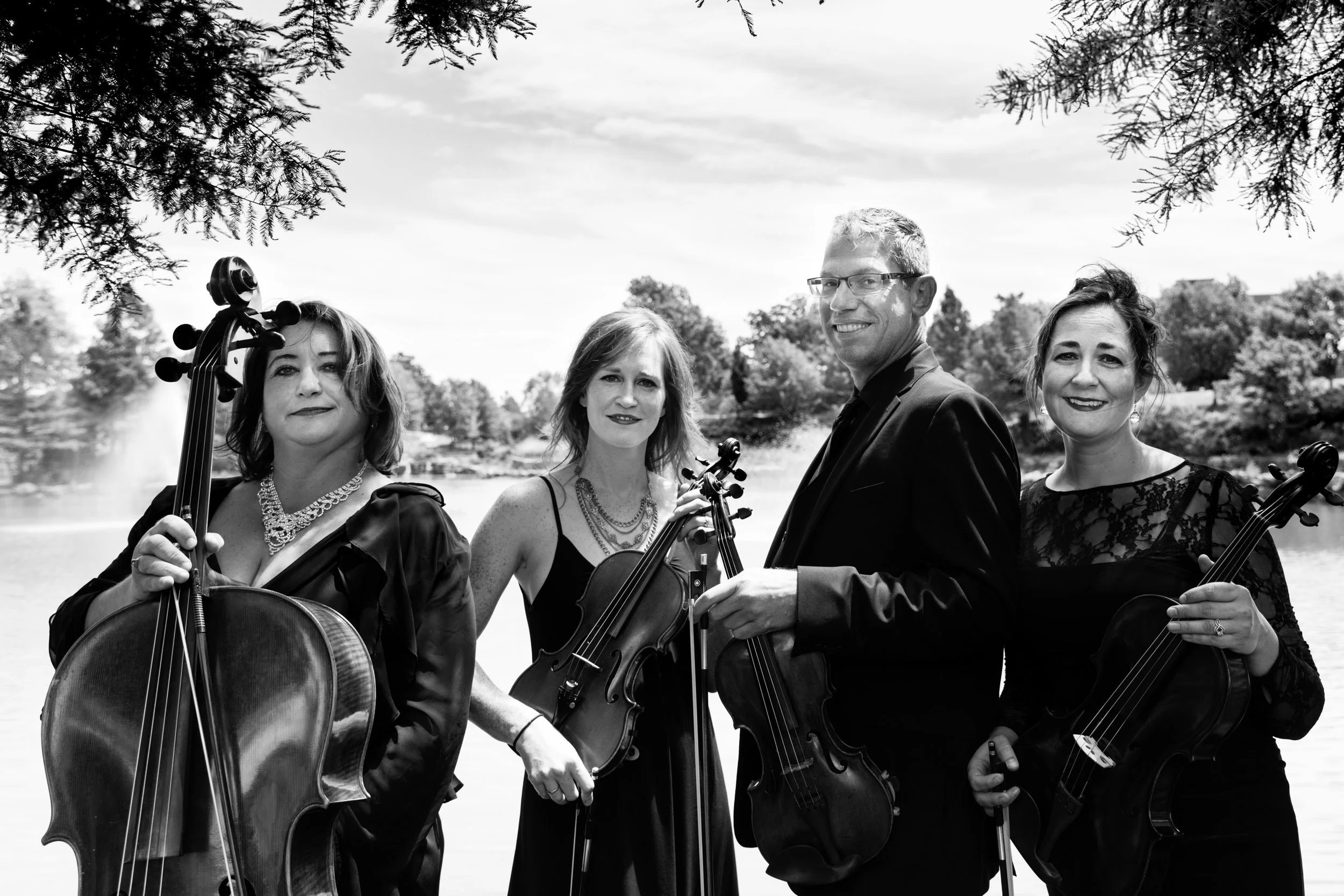
photo by Andrew Fassbender
Anyways, I'm back now, and I hit the ground running! This week Music Mondays is a shameless plug for TRQ's 'Brown Bag It' concert at the Tulsa Performing Arts Center, this Wednesday at 12:10 pm. For more details check the website at http://tulsapac.com/
This concert will be full of Rock 'n' Roll classics arranged for string quartet. Noam Faingold will also be joining us to perform two of his songs, recorded by his band Burning City Orchestra (BCO), and arranged for string quartet.
Here's a little something about BCO (from their website www.burningcityorchestra.com)

We take orchestral rock song-writing where it's been a long time coming. Praised by Anoushka Shankar for our “gorgeous” strings and “wonderful” lyrics (BBC), Burning City Orchestra celebrates traditional chamber music-style intimacy, while incorporating powerful rock, jazz, and punk influences. BCO is run by composer & singer/songwriter Noam Faingold whose “lyrical” (New York Times) music has been called “A tour de force of Jazz melded with classical,” (Downbeat Magazine), and an “outside-the-box perspective” (Dennis Cook).
WHO
BCO is comprised of renowned contemporary musicians including members of The Royal Ballet Orchestra, the BBC Concert Orchestra, The American Symphony Orchestra, Alarm Will Sound, and the Bang on a Can festival. Members of BCO can be seen performing at venues ranging from The Kennedy Center, Carnegie Hall, to Le Poisson Rouge NYC and The Stone. Our collaborators are among the most accomplished artists and ensembles in NYC and London's contemporary music scenes.
Below is one of the songs we will play on Wednesday.
Enjoy and we hope to see you there!
Mini-Series Part V: Alexi Kenney
The final installment of my Mini Series is here. Featuring Alexi Kenney with SoNA and Maestro Paul Haas.
This (final) installment in my season-long series is a few weeks late. Oops! Sorry about that!
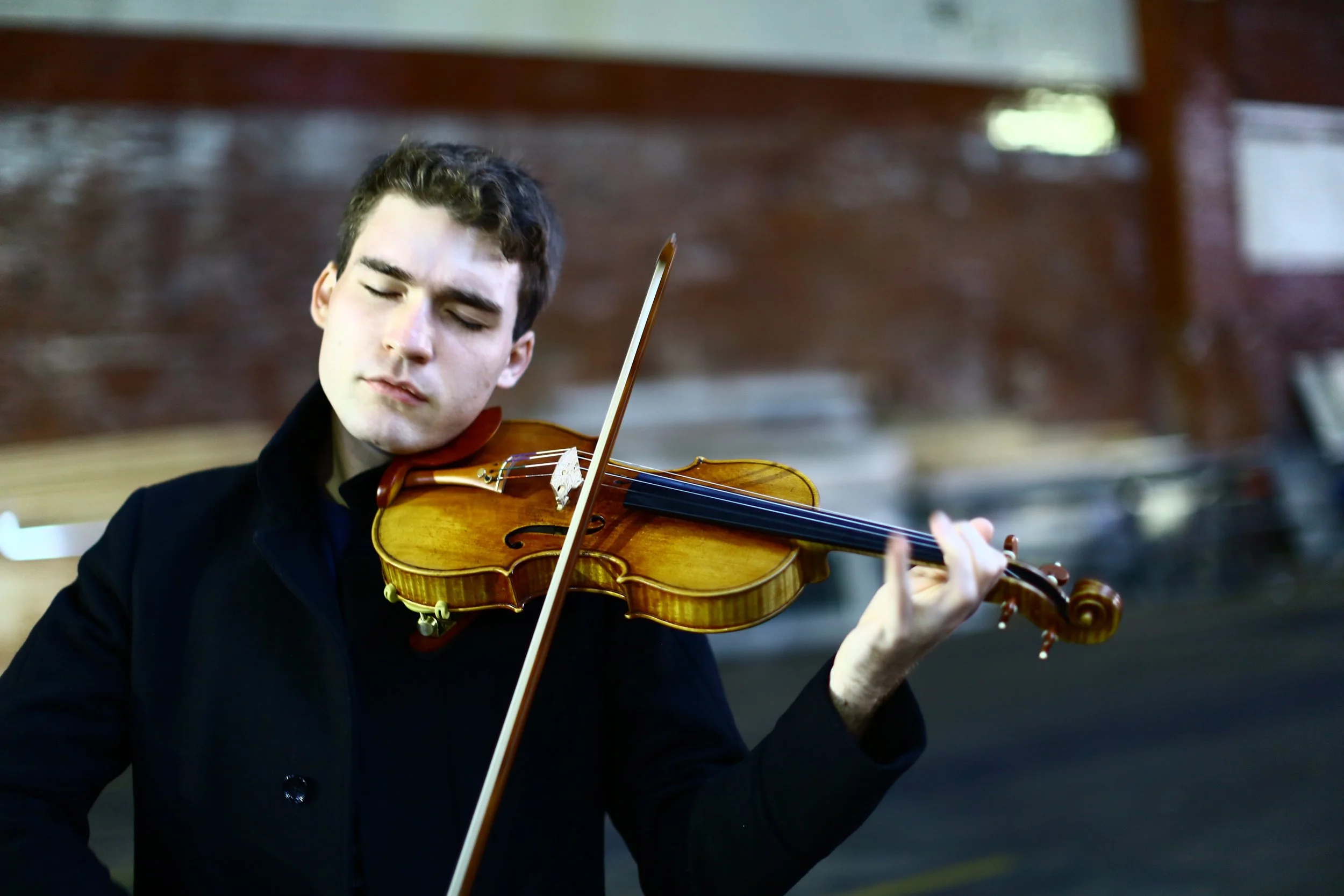
The first weekend in March, Alexi Kenney performed the Sibelius Violin Concerto with the Symphony of Northwest Arkansas (SoNA) and Maestro Paul Haas.
I was super excited about this concert. The program included The Sibelius Violin Concerto, Beethoven Symphony #5, and Fratres by Arvo Pärt. I adore all of these pieces, and until the week we received our music I was jumping with excitement assuming we would play the solo violin version of Fratres (see my fairly recent Music Mondays Blog Post titled Fratres).
The Sibelius Concerto has long been one of my absolute favorites, and incidentally, the only instrumental concerto that Sibelius ever wrote.
Here is what the ever so scholarly Wikipedia has to say:
The Violin Concerto in D minor, Op. 47, was written by Jean Sibelius in 1904, revised in 1905. It is his only concerto. It is symphonic in scope, with the solo violin and all sections of the orchestra being equal voices. An extended cadenza for the soloist takes on the role of the development section in the first movement.
Sibelius originally dedicated the concerto to the noted violinist Willy Burmester, who promised to play the concerto in Berlin. For financial reasons, however, Sibelius decided to premiere it in Helsinki, and since Burmester was unavailable to travel to Finland, Sibelius engaged Victor Nováček (1873–1914), a Hungarian violin pedagogue of Czech origin who was then teaching at the Helsinki Institute of Music (now the Sibelius Academy). The initial version of the concerto premiered on 8 February 1904, with Sibelius conducting. Sibelius had barely finished the work in time for the premiere, giving Nováček precious little time to prepare, and the piece was of such difficulty that it would have sorely tested even a player of much greater skill. Given these factors, it was unwise of Sibelius to choose Nováček, who was a teacher and not a recognized soloist, and it is not surprising that the premiere was a disaster. However, Nováček was not the poor player he is sometimes painted as. He was the first violinist hired by Martin Wegelius for the Helsinki Institute, and in 1910 he participated in the premiere of Sibelius's string quartet Voces intimae, which received favorable reviews.
Sibelius withheld this version from publication and made substantial revisions. He deleted much material he felt did not work. The new version premiered on 19 October 1905 with Richard Strauss conducting the Berlin Court Orchestra. Sibelius was not in attendance. Willy Burmester was again asked to be the soloist, but he was again unavailable, so the performance went ahead without him, the orchestra's leader Karel Halíř stepping into the soloist's shoes. Burmester was so offended that he refused ever to play the concerto, and Sibelius re-dedicated it to the Hungarian "wunderkind" Ferenc von Vecsey, who was aged only 12 at the time. Vecsey championed the work, first performing it when he was only 13, although he could not adequately cope with the extraordinary technical demands of the work. The first time Sibelius himself conducted the revised version was in 1924, in Stockholm, at the same concert as the premiere of his Seventh Symphony.
The initial version was noticeably more demanding on the advanced skills of the soloist. It was unknown to the world at large until 1991, when Sibelius's heirs permitted one live performance and one recording, on the BIS record label; both were played by Leonidas Kavakos and conducted by Osmo Vänskä. The revised version still requires a high level of technical facility on the part of the soloist. The original is somewhat longer than the revised, including themes that did not survive the revision. Certain parts, like the very beginning, most of the third movement, and parts of the second, have not changed at all. The cadenza in the first movement is exactly the same for the violin part.
Pretty interesting stuff!
The first interpretation of this concerto I remember listening to regularly was recorded by Anne Sophie Mutter. That was many (many) moons ago. When I hear that performance now, it feels so nostalgic - like the first time you did anything with enthusiasm, it forever holds a special place in your heart but these days, even though I don't turn to this recording first, I still listen to it on occasion.

Back to Alexi...
When SoNA first announced the 2016/17, I was unfamiliar with the name Alexi Kenney. So in preparation, I did a little research (aka internet stalking).
Here is a slightly abbreviated bio from his website www.alexikenney.com

The recipient of a 2016 Avery Fisher Career Grant, violinist Alexi Kenney has been praised by the New York Times for “…immediately drawing listeners in with his beautifully phrased and delicate playing.” His win at the 2013 Concert Artists Guild Competition at the age of nineteen led to his critically acclaimed Carnegie Hall debut recital at Weill Hall.
He has given recitals at the Kennedy Center in Washington, D.C., Jordan Hall and the Isabella Stewart Gardner Museum in Boston, Napa’s Festival del Sole, Chicago’s Dame Myra Hess series, and the Mondavi Center for the Performing Arts, and he has been featured on Performance Today, WQXR-NY’s Young Artists Showcase, WFMT-Chicago, and NPR’s From the Top. Recent concerto engagements include the Santa Fe Symphony, Las Vegas Philharmonic and Roswell Symphony in New Mexico, the Hofheim Academy Orchestra in Bad Soden, Germany, and the NEC Philharmonia at Symphony Hall in Boston in a performance of John Adams's Violin Concerto with Hugh Wolff.
Chamber music continues to be a focus of Alexi"s life, touring with Musicians from Marlboro and Musicians from Ravinia's Steans Music Institute and regularly performing at festivals including Caramoor, “Chamber Music Connects the World” at the Kronberg Academy (Germany), ChamberFest Cleveland, the Lake Champlain Chamber Music Festival, Marlboro, Music@Menlo, Open Chamber Music at Prussia Cove (UK), Ravinia, and Yellow Barn. He has collaborated with artists including Pamela Frank, Miriam Fried, Gary Graffman, Steven Isserlis, Kim Kashkashian, Gidon Kremer, and Christian Tetzlaff.
He is the recipient of top prizes at the 2012 Yehudi Menuhin International Competition, the 2010 Mondavi Center Competition, and the 2013 Kronberg Academy master classes. He was praised by Strings magazine for his “beautiful, aching tone” for a performance of the Sibelius Concerto with the China Philharmonic Orchestra in Beijing during the Menuhin Competition.
Born in Palo Alto, California in 1994 and currently residing in New York, Alexi Kenney received his Bachelor’s of Music degree from the New England Conservatory of Music in Boston, where he is currently the only violinist in its selective Artist Diploma program. At NEC he studies with Donald Weilerstein and Miriam Fried on the Charlotte F. Rabb Presidential Scholarship. Former teachers include Wei He, Jenny Rudin, and Natasha Fong.
In layman's terms, Alexi is a young and rising star with a massive career ahead of him.
What struck me as particularly interesting was the performance excerpts he includes on his website. I had just been listening to one of my favorite podcasts, Meet The Composer, hosted by Nadia Sirota, where she interviews Kaija Saariaho, and it sent me on a quest to acquaint myself with more of her music. I ran into her piece for violin and electronics called Frises. It is so cool - I even went so far as to look up some images of the score - yikes it is hard! You can read more about the piece here OR Saariaho's own program notes here. All this to say that Alexi Kenney includes recordings of 2 movements of this piece on his website, along with a few other contemporary, and 20th-century works. I increasingly admire performers who choose to perform and endorse contemporary composers. A Champion of the Present, is often how I think of them, and I admire their investment in the music that is shaping the future. I recommend exploring the recordings on Alexi's website.
http://www.alexikenney.com/listen/
I ended up running into him at a local coffee shop in Fayetteville, and we chatted for a little bit. It turns out that the week before, he was serving as guest concertmaster of the Pittsburgh Symphony, where -small world- the assistant conductor, Andres Franko, also happens to be the music director of the Signature Symphony in Tulsa where I am the Associate Concertmaster. Sometimes the music world is crazy small! It was fun to share that little connection and chat about the differences and challenges of performing as an orchestral musician, chamber musician, and soloist, life in Brooklyn and on the road (he travels to perform almost constantly), cheap tickets at the Met and Carnegie Hall, good coffee, and yummy food around town.
I really loved Alexi's interpretation of the Sibelius. The guy has bow control for days! I was so relieved NOT to be on the front stand for this performance so I could relax a little bit and watch him perform. On his website, Kenney includes a performance quote from the New York Times that reads;
"a spellbinding, thoroughly honest performance that revealed his architect’s eye for structure and space and a tone that ranges from the achingly fragile to full-bodied robustness”.
This is spot on. His musical pacing is exact: effortlessly exciting, and convincingly unique. I loved his 3rd movement, which, all of a sudden seemed to be infused with an almost Latin groove. I had never even thought that could be a thing with this piece. A war horse of the violin repertoire, I heard Kenney's performance and just couldn't believe how it danced and grooved in a completely new and refreshing way. Donald Tovey refers to the third movement as a "polonaise for polar bears" but this had something a little more sizzling about it.
The video above is a few years old, and I think his tone is much more blazing now but unfortunately I could not find a more recent performance of the Sibelius. The 3rd movement starts roughly 10 mins from the end, but I recommend savoring the entire performance.
As a perfect compliment, Alexi performed Piazzolla's Tango Etude #3 as an encore. Oh man was it fun!
Not to sound biased, BUT, this may have been my favorite violin performance of the season. What a treat to hear, and meet a violinist at the beginning of an exciting career, playing one of the greatest pieces in the repertoire.
I can't wait to see where Alexi's Career takes him.