

Mini-Series Part IV: Rachel Barton Pine
Mini-Series Part IV is here!
Read about Rachel Barton Pine, Vivaldi's Four Seasons, Baroque Bows, and violinists playing in bands here!
True Confessions: I had way too much fun writing this!
This week Rachel Barton Pine performed Vivaldi's The Four Seasons with the Wichita Symphony and Maestro Dan Hege (I seem to be playing quite a few violin concertos with Maestro Hege this season).

I have been looking forward to this concert all season. The Four Seasons feel like the classic rock of classical music. They are so famous, so beloved, and so riveting I'm pretty sure they still hold the record as the most recorded piece(s) ever. In preparation for this week, I have been listening to them pretty much non-stop. They are the soundtrack to my driving, research, work in the music library, and social media scrolling. They make me want to rock out and dance around.
This program consisted of all Baroque music. Pretty much all of the super famous stuff that you might hear at a wedding, and play in Suzuki recitals. Handel's Water Music and Bach's Suite No.3 made up the first half of the program.

How I felt this week.
To put a cherry on top of an already exciting week, we string players were loaned baroque bows for the performance. That doesn't happen very often! True confessions: I've never performed with a Baroque bow. It feels pretty different, and I was not convinced about it until Rachel gave us a demonstration and explained some of the unique sound qualities that our modern bows just don't execute particularly well.

baroque violin, viola, and cello bows

My view for this concert. The very back row of the 1st violins.
Our concerts featured seasonal photography of Kansas by photographer Larry Schwarm.
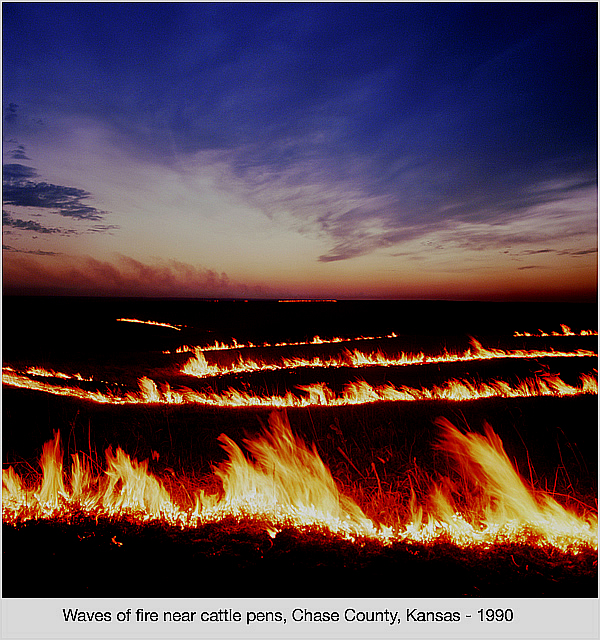
This concert was also a quasi-lecture where Rachel would explain some of the effects in each season and perform a few demonstrations before playing the work. It was super cool! I really appreciated hearing her descriptions and then emulating that effect - bird calls, bagpipes, dogs, raindrops, the wind, bugs, storms - you name it! All of those sounds you hear outdoors throughout the year as performed by an orchestra.
Here is the explanation of Le Quattro Stagioni found on britannica.com
The Four Seasons is the best known of Vivaldi's works. Unusually for the time, Vivaldi published the concerti with accompanying poems (possibly written by Vivaldi himself) that elucidated what it was about those seasons that his music was intended to evoke. It provides one of the earliest and most detailed examples of what was later called program music - music with a narrative element.
Vivaldi took great pains to relate his music to the texts of the poems, translating the poetic lines themselves directly into the music on the page.
His arrangement is as follows:
Spring (Concerto No. 1 in E Major)
Allegro
Spring has arrived with joy
Welcomed by the birds with happy songs,
And the brooks, amidst gentle breezes,
Murmur sweetly as they flow.
The sky is caped in black, and
Thunder and lightning herald a storm
When they fall silent, the birds
Take up again their delightful songs.
Largo e pianissimo sempre
And in the pleasant, blossom-filled meadow,
To the gentle murmur of leaves and plants,
The goatherd sleeps, his faithful dog beside him.
Allegro
To the merry sounds of a rustic bagpipe,
Nymphs and shepherds dance in their beloved spot
When Spring appears in plendour.
Summer (Concerto No. 2 in G Minor)
Allegro non molto
Under the merciless sun of the season
Languishes man and flock, the pine tree burns.
The cuckoo begins to sing and at once
Join in the turtledove and the goldfinch.
A gentle breeze blows, but Boreas
Is roused to combat suddenly with his neighbour,
And the shepherd weeps because overhead
Hangs the fearsome storm, and his destiny.
Adagio
His tired limbs are robbed of rest
By his fear of the lightning and the frightful thunder
And by the flies and hornets in furious swarms.
Presto
Alas, his fears come true:
There is thunder and lightning in the heavens
And the hail cuts down the tall ears of grain.
Autumn (Concerto No. 3 in F Major)
Allegro
The peasant celebrates with dancing and singing
The pleasure of the rich harvest,
And full of the liquor of Bacchus
They end their merrymaking with a sleep.
Adagio molto
All are made to leave off dancing and singing
By the air which, now mild, gives pleasure
And by the season, which invites many
To find their pleasure in a sweet sleep.
Allegro
The hunters set out at dawn, off to the hunt,
With horns and guns and dogs they venture out.
The beast flees and they are close on its trail.
Already terrified and wearied by the great noise
Of the guns and dogs, and wounded as well
It tries feebly to escape, but is bested and dies.
Winter (Concerto No. 4 in F Minor)
Allegro non molto
Frozen and shivering in the icy snow,
In the severe blasts of a terrible wind
To run stamping one’s feet each moment,
One’s teeth chattering through the cold.
Largo
To spend quiet and happy times by the fire
While outside the rain soaks everyone.
Allegro
To walk on the ice with tentative steps,
Going carefully for fear of falling.
To go in haste, slide, and fall down to the ground,
To go again on the ice and run,
In case the ice cracks and opens.
To hear leaving their iron-gated house Sirocco,
Boreas, and all the winds in battle—
This is winter, but it brings joy.
I don't know who the dude playing 'Winter' is, but that video is NEXT LEVEL
On a somewhat related note - does everyone remember Vanessa Mae's Album Storm? I was reminiscing about this album and her white electric violin with a violinista colleague - oh the 90s (and techno)! How special!
Rachel Barton Pine
I first came across Rachel Barton Pine when I was a student in Minnesota. At the time, I was playing in a band and feeling a little alone in the "classically trained violinist wanting to pursue more than a traditional music career" category. I was browsing Myspace (I know, right? Who even remembers that) for violinists who play in bands and found Rachel. I was so intrigued....and very confused. She plays metal like classical music and classical music like metal. It is insane!
I bet you didn't think a Guarneri Del Jesu could play metal like that! Pretty crazy right?
Her bio includes pretty much everything. I was going to include an excerpt but it is so long and insane that it would take up too much room. She is the recipient of numerous awards, winner of many competitions, and performs as a soloist and recitalist all over the world, as part of the metal band Earthen Grave, and as part of Trio Settecento.
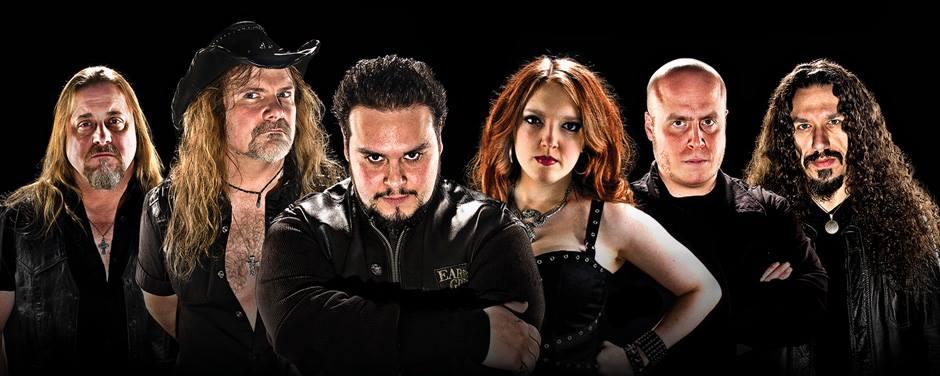
Earthen Grave
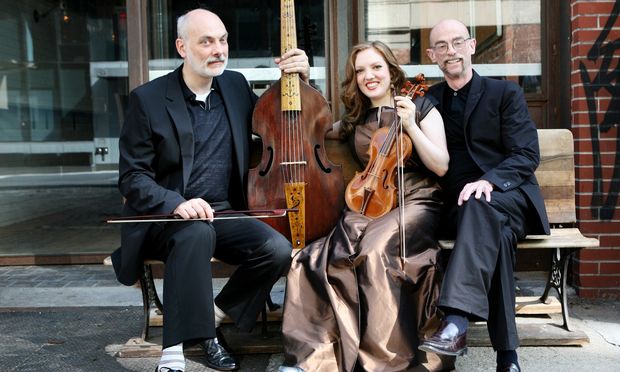
Trio Settecento
She records music in a variety of different genres and time periods. If you scroll through Spotify you can find recordings of the Bach Sonatas and Partitas, lesser known repertoire associated with American virtuoso Maude Powell, the Viola D'amore concertos of Vivaldi, violin concertos composed by African-American composers, the sonatas of Handel, etc. Not your typical fare.
Another recording of Rachel's that I love is this one of Deliver My Soul by David Baker. I studied with David Baker at the Jamey Aebersold Summer Jazz Workshop several summers ago and learned so much! He is the original jazz cellist, and long time faculty member at Indiana University. Sadly, Baker passed away last year. Not many people seem to know this work, but I think it is fantastic and I hope it makes its way onto more recital programs in the future.
I really love Rachel's investment in the obscure and lesser known. I admire a famous virtuoso who has the interest, diligence, and enthusiasm for the less-than-pop classical music. When she speaks about performing Baroque music, and using a Baroque bow it is with experience and full understanding. She is academic but not stale. It is exciting AND informed. It is so refreshing!
Back to that Viola D'Amore reference I threw in there....
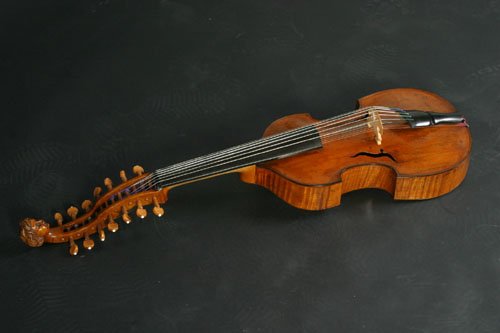
The viola d'amore is a 6 or 7 stringed instrument held under the chin and was popular in the Baroque era.
Rachel performed her encore on a Viola D'Amore and at rehearsal she invited us to come and try it. It was AWESOME! I want one now! (also, fangirl moment - she was so approachable and nice, it was really cool).

That smile is genuine JOY.
So after all that, yeah - this concert put a skip in my step. I am going to buy the Urtext of the Bach solo sonatas and partitas, I'm now eyeing a Baroque bow online, and want to play in a band again...any takers?
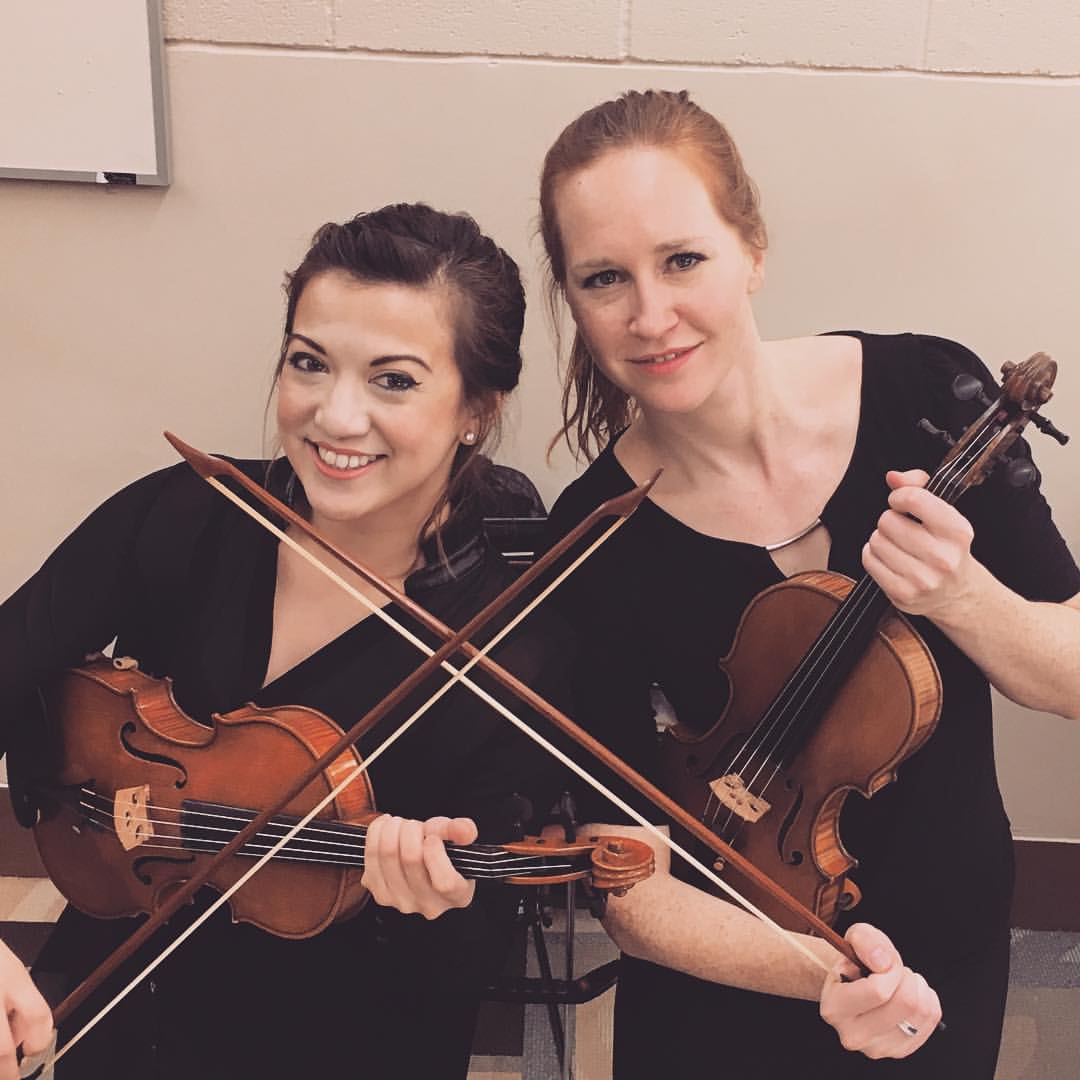
Two Baroque Girls
When I grow up I want to be Rachel Barton Pine. Did I mention she's also a redhead? (It must be a sign!)
I hope you enjoyed this post! Leave your comments below.

Mini-Series Part III: Rossitza Goza
Tzigane with the Tulsa Symphony featuring Concertmaster Rossitza Goza and Maestro Dan Hege.
The third installment comes in quick succession of part II. I am on a roll...and also falling behind!
This post features Rossitza Goza as the soloist performing Tzigane with the Tulsa Symphony and Maestro Dan Hege.
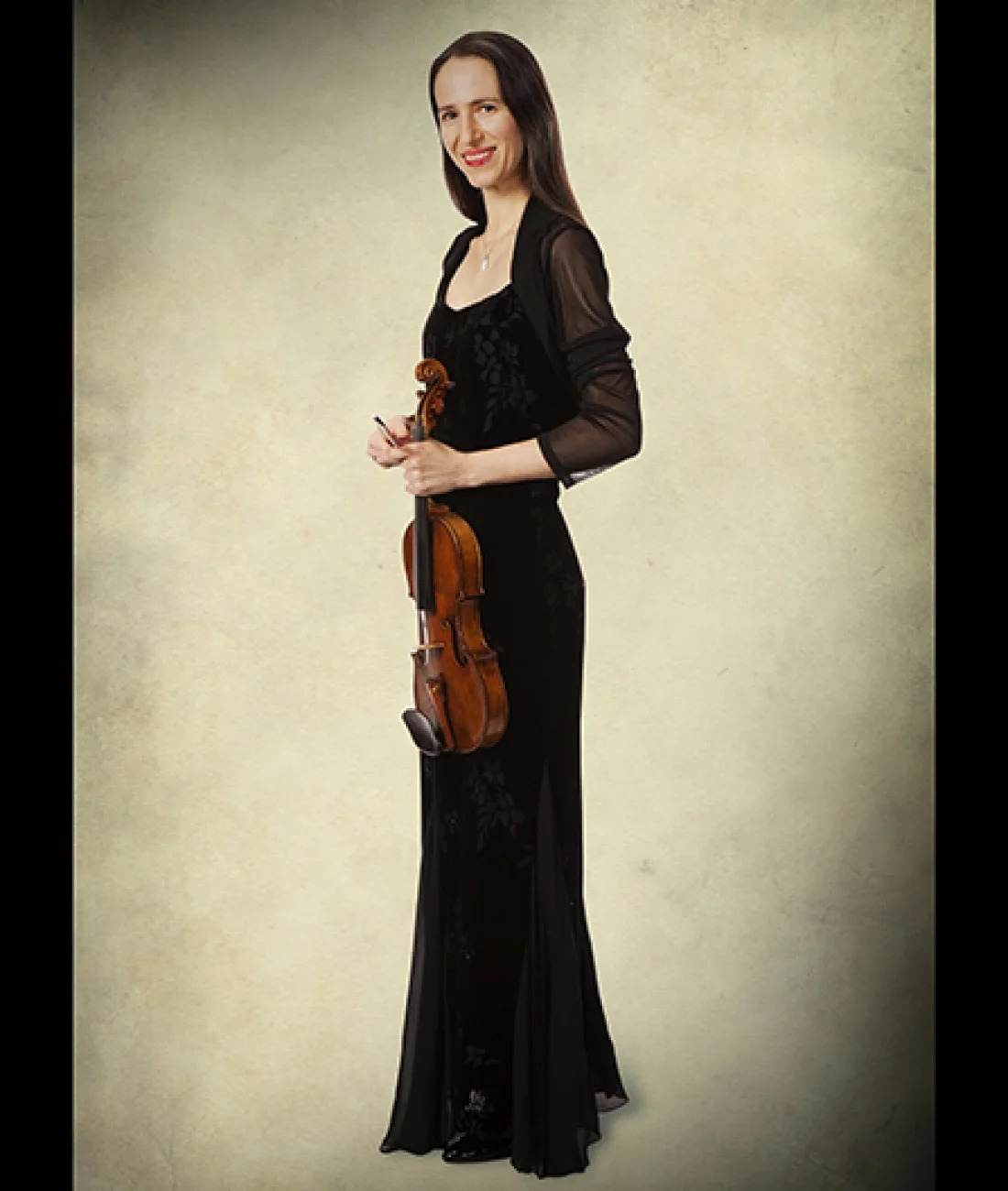
Fortunately for me, I've already published a blog post on this piece (phew!) to read it, click here. That saves me a TON of work and agonizing over what to say, recordings to use, etc. I really hope you check out my last post on this one - I'm serious! At one point in my life (not too long ago) I put a great deal of energy into learning this piece AND about this piece. That's the thing about getting your doctorate and preparing doctoral recitals - they really grill you on the repertoire!
Anyways, this program might be one of my favorites of the season.
The Hebrides Overture, Mendelssohn (#felixforever!)
Le Tombeau de Couperin, Ravel
Tzigane, Ravel
Symphony #4, Beethoven
I didn't know The Hebrides Overture before working on this program but I really love it now. If you're anything like me (aka a super fan of Mendelssohn) you'll like it too. It evokes mists and the rugged shorelines of Scotland. There is an expansive poetry in the melodies and textures that really makes my skin tingle and takes my breath away.
Le Tombeau de Couperin begins with a massive oboe solo and our principal oboist, Lise Glaser really knocked it out of the park! She can regale you with stories about playing this for different auditions and conductors that are all charming and rather absurd.
Tzigane (if you don't already know this) is one of my favorite violin pieces. I know for a fact that I am not the only violinist who thinks this. In September, while writing the post on Joshua Bell (you can read that here) I realized that Tzigane is on my first violin CD and coincidentally I still love all the violin repertoire on that album. Ahh the power of exposure as a youth!
For those of you out there who might not know, Rossitza is the Concertmaster of the Tulsa Symphony so this concert featured one of our own.
Here is an excerpt from Rossitza's bio....
Violinist Rossitza Jekova-Goza has made numerous appearances as concerto soloist and recitalist in the United States, Germany, Switzerland, Italy and her native Bulgaria. She has served as concertmaster of the Baton Rouge Symphony Orchestra and the Verbier Festival Orchestra in Switzerland, and has been featured as principal second violinist of the Royal Philharmonic Orchestra in London.
A winner of concerto competitions, she is also a co-winner of the 1999 MTNA national competition in chamber music. Prior to joining the Harrington String Quartet in 2010, she taught at the Universities of Arkansas, Oklahoma and North Texas, and for six years was on the faculty of the prestigious Encore School for Strings.
Her advanced degrees are from Louisiana State University (MM) and the Cleveland Institute of Music (DMA). Currently Dr. Goza is a Harrington Lecturer at West Texas A&M University, first violinist of the Harrington String Quartet and concertmaster of the Tulsa Symphony Orchestra.
Her dress was a statement. Bold and Red, it really suited the piece. And not to sound like somebody obsessed with what a performance looks like BUT I do think that clothing and other non-musical elements can set a tone for a performance.
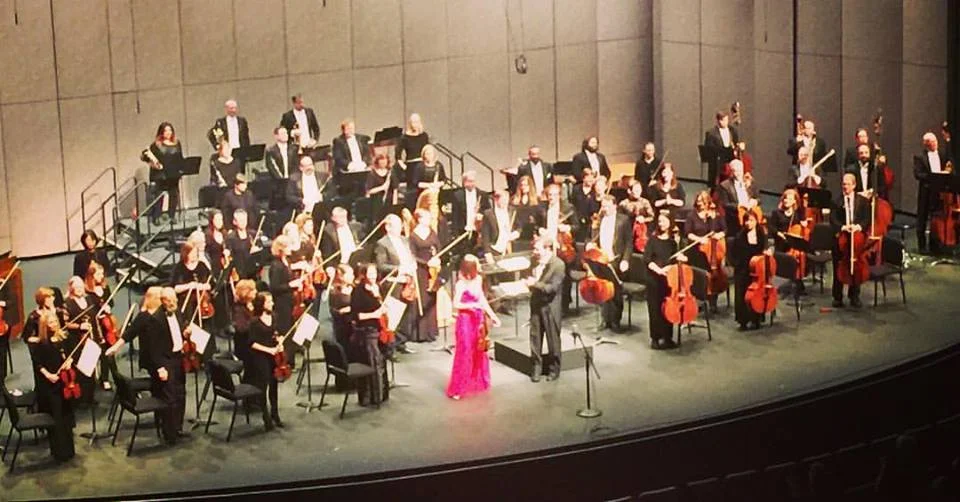
This photo does not do the dress justice. Photo credit to Angela Brenton-Carter, our bass clarinetist who snapped this picture from the balcony.
This piece is so fun to perform (as a member of the orchestra). You get to sit back, relax, and watch the soloist for a full five minutes without having to worry about counting rests. The silence that overtakes an audience at the very beginning is always astounding. A full concert hall sits rapt, listening to a solo violin. It is a very special mood that I really love, as if there is static electricity silently running through every seat in the hall. It happened when Joshua Bell played the cadenza of the Tchaikovsky last September (and there were even audible gasps from the audience).
Talking to our harpist Jill Weibe, I discovered that the harp solo in Tzigane is one of the HARDEST things ever written for the instrument. I was so impressed! She sat right next to me for this piece and I would never have guessed that she was nervous or that the part was difficult.
After her daring performance and standing ovation, Rossitza led the orchestra through the second half of the program. That is quite a workout for one evening! It was a great program and wonderful performances from all of the soloists of the Tulsa Symphony. A performance where your colleagues have an opportunity to shine is definitely a special thing.
Unfortunately I don't have a recording from this performance so you'll just have to make do with this pretty wonderful one of Maxim Vengerov and the Moscow City Symphony.
*As a side note I think that his pacing of the opening cadenza is fantastic. Often, violinists speed through the rests and don't let the phrasing really breathe. That is not the case here.
I hope you enjoyed this post!
Thank you for reading it!

Mini Series Part II: Hye-Jin Kim
The Mini Series (finally) continues! Read about my thoughts on Saint-Saen's Violin Concerto No. 3 with The Oklahoma City Philharmonic, Hye-Jin Kim and David Lockington.
I'm already behind on this project and will be typing up a storm in January so stay tuned for more violin performances.
Once upon a time, I wrote an announcement about a little blog series I planned to work on this season. The first installment occurred all the way back in September 2016 and featured the one and only Joshua Bell with the Tulsa Symphony and Dan Hege conducting.
Then, for several months, not a violin solo was heard, not even a mouse, as we played The Nutcracker (ad nausea) and countless other serious and not-so-serious concert programs in between.
Perhaps to keep me working on one of my resolutions (to write every day), there is now a slew of upcoming violin soloists on my calendar, and I'm a little worried I am going to fall behind!
Hello, 2017! Happy New Year!
My first concert of 2017 was with the Oklahoma City Philharmonic. I won a partial contract with them in late summer and the stars finally aligned for me to perform with them. Having regularly attended their concerts during grad school, I was eager to join them onstage and play alongside many of my university professors.
The OKC Philharmonic is in an interesting situation this season; their long-time Music Director is retiring at the end of the year and they are in the midst of a search for a new one. Each concert this season features a different candidate on the podium. This was the third new face and it was interesting to hear the orchestra members compare the strengths and weaknesses of each candidate thus far.
Bear with me here as I now try to weave my high school memories with the present blog post.
This week the conductor was David Lockington.
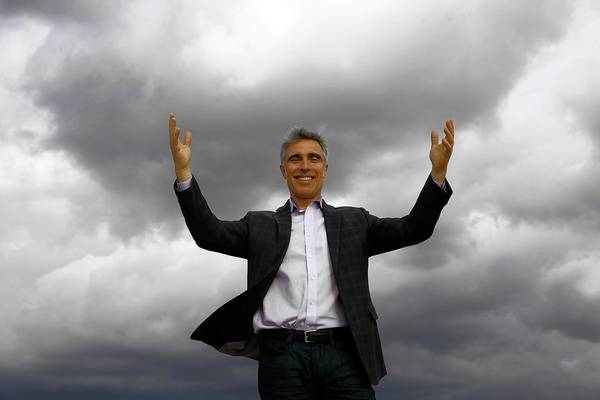
Several seasons ago, Lockington led the Tulsa Symphony in a great program including Beethoven Symphony No.7 and the Shostakovich Violin Concerto (a pretty stellar program) featuring his wife Dylana Jensen as the violin soloist. As I recall, she was fantastic. Dylana was one of those rare child prodigies that managed to make a recording with the famed Philidelphia Orchestra and Eugene Ormandy. For more on her, click here.
David Lockington took great care with the details in each piece. A cellist himself, it is clear that he is a musician who holds himself to a high standard and expects the same from the orchestra. To read more about him, click here. I LOVE his recording of Vivaldi's Four Seasons with Anne Akiko Meyers. So tight, so precise, and so musical.
Many moons ago, when I was a wee high schooler at Interlochen Arts Academy Dylana would visit occasionally and give masterclasses and visit her daughter (a creative writing major at the time). It is just so funny and charming when the music world works like that. I remember her being a fiery and passionate teacher and performer.
The best, most unexpected surprise of the week was a reunion with Steven Li! Steven and I went to high school together in Michigan. Steven was a senior when I was a freshman and he was the violin superstar. We hadn't seen each other in 15 or 16 years. It was a real treat to reconnect and share the stage again. He lives in Fort Worth now with his family and is a full time member of the Fort Worth Symphony (Associate Principal Second to be exact).

I think Steven is aging better than I am!
Anyways, back to 2017...
Hye-Jin Kim is an up-and-coming violin soloist who is just taking off on what will likely be an exciting career! Here is an excerpt from her bio:

Describing the artistry of violinist Hye-Jin Kim, winner of the Concert Artists Guild International Competition, The Strad lauded her “heart-stopping, unrivalled beauty” of sound and her “supremely musical playing, well-thought out, yet of the moment.” Ms. Kim’s sensitivity to the expressive and contextual components of the violin repertoire enables her to transport audiences beyond mere technical virtuosity, and this remarkable musical depth and passion brought her to international prominence when she was awarded First Prize at the Yehudi Menuhin International Competition at the age of nineteen.
Ms. Kim has performed as soloist with the Philadelphia Orchestra led by Christoph Eschenbach and the New Jersey Symphony with Gerard Schwarz, as well as with the BBC Concert Orchestra, Seoul Philharmonic Orchestra, Pan Asia Symphony (Hong Kong), and Hannover Chamber Orchestra. She has appeared in major venues including Weill Recital Hall at Carnegie Hall, the Kennedy Center Terrace Theater, Kimmel Center Verizon Hall, the Kravis Center, Salzburg’s Mirabel Schloss, St. John’s Smith Square, and Wigmore Hall in London. At the invitation of Korea’s Ministry of Foreign Affairs and Trade, she performed at the U.N. Headquarters in Geneva and New York. Ms. Kim has also served as a cultural representative for Korea in Switzerland, Australia, New Zealand, Kazakhstan, and Uzbekistan through concert and outreach engagements.
She performed Saint-Saens Violin Concerto No.3 in B minor with the Oklahoma City Philharmonic
Hye-Jin's performance was exciting! The audience gave her a standing ovation at the end. To read the review of the performance, click here. Honestly, I don't think I've heard someone perform this with an orchestra since high school when two of my violin studio mates won the annual concerto competition with it. Now, I want to dig out my old, coffee-stained part and relearn it. It is so virtuosic and violinistic with big flashy runs high up the E string (and G string), chords galore, and beautiful singing melodies. To hear some of Hye-Jin's playing click here for recordings available on the OKC Philharmonic website.
And not to be shallow or anything but....
Her performance dress is one of my all time favorites thus far IN MY LIFE. As soon as she walked out on stage, I admired it. The bright colors and bold modern cut were riveting. It was a confident dress that didn't didn't appear to sacrifice comfort for couture. I have since scoured the internet for a photo of it but no luck. It is driving me crazy! If anyone reading this happens to have a photo, please upload it in the comments section (I'm begging you).
Typically (and rather tragically) this piece is often taught as a pedagogical steppingstone and then abandoned in pursuit of some of the 'bigger' repertoire (think Sibelius, Brahms, Beethoven, etc.).
Digging around trying to find a recording of the complete concerto I found this one performed by Louis Kaufman. What A pleasant surprise! Kaufman was a very important figure in the violin world and is mostly famous for his performances of new music. This recording of the Saint-Saens is really charming - I hope you enjoy it!
Now that I'm an adult, and have studied violin repertoire for several years now I find this concerto to be sort of strange. I LOVE the beginning, it is so intense and fiery! The melodic material is gorgeous and lush but I feel unfulfilled after the first movement as if Saint-Saens hinted at a musical climax that was never fully realized. I think because of this, the concerto demands a through-listening. You get the sense that the pacing takes place on a larger arc than just one movement at a time.
Here's a little info about the piece....
The Violin Concerto No. 3 in B minor, Op. 61 was premiered in 1880 and was originally dedicated to the famous Spanish virtuoso Pablo de Sarasate. ~Can you hear the Spanish flair? Typically, when pieces are dedicated to a specific performer, especially one with such a specific musical identity, have trademarks and homages written in paying tribute to the performer. When you listen to this concerto now, can you hear the Spanish inflection? The insinuation of dances, melodies, and flair?
But where is the cadenza?
WHAT?! The cadenza, to any non-performers/musicians who might stumble upon this, is a soloist's big unaccompanied moment to shine. Often found at the end of a movement (but definitely not always), the cadenza is typically filled with all the flash and panache the composer/performer can muster. It is a soloist's bread and butter. It almost feels impolite to refuse a soloist their moment of hard-earned bravado but Saint-Saens did not care to leave space for one. An interesting choice and one that musicologists can probably explain much more articulately than I can.
The other pieces on the program were Copland's Buckaroo Holiday and Edward Elgar's Enigma Variations. I don't often listen to either of these pieces and forgot how much I love the Enigma Variations. Especially Nimrod, one of the most glorious, achingly beautiful pieces ever written in my opinion. Lush with emotion, it is as moving to play it as it is to hear it.
On that note, enjoy!