
Funny Fiddlers
Violinists often get a bad rap. We tend to be seen as snobby, elitist narcissists who just want to show off and be the best. And yes, to a degree that is true. But there are some funny ones that walk amongst us breathing some life and laughter into this field, and they deserve some praise and attention.
Sometimes we all need to be reminded that this is fun! We do it because we like it! We get so distracted by all of the work, the practice, the competition, and the high frequencies that it can be so easy to take life a little too seriously. I watch a few of these periodically to keep my spirits up and because laughter is the best medicine - right? A chuckle a day keeps the some-sort-of-specialist-psychologist-doctor at bay. When stakes get high - the impending doom of an audition, or a high pressure performance looms - take a few moments to smile and remember why you started playing violin to begin with. Just because you're the most serious doesn't mean you're the best. Remember to keep it light. All of these musicians are top notch! No joke! They most likely would be incredibly successful as 'boring, serious musicians' but have chosen to highlight their lighter side. What a relief!
This violin/piano duo were the original musical comedy couple for me. I was first introduced to their work during my undergrad while preparing for my junior recital. My friend showed them to me when I was really fretting about my preparation and these guys made me laugh until I cried. I would go to the library on my practice breaks and watch a video or 2 before returning to work, instantly in a better mood. They tour the world and perform with some of the biggest names in classical music. They garner praise for their playing, comedy, and ability to poke at classical music tropes that we are constantly trying to memorize in school. I would pay big bucks to see them live.
https://www.youtube.com/user/igudesmanandjoo/videos this is a collection of their videos.
Here are a few classics that I have always loved and enjoyed from way back when.
Ray Chen has earned the right to be a serious, snobby violinist - the winner of both the Queen Elizabeth AND Menuhin competitions is no easy task. Recently he has actually acted as a competition judge for the Queen Elizabeth meaning he is a highly regarded, truly respected musician. He tours constantly as a soloist and recitalist but always seems to make time for an amusing Instagram photo, Facebook post or (wherever the cool kids are posting them) video. I don't know how he does it but his quick wit is always in tact no matter what sort of crazy pressure he is under. He even makes fun of himself and gets other famous violinists - those who are perhaps not typically thought to be hilarious - in on the joke. The following are a few of my favorites. I also really enjoyed the short instagram videos he made with British violinist Daniel Hope.
He updates his Facebook with all of his extra funny (and not so funny) posts regularly so if you're looking for a chuckle check it out. https://www.facebook.com/raychenviolinist
These guys are hilarious! They don't appear to have a proper website and they don't post most of their videos to youtube but they are a pleasant addition to any Facebook feed. Everything from making fun of youth orchestra rehearsals and the secret fears (and fantasies) of all violinists to weird things teachers say in lessons, and epic concerto rap battles. They are not to be missed!
Salut Salon - seduced classically
These ladies pull off some crazy antics on their instruments. I first encountered their work about a year ago and was both impressed and amused. Inventive, silly, and actually really really difficult to pull off - especially in heels and a dress!
Shreds
This isn't so much a specific musician, or group, but rather a very talented producer (or producers) who overdub famous musicians with terrible versions of the music. Perlman Shreds is the one I know best. They actually make the music sound how you might imagine it sounding based only on what it looks like - facial expressions, quirky technique, posture, breathing etc.
Here's a great one of Pinchas Zukerman
And probably the most painful one of all - the performance at Barack Obama's inauguration.
and just so you know what it actually sounded like, here is the actual performance
A Brief Violin Family History
This is a story of the musical tradition I grew up in, the enduring professional role models in my life and a great example of just how small the music world really can be.
Once upon a time I was a little girl living in Seattle. One summer, when I was about 4 or 5 there was a block party held on out street and a young violinist played. It was awesome. I remember watching her and marveling at how cool it sounded. I was immediately enamored with the instrument. Legend has it (according to my mom, because I don't really remember what happened next) that I would not stop talking about playing the violin for months. I wanted to do it! I wanted to be that cool girl at the block party playing awesome music and impressing everyone! Wow - Ego much? So flash forward to the next summer when the same super cool violinist came back and played at our block party again. My mom finally caved and approached the girl's family about pursuing violin lessons.
For the next several years I took lessons in the Suzuki Method. My teacher was the best. I can't actually tell you what we did in lessons but I do remember laughing really hard, enjoying my lessons and teacher, and striving to do better. By the time I was 9 I was in book 6. La Folia by Corelli was my jam. I could play it, and often used it to show off at my new school because finally I felt like a violin star.
From ages 9-14 I lived in England. Culturally this was great. I did cool stuff my American friends couldn't do like visit castles on the weekend, drink tea at fancy tea shops, and play netball (a sport few people outside of Great Britain have even heard of) but it was not a hot time for my violin skills. I LOVED my first teacher and none of the teachers in England were stacking up well in her shadow. I was new to the British social norms that exist between teacher and student and was not excelling in that tradition. I was supposed to strive for greatness regardless of my interactions with my teacher and I found this rather boring. Another curve ball was the lack of Suzuki teachers - I was plunged into the traditional British system that emphasizes note reading, sight reading, and music theory and requires an examination in order to pass on to the next level. It was so different, and it was tough. I'm sure that these teachers were actually really great but to a pre teen with as much moxie as I had it wasn't necessarily a good fit. My fancy violin skills began to tarnish and fade but in my little heart of hearts I still wanted it.
My family moved to Michigan after that and I attended Interlochen Center for the Arts throughout High School. I rubbed shoulders with some very popular and successful artists, performers and musicians. Even now, I regularly see someone I went to high school with modeling in a magazine, acting in the hottest new movie or performing on the world's greatest stages. I loved boarding school and the rigorous environment. It truly was a creative and exciting place and has had a lasting impact on how I approach education, learning, practicing, expectations and goals. My teacher had a huge personality and was much easier for me to form a working relationship with then any of my teachers in England. It was certainly a step in the right direction.
Upon graduating from Interlochen I moved to Minneapolis to attend the University of Minnesota and study with Sally O'Reilly. She is still a major influence in my life. I turn to her advice when struggling with professional relationships, learning new repertoire, teaching my own students and most importantly when making big decisions (like buying a new instrument, applying for graduate school, and acquiring letters of recommendation). I still use the technique books we worked on together, and still put myself back in her bootcamp routines periodically. She motivated me to work hard and use my technique to express myself fully on the violin. Lessons were really productive yet pleasant. Don't get me wrong - she is very demanding and her expectations are high. I was definitely not a stranger to the practice room in those days. She did not try to change my individual nature, only to nurture it and organize it violinistically. She is funny - like hilariously funny. She even has a Facebook page devoted to her quotes called 'The Incredibly quotable Ms. O'Reilly' - check it out, there are some real gems on there.
Cool right? Here is a quick history of my life - who cares? Ready for the the plot twist? My very first violin teacher and her daughter, the awesome violinist at the block party both studied with Sally O'Reilly!!!!!
It was like the stars had aligned from the very beginning. My first teacher was Janai Fuller, and she is now the director of The Suzuki Institute of Seattle. You can read her brief bio here. Her daughter, the reason I wanted to play violin in the first place is Angie Fuller. The following is Angie's professional bio copied directly from the Dallas Symphony website:
Violinist Angela Fuller Heyde joined the Dallas Symphony Orchestra as principal second violin in September of 2009. Previously, she served as concertmaster of the Houston Symphony and as a first violinist of the Minnesota Orchestra, and has been a guest concertmaster with the orchestras of Atlanta, Bergen (NORWAY), Indianapolis and Seattle. Fuller Heyde made her Houston Symphony concerto debut in September of 2007 with critically acclaimed performances of the Bruch concerto. An avid chamber musician, she was a member of the celebrated Prospect Park Players in Minneapolis with conductor/pianist William Eddins and Milwaukee Symphony principal cellist, Joseph Johnson. She has collaborated with such artists as Janos Starker, William Preucil, Charles Castleman and Andrew Litton. A champion of new music, Fuller Heyde gave the Texas premiere of Hilary Tann's Here the Cliffs with the East Texas Symphony in Tyler, TX, and performed that work again with California's Monterey Symphony. Other solo appearances have included the concerti of Brahms and Sibelius with the Minnesota Orchestra. Fuller Heyde began violin studies at the age of three with her mother, Janai. Her teachers include Camilla Wicks, Sally O'Reilly and William Preucil at the Cleveland Institute of Music. She was the 2000 winner of the Irving M. Klein International String Competition held in San Francisco, as well as the winner of the 1998 Minnesota Orchestra's WAMSO competition. In addition to frequent appearances at the Minnesota Orchestra's Sommerfest, she has performed at the music festivals of Aspen, Grand Teton, Tanglewood, San Diego's Mainly Mozart Festival, the Chautauqua Institution and the Olympic Music Festival. A dedicated teacher, Fuller Heyde has served on the faculty of Rice University's Shepherd School of Music and has given master classes throughout the United States.
Do I have good taste or what!? Let me just spell this out one more time for you - the violinist who first inspired me to play is now a principal player in a major symphony, AND she is the winner of several international competitions. I know talent when I see it, even at the age of 4!
So now what? - Well, I correspond fairly regularly with Sally O'Reilly. I called her to discuss the final year of my Doctorate and my last degree recital program several months ago and she immediately suggested I go to Dallas to have lessons with Angie. Angie had performed Tzigane recently with the Dallas Symphony and regularly performs the other repertoire on my program. So off I went - Spring break became perhaps the most epic professional/personal reunion I have ever experienced. My entire violin life came full circle. To learn from the person who had first inspired me to play violin was freaky, and awesome. To share more than just one teacher from our past is wild and certainly makes me feel extremely honored and very privileged (it also makes me want to practice like crazy because, you know, these are some major players in the violin world and I really don't want to be the bad seed/black sheep/epic failure in this lineage).
And how was the lesson? Honestly? I'd have to say it was one of the best lessons I've had in years...There is a reason Angie is so successful! It was full of the great tips and tricks, sound advice, musical wisdom, and a few clues into how she maintains her awesome violin skills. Angie is a great communicator - funny, dynamic, clear, encouraging and demanding - just like someone else we both studied with. I definitely walked out of our lessons feeling like I had a ton of work to do but also that I had a plan it was not an impossible road ahead of me and I was excited to get to work. Just the way I like it.
I wish I had a photo of us from way back in the early 1990s in Seattle - maybe my mom has one hidden away somewhere? If I find one I'll make sure to update this post.
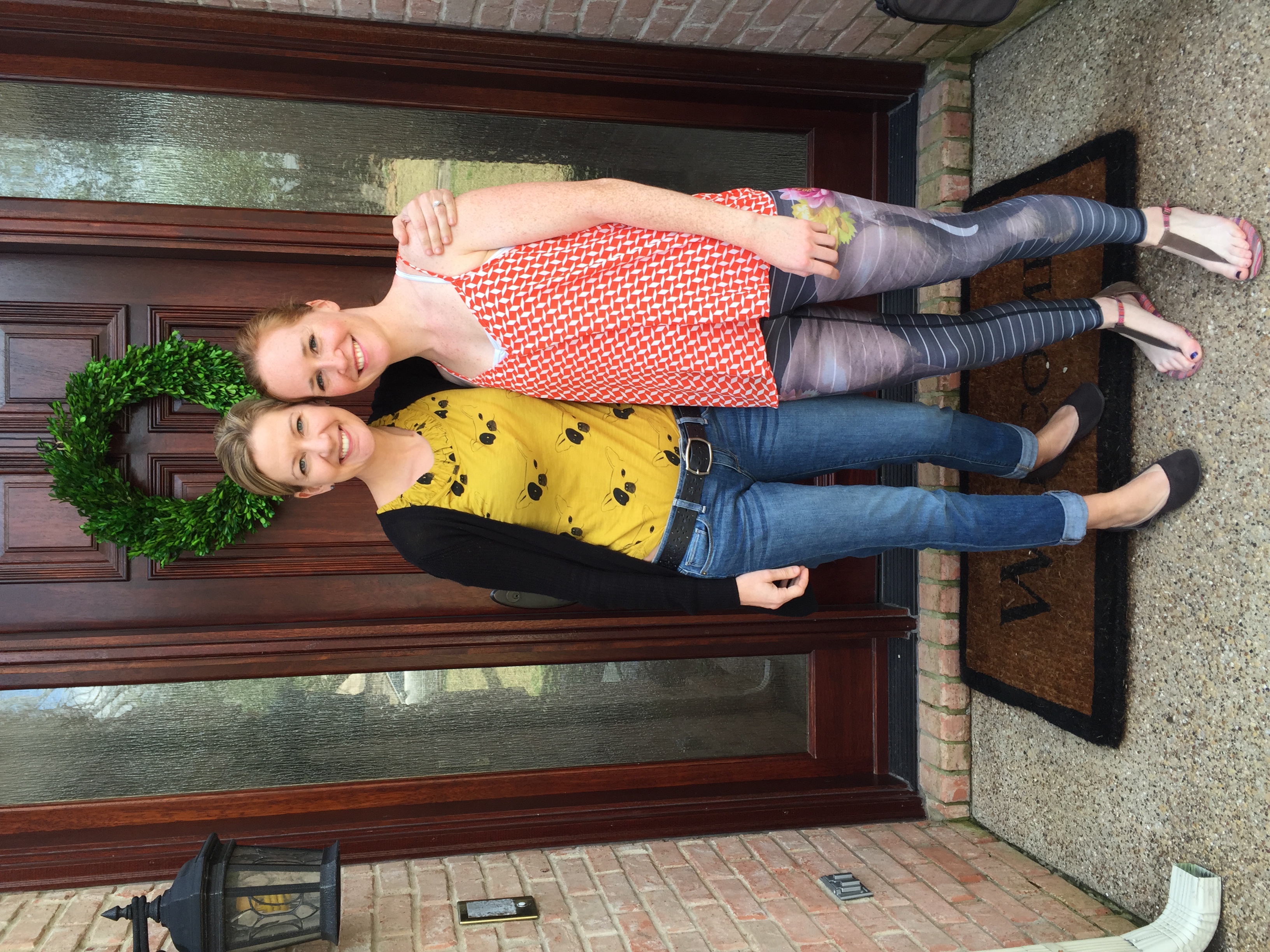
Me and Angie in Dallas, March 2015. After a great lesson - and I'm still smiling (and so is she!). Ignore the pants - my mom says they make me look like I have Gangrene. She doubts my yoga-chic fashion choices all of the time.
Prepping Like a Pro

Piles and piles of progress!
Over the past few months I was forced to step my performance and practice game up several notches. I gave my final doctoral recital in April, won an orchestra audition the week after, assumed a principal position in 2 orchestras and played some freaky hard 20th century music, all while maintaining my regular teaching and orchestra schedule. It was tough! The following tips are lessons I gleaned from others and truths I realized along the way. Many of them are tried and true and have been written about by many great pedagogues and performers. Some of them are little things I discovered on my own and a few may seem totally unrelated to the act of playing violin but are extremely important.
1. Use a metronome! - as if you've never heard that one before! Sometimes we forget the versatility capable of such a seemingly simple device. I use my metronome for lots of random things.
a. Slow practice. You think that's slow? Do it Slower! Fast movement of Bach got ya down? Work that sucker from the ground up. If I have a long passage of 16th notes for example - I put my metronome at 16th = 80 and I work it faster little by little. If you trip over a few notes go back and do them again AND THEN repeat the passage. This is the short cut. Practicing like this builds fantastic muscle memory. Nerves on Stage? Something about highly rhythmic, slow practice keeps your left hand working even when your mind might not be so calm.
b. Use it to test your memory. Here's another Slow practice tip I learned from Sally O'Reilly. Are you trying to memorize that Presto movement? Test your memorization skills by playing it with the metronome at 16th= 60-80 (or whatever the smallest subdivision of the beat is) without the music but with all of the correct bowings, dynamics and fingerings etc. Did your mind wander? Did you space out for a second? Did you come to a spot that is easy when played quickly and hard to organize when played slowly? BUSTED! Slow metronomic practice increases your mental endurance as well. I'm telling you - if you can't play it slow, you shouldn't play it fast.
c. Play it faster. This is especially appropriate for excerpts. Can you play it at the proper tempo? Good. Now do it faster. Did you find a place that falls apart? That is your weak spot. If you can't play it cleanly at multiple different speeds - both fast and slow - then you have some weak spots in your playing. Maybe your shifting gets a little sloppy and desperate when you crank up the speed. Maybe you find some weird accidental or unintentional accents caused by faster tempos. Welcome to the problem that needs to be addressed. And say hello to some technical exercises (see below).
d. Keep the subdivision. It is important to physically memorize the feeling of a consistent subdivision. If your little beats rush your big ones will too. Playing a passage 2 against 3? Triplets? Quintuplets? Guess you better figure those out EXACTLY before you start flippantly rushing through them. Play it 3 against 2, 2 against 3 etc. You get the idea. Figure out the precise placement of all those notes before you start making artistic decisions about slowing down and speeding up.
2. Drone! Pick a note, any note! Okay maybe not any note but something that will be consonant or perfect with at least 80% of the passage at hand. Play slow. No vibrato and align your intonation with the drone. Then pick another pitch and do the same - the root and 5th of a chord are a good starting place with this type of work. This tightens up your chords and passagework so your putting your fingers down in exact places and not just willy nilly in the heat of the moment. Speed it up once you are acing it and see if it sticks at a faster tempo. The last thing you should add is vibrato.
3. Record Yourself. Everyday and Every way. I was fortunate enough to work with a teacher who recorded every lesson I had. It made me cringe! But wow do you learn a ton from watching and listening to yourself. Sometimes you're so busy trying to pull off all of the fireworks on the page you can't hear everything that is actually coming out of the instrument. The only way to find the weak spots and improve is to hear them or have a teacher catch them for you. What happens when you don't have a teacher? You have to find these sections yourself - and this is the best way to do it.
I recorded little portions, larger sections, whole movements, rehearsals with pianists and lessons. I heard a whole bunch of stuff that made me want to quit the violin and never pick it up again. Yikes! It was tough listening to it all. But we do it in the name of progress and the quest for near perfection. Remember! YOU DO THIS TO IMPROVE NOT TO FEEL SORRY FOR YOURSELF!! Each day I would record numerous tracks then listen to them during my drives to work and gigs and teaching. Sometimes I was in tears, sometimes I was pleasantly surprised and always I had a distinct idea of what needed fixing or changing. Don't forget to listen for the musical elements as well as intonation and technique. You might stumble across a moment of your most natural musicality and it will be a pleasant surprise.
4. Sing. Sing for phrasing, sing for musicality, and sing for intonation. If you can sing it you can play it! If you have no idea what the next note should sound like how on earth are you going to find it on the violin? Don't cross your fingers and hope for the best, make a plan and stick to it. The first part of the plan includes what note comes next! Is there a big shift? Sing the note you're aiming for, once you figure that out you're halfway there. Sing against a drone. Its funny how your own tonal center, as in the one INSIDE you, needs to be just as precise as your intonation on the instrument. It helps you anticipate the correct pitches and plan more precisely.
If you're looking for some real fun sing and play at the same time. Working on Bach A minor fugue I realized its kind of fun, and at the very least interesting to sing one voice as you play 1 or 2 of the others. Its hard! And funny - and according to my dog sounds absolutely terrible but if you can play in tune with yourself those double stops and chords will be so in tune it hurts. I started working on all double stops like this. It keeps your inner ear in tip top shape which only serves to improve your left hand.
5. Breathe. Breathe, breathe, breathe, BREATHE. You must practice this. Breathing is calming. Breathing helps your brain function the best it can. If you hold your breath, you deprive your brain of oxygen and send your body into panic mode. This makes you rush, tighten up, forget things, miss shifts and function in a state of desperation. This undermines all of the work you calmly did in your practice room. Don't let a lack of breath get the best of you. Spend some time before the performance or audition or whatever calmly taking large, expansive breaths. Then continue this throughout the performance. Do you feel yourself clamming up? Or sense the tension from a tricky passage coming up? Replace that anxiety with a reminder to breathe. Even write it in your music if it helps. Keeping your breath calm and not shallow is essential for performing at your best.
6. Stretch. Amping up your practice schedule in anticipation of a big event can lead to tight and overworked muscles. I'm a huge fan of yoga. I practice on my own, attend class whenever I can and throw in a few poses mid rehearsal if I feel extra stiff. Almost immediately I can feel my body expand and relax, like a massive THANK YOU to my whole system. Even my brain feels better. I like to start and end my day with a little bit of yoga. At the minimum 20-30minutes in the morning and right before bed do a world of good. You can stretch however you'd like but yoga has always been the most effective for me. At times of my life when I feel really stressed I turn to slow, meditative and restorative yoga. Your body needs to open up and find length - not tighten up and muscle through a workout. I aim for that Yoga High at the end of practice. If I achieve that in yoga I know my violin practicing will go much more smoothly.
7. Drink Water. Sounds Silly, I know but staying hydrated helps you concentrate and also wards off feelings of exhaustion. The last thing you want to do is battle fatigue while you're working up a recital. I like to think that I'm flushing all of the stress out of my body with every gulp of water. Its amazing the effect of being properly hydrated has on your entire system and ability to work.
8. Practice the thoughts. Thoughts are things. I'm not kidding! If you think 'I can't do this' or 'this is the spot I always mess up' guess what happens? Practice the positive thoughts, the helpful ones, the ones that give you success. Like 'I am calm' or 'Breathe' or even the practical rational things like 'where is my contact point?' Make a mental plan - sometimes the distraction of having real and practical things to focus on gives you no room for all of the awkward freak out thoughts that like to creep into our heads in times of stress. THINK RATIONAL THOUGHTS.
9. Sleep. Your brain needs a chance to throw out the garbage and clean all of the cogs and wheels of the mind. If you never hit the off switch you never have a chance to recharge. Don't skip the zzzzzzs. Not only does it hit reset it also magically helps all of the things you've worked so hard to solidify stay in place. That metronome work you did yesterday? Still there. That shift that was really difficult last week? Still improving. I love sleep, it feels good to be well rested. Don't deprive yourself the luxury of several horizontal hours.
10. Technique. Don't skimp on your scales! Seriously! A little a day keeps you a lean, mean, playing machine. I highly regret not spending more of my practice time solidifying the basics prior to my recital. Gearing up for the audition I amped up the Sevcik and Flesch and man were my hands well behaved and my playing was pretty rock solid. Now I keep a little practice log so I don't repeat the same things too often. The following is a sampling of my current favorites. I take a taste from each everyday. On a good day I spend 1.5-2.5 hours on this stuff. It feels good to dive in. At the end of your practice session you feel instant improvement. The benefits of practicing technique are far reaching and you will feel the effects in repertoire almost immediately.
Flesch Scales - all on 1 string, 3 octaves, arpeggios, broken thirds, chromatic. A new key each week
Sevcik Bowing - Like meditation for the right hand. Slows me down so I appreciate every inch of my bow. Hones specific techniques that might be a little weak (aka up bow staccato)
Sevcik Shifting - I rotate through a few of these every week. My shifting was getting sloppy and now I feel much more finely tuned. I practice slow, without vibrato.
Sevcik Double Stops - Intonation. FEEL THE INTERVALS.
Galamian Scales and Arpeggios - I pick the same key as the Flesch and do these for the accelerations and alternative chord progression in the arpeggios.
Schradieck - A messy, poorly behaved left hand cannot play efficiently. This helps my concentration and my dexterity.
Etudes/Caprices - Right now I'm challenging myself to some Paganini. Its the toughest of the tough but I think I'm getting there.
I could keep going. But these are the points I find most helpful in prepping for anything. Anyone have some good ideas to add? Leave a comment!

proof of all the personal recordings I took as part of the preparation process.