
Finally Sharing My Quarantine Playlist
Finally getting around to sharing my quarantine playlist with the world. Too bad there is only one song on it. The Bach Chaconne in D minor is holding major space in my life so I just couldn’t help myself. I needed to share it with you. Welcome to my current obsession. Join me on this wild, baroque ride.
I keep seeing people sharing their playlists and I wanted to share mine too so I started thinking about what music I’ve been listening to lately. So I started thinking about what I’ve been listening to over the last few weeks and realized I’ve been listening to books and the Bach Chaconne…and that’s pretty much it. So I thought I would share a little bit about the piece like I did with the Tzigane several years ago when I was borderline obsessed with that piece. Plus, my mom told me she enjoyed listening to all the different versions and surely she can’t be the only one, right?
I referenced this piece in my Silver Linings Post a few weeks because I’ve finally mustered the courage to work on it but now it has turned into more of an obsession. I know that not everyone who reads my blog is a violinist so here is some history, theory, and a whole bunch of performances so you can see for yourself what is so great, and also so you can see how it can sound so different depending on who is playing it, but still so fantastic.
First of all, what is a Chaconne?
According to everyone’s favorite research tool, Wikipedia:
A chaconne is a type of musical composition popular in the baroque era when it was much used as a vehicle for variation on a repeated short harmonic progression, often involving a fairly short repetitive bass-line (ground bass) which offers a compositional outline for variation, decoration, figuration and melodic invention. In this it closely resembles the passacaglia.
The ground bass, if there is one, may typically descend stepwise from the tonic to the dominant pitch of the scale; the harmonies given to the upper parts may emphasize the circle of fifths or a derivative pattern thereof.
What about THIS Chaconne?
The encyclopaedia Britannica has this to say about Bach’s famous work:
The Chaconne forms the longest movement of the piece by far, making up roughly half of the entire partita. It draws upon the Baroque dance form known as a chaconne, in which a basic theme stated at the opening is then restated in several variations. In Bach’s Chaconne, the basic theme is four measures long, short and simple enough to allow for 64 variations. From a stern and commanding mood at the beginning, Bach gradually increases the complexity of his theme, mixing in various compositional effects. Some twists upon the theme are spacious and grand; others flow nimbly. Fast runs and large interval skips are frequent, requiring much dexterity from the performer. Bach also calls forth changes in emotional intensity, as some variations are dominated by long notes and others by many, more urgent short notes. Bach builds up his work over 256 measures, finally restating the theme at the end with new, even stronger harmonies.
A Little History:
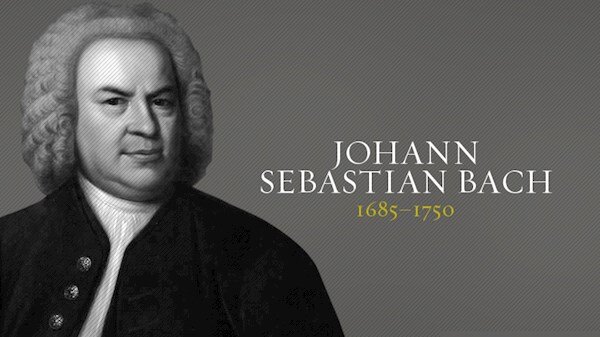
Bach composed the chaconne sometime between 1718 and 1720. Historians speculate that Bach composed it after returning from a trip to find his wife (and the mother of seven of his children) Maria Barbara dead and buried.

According to the obituary co-authored by Carl Philipp Emanuel and Bach student Johann Friedrich Agricola, Maria Barbara's death in 1720 was sudden and unexpected. Bach was at the Carlsbad spa accompanying his employer, Prince Leopold of Anhalt-Köthen, when she died. When Bach left Köthen, Maria Barbara was in perfectly good health; but when he returned two months later, he was shocked to learn that she had died and been buried on 7 July. The cause of her death is undocumented. Professor Helga Thoene proposed that Bach's famous Violin Partita No. 2 (especially the final "Chaconne" movement) was written as a tombeau for Maria Barbara, however these claims are controversial.
Professor Thoene’s line of thinking resonates with the modern listener. A few summers ago while I was studying with violin teacher extraordinaire Felicia Moye at summer camp, I was introduced to Professor Thoene’s theory. It shines such a poignant and moving light on the piece, that it was composed in response to the death of his wife. There is so much emotion contained in the music that it demands a story. Otherwise, it leaves us all wondering “why” and “how.”
In the excellent article titled, “The New Mythologies: Deep Bach, Saint Mahler, and the Death Chaconne,” author Michael Markham gives some context to our modern notions, and the evolution of those ideas. Here are a few excerpts that wonderfully sum up the concept:
Artists of the early 1700s did not wear their lives on their sleeves, and we do not invest the era with particular psychocultural significance. Their goal was not to expose the hidden and the personal but to replicate the empirical and the universal; their domain was not the unconscious but the observable world. Whatever “truth” might be recoverable about the original motivation behind the Chaconne will be rooted in that culture, not ours. To be a canonical work, however, means to outlive your birth era, and so the Chaconne has undergone a number of emotional transformations since Bach’s lifetime.
There is no evidence that Bach himself considered the Chaconne to encode an entire vista of the universe or to sound out his own emotional depths. Such Romantic notions would never have occurred to a court composer who had trained in the late 1600s as a Lutheran town organist. Creating art then and there was not an act of personal expression but one of civic or religious service. Of course emotions could be depicted and messages delivered. But musicians of Bach’s generation did not need to feel an emotion in order to depict it. It was the next generation, beginning with Bach’s own son Carl Philipp Emanuel, who began to demand that a musician express emotions in a way we would call “authentic”:
The aspirations, motivations, and meanings that have since accrued to Bach’s works, and in particular to the Chaconne, have been filtered through others — Brahms, Busoni, and Stokowski — and are not Bach’s but theirs and ours. But to say this is not to dismiss such meanings. I experience them, enjoy them, rely on them in my own listening. There is no crime in that, nor any mistake or shallowness. It is inevitable, normal, and necessary. That is consumption history. We select it because it pleases us. We change it so that it can continue to please us.
Speaking of Brahms… in a letter to Clara Schumann, he described the Chaconne like this:
“On one stave, for a small instrument, the man writes a whole world of the deepest thoughts and most powerful feelings. If I imagined that I could have created, even conceived the piece, I am quite certain that the excess of excitement and earth-shattering experience would have driven me out of my mind. If one doesn’t have the greatest violinist around, then it is well the most beautiful pleasure to simply listen to its sound in one’s mind.”
Back to Markham….
The Chaconne had become both broader (“a whole world”) and deeper (its “emotional tension” putting your very psyche at stake). Brahms wrote this while reworking Bach’s violin piece as a left-hand-only piano étude, a process that for him bordered on the mystical. In the century since Bach’s death, Kant, then Beethoven, had given us the Romantic sublime, and musical composers had become philosophers-in-notes. For the Romantics, a great piece of art was a psychological sucker punch, knocking loose some terrifying unconfronted truth. The technical grandeur of Bach’s Chaconne (and his newfound role as Großvater of German music) had given it Himalayan stature — immovable, ancient, a platform from which to survey the universe. Brahms was not the last to approach it this way.
In his article, Bach and Clinical Care: a proposition, Dr. John Edmund Spicer, a medical doctor, advocates for listening to the Bach, and specifically the Chaconne to be a better doctor.
“When we as clinicians listen to something as profound as the Chaconne, we are hearing the transmuted emotions of a great composer to which we respond emotionally and interpretively: we have two ways of responding. And that is just the same sort of task we face when listening to the stories of our patients, particularly the complex patients. I suggest the two areas of activity help each other.”
Some performance perspective:
In his book Violin Dreams, legendary violinist Arnold Steinhardt talks at length about the Chaconne, and his lifelong relationship with the piece. Below is an excerpt which I think beautifully sums up the violinists personal relationship with a piece that has taken on mythic proportions.
As far as I could see, my first task was to figure out how best to combine these ever-changing variations cohesively. I had not forgotten Isaac Stern's advice in violin camp years ago: think of the Chaconne's variations as occurring in groups, so that the evolution of thought and feeling unfolds convincingly. At the outset my course seemed relatively clear, since the early variations all came as matched pairs in which the second of each could be treated as a simple response to the first. But every now and again a lone variation would appear, begging me to direct it somewhere. These orphans vexed me. Did each belong with the next or the previous pair, or did they stand alone to freshen the palate between courses? The basso ostinato also perplexed me. This recurring bass line was supposed to do just that — to repeat endlessly without significant alteration and to serve as the work's distinctive theme. Yet Bach refused to stick consistently to the bass template he fashioned for the beginning and chose rather to draw from several quite distinctive and different ones.
Another characteristic trait of a chaconne is a regularly repeating harmonic structure. Here again I could easily recognize not one but three or four different patterns. It was as if Bach had begun a card game with hard-and-fast rules that he then changed at whim again and again during play. Even the most easily identifiable element of a chaconne, a dance-related emphasis on the second of the bar's three beats, appeared only sporadically. If I were to dance the Chaconne, where and how would I place my feet when the stress was not on the second beat?
I decided to put past considerations aside for the moment and try to look at the bigger picture. The Chaconne was divided into three large sections. The dark and brooding outer sections flanked a hymnlike inner one that evoked peace, gratitude, and optimism. Was it far-fetched to think that Bach, a devout Christian, might have offered the Chaconne as an expression of the Holy Trinity, its bedrock spiritual principle? The first section, in D minor, would represent the Father; the next, in D major, the Son; and the final section, in D minor, the Holy Spirit. This line of thought intrigued me, even though I was on shaky footing as a secular Jew with only the flimsiest knowledge of Christianity. The more I looked, however, the more "threes" I found. The Chaconne's basic building block was a three-beat bar, the initial theme appeared three times — at the beginning, the middle, and the end — and then there were those evocative three-note groups that appeared over and over again. Was the Chaconne some kind of message in a bottle destined for (dare I think it?) God?
Excerpted from Violin Dreams, by Arnold Steinhardt (Houghton Mifflin, October 11, 2006).
So, do you want to hear it now? This first video was created by 14 violinists during lockdown and it was kind of the impetus for writing this post. The rest of these are performances I think are incredible and/or are historically of note. I do have a favorite, but I’m not going to tell you which one it is. Can you guess?
(Interesting to note that Midori’s video was filmed where Bach wrote the Chaconne - how cool is that?
Sources:
https://en.wikipedia.org/wiki/Partita_for_Violin_No._2_(Bach)
https://en.wikipedia.org/wiki/Maria_Barbara_Bach
https://www.britannica.com/topic/Chaconne-by-Bach
https://onbeing.org/blog/the-story-behind-bachs-monumental-chaconne/

The Violin Music of East Germany Part II: Kurt Schwaen
Spotlight on the life and music of Kurt Schwaen, a composer who lived and worked in East Germany and wrote many pieces for violin, and string chamber ensemble. This is the second installment in my Violin Music of East Germany series. I am writing about the people and music I uncover as I pursue this research and performance endeavor. Enjoy!
This post is the 2nd installment of my GDR music project research. Over the past few months, during this era of social distancing, I have done quite a bit of research and score collection for this project. I have found many names and scores, many rabbit holes to jump down and treasure to hunt. As always, with research, you uncover more questions than you do answers, but that's just part of the game. I haven't come out completely empty-handed, though. Thankfully, some scores are not impossible to find, and I will be highlighting some of those people and their work here.
In my preliminary research about the composers and pieces written in East Germany, Kurt Schwaen's name is one of the most readily available. Before starting this project, I didn't know the name at all, and I'm guessing several of you are equally as unaware (but bravo if his name is already in your library). There is a website devoted to Schwaen's musical career that is updated and curated by Dr. Ina Iske-Schwaen, but this is certainly not the case for most East German composers. It has added to the ease and simplicity of finding and collecting some of his scores.
To clarify: I'm most interested in finding violin music written between 1949-1989, including solo works, concerti, sonatas, and works for small chamber ensembles (quartets, piano trios, duos, etc.). Many composers wrote works before and after this period, and I will probably end up collecting many of these scores too. Below, you will find a list of compositions found on various sources online. I have noted which ones I have successfully obtained at the time of writing this.
The following is a little bit about Kurt Schwaen and his music.
b. June 21, 1909, in Katowice, Poland (under Nazi occupation during WWII)
d. October 9, 2007, Berlin, Germany
From 1929 to 1933, Schwaen studied musicology, art history, philosophy, and German at the universities in Breslau, Poland, and Berlin, Germany.
In 1930 he met Hanns Eisler (more on him later) who greatly influenced his compositional style. After becoming active in an anti-fascist student group, he joined the Communist Party of Germany, and from 1935 to 1938, and he spent time in prison because of his political views. After his release, Schwaen found enduring inspiration from his work as a pianist with renowned dance soloists in a studio for expressive dance in Berlin.
After the war, he returned to Berlin. He spent much of his time working to rebuild the musical culture of that city by writing compositions for amateur music groups, choirs, music schools, and chamber ensembles. After the end of World War II, which Schwaen survived in the Penal Division 999, he found ample work in the rebuilding of the public music schools and as musical advisor to the German Volksbühne Theatre.
Between 1953 and 1956, he worked with Bertolt Brecht, who had a profound impact on his future compositions. He worked with Brecht from 1953-1956. In 1961 he became a member of the DDR Akademie der Künste, where he was head of the music department from 1965 to 1970. From 1962 to 1978, he was president of the East German National Folk Music committee. Between 1973 and 1981, he directed the children's musical theatre in Leipzig.
Schwaen has held numerous honorary positions, including being named an official member of the Association of Composers and Musicologists, the Academy of Arts in 1961. In 1983 he was awarded an honorary doctorate from Leipzig University and received several other state awards. His compositional output, which spans seven and a half decades, contains more than 600 works in every genre, from song and chanson to choral music, piano works, chamber music, and orchestral works, and includes opera and works for the ballet.
Schwaen later settled in Berlin-Mahlsdorf, where he died at the age of 98. His widow, Dr. Ina Iske-Schwaen, maintains an archive dedicated to his works in his Mahlsdorf home.
There are a couple of great quotes from Schwaen on his website that I enjoy:
Everything easy is unusual.
Everything easy is unusually difficult.
I am for shortness.
But shortness because you choose no length, not because you are not able to.
Compositions applicable to my project:
· Piano Trio No. 3 for violin, violoncello, and piano (1982)
· Suite Classique (Classical Suite) for violin and piano (1980) ACQUIRED
· Piano Trio No. 4 for violin, violoncello, and piano (1983)
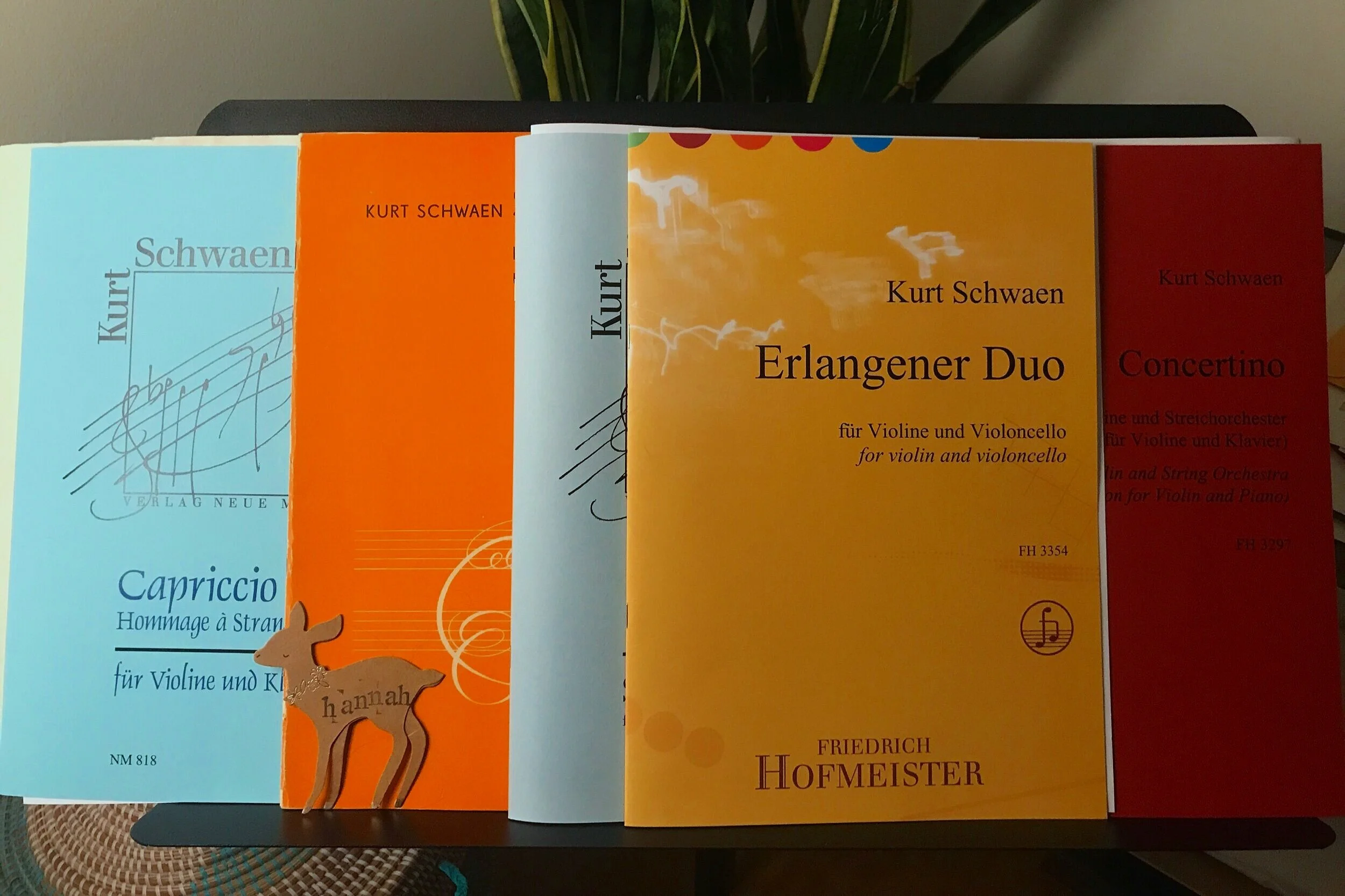
· Capriccio. Hommage à Strawinsky for violin and piano (1986) ACQUIRED
· Sequences in Es-flat. Four movements for violin and piano (1996)
· Piano Trio No. 5 – »en miniature« for violin, violoncello, and piano (1987)
· Serenade for Solo Violin and 3 Solo or Tutti Violins (1998)
· Violin Concerto KSV 433 (1979)
Pieces Not listed online, but (somehow) acquired:
· Concertino for Violin and String Orchestra (1971) ACQUIRED
· Sonatine for Violin and Piano (1951) ACQUIRED
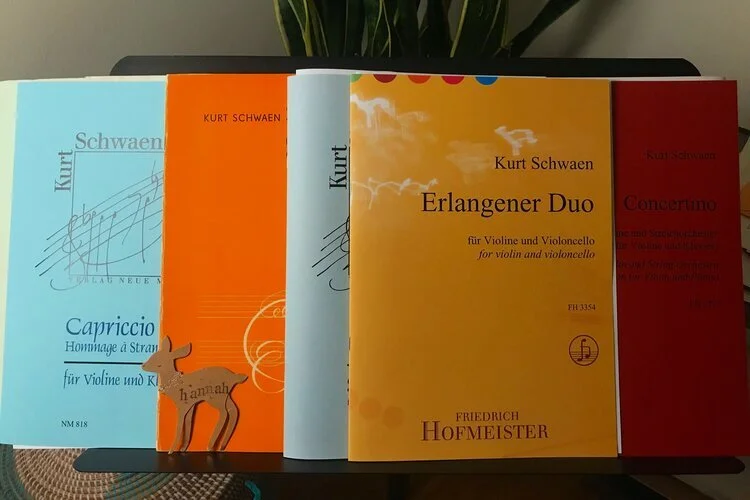
· Erlangener Duo for Violin and Cello ACQUIRED
A little about some of the music listed above:
In the Suite Classique (Classical Suite) for violin and piano, Schwaen consciously employs traditional form to organize this piece. Of course, he uses this model for his unique purposes in the formation of different movement characters. The outer movements are determined and virtuosic, whereas the inner ring, which frames the unrestrained third movement, are more »cantabile«. Whether calm or active, tense or relaxed, powerful or floating and light, complicated or simple – Schwaen writes with a compelling musicality.
These traits also apply in the case of the Capriccio for violin and piano. Written for the same instrumental combination, Schwaen here channels his intention toward the presentation of a particular genre, an »Hommage à Stravinsky«. The role model function of this master is well-known. Schwaen even spoke of influence. This work is built on formula-like circular, short repetitive motions. It presents itself dancingly light, even playful. A melodic, at times improvisatory sounding middle section allows the »capriccioso« to come to the fore, especially clearly.
Surprisingly, considering how easy – relatively speaking – his violin music was to obtain, there are very few recordings of his music available online. I checked Youtube, Vimeo, Spotify (there is only one album of simple pieces with German introductions), Amazon Music, Apple Music, and Soundcloud. One recording that I did find and enjoy is this recording on youtube of his Concerto Grosso for String Quartet and chamber orchestra.