
Audition Necessities
Items I need to feel successful at auditions.
Hello Hello! Now that I'm in winter quasi-hibernation, or maybe I'm coming out of audition prep hibernation? I have blog posts for days to churn out!
The last few weeks have been intense! Performances every weekend, rehearsals almost every night, auditions to prepare for, proposal edits to consider, research to do, not to mention all the normal stuff that has to happen (my dog won't walk herself!)
I did 2 auditions in 10 days and lived to tell the tale. More than that actually, I won. With every audition I do, I am gradually refining my preparation process and game day routine. You can prepare like a champion, practice hours every day, and then right before your time slot those silly nerves kick in and turn you into a useless heap of jittery limbs, clumsy fingers, and sweaty palms. Not Fair!
There are professionals out there who really have some insight into the preparation process (hint hint Nathan Cole), and those people have won way bigger, more prestigious auditions than I have. They can tell you things like what fingering to use, what bowing works best, how to practice that one specific passage for the best results. I don't think I can do that yet. What I do think I have finally figured out is my audition day routine and necessities.
Many moons ago, when I was a high school student at Brevard, there was a lecture on successful orchestra audition taking. One of the speakers (whose name, of course, I can't remember) was a percussionist, and he was cool. Like way cool. Like, ride his longboard around summer camp cool. At the time he was the principal percussionist of the Pittsburgh Symphony. He made a point of emphasizing that this is a race. You train for this with the same dedication you would for the Olympics. You do everything it takes to win. You arrive at the venue prepared to be there for a full day BECAUSE YOU HAVE PREPARED TO WIN...and winning, where auditions are concerned, can take all day or even a few days.
I don't claim to have it all figured out but here are a few things that I bring with me.

1. Bring your own copies of the excerpts and solo.
Kind of a no brainer - you want your fingerings, markings, and personal reminders. Typically, the orchestra will supply copies, but they will look completely different than what you've been staring at for months now. Just bring them. Even if you're concerto is memorized (which it should be if you're really prepared) bring a copy.
2. Notes and Reminders
I was so nervous at a recent audition that I had to remind myself to smile. Silly Right? Smiling relieves stress (so they say). If you're like me and can't stop talking when you're nervous try to joke a little with whoever is fetching you and transporting you to the 'chamber of doom' it will relieve just a little of that anxiety and dread. I try to induce some backstage yawning to keep my jaw relaxed and my brain oxygenated.
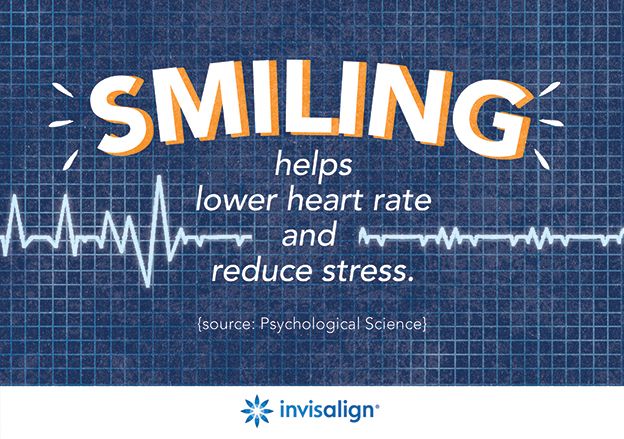
The notes I write (like those seen above) are general and broad. All of my specific notes are contained within the relevant excerpt. This is just the stuff I need to remember to set the right tone for the entire audition.
3. Snacks
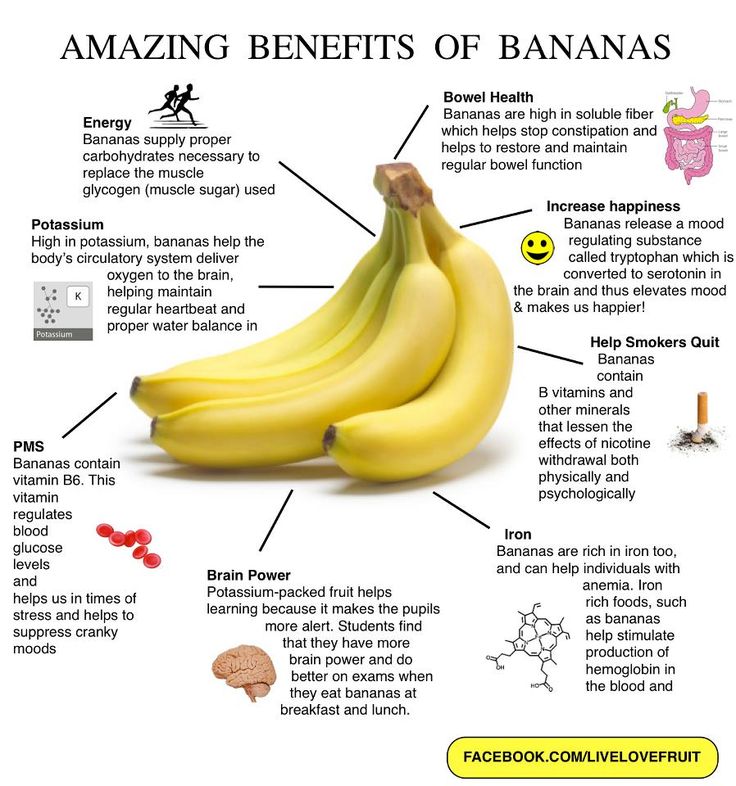
Not just any old snack - something healthy. I pack bananas and peanut butter and jelly sandwiches. I know everyone claims that the potassium in bananas relieves nerves and that is a good reason to eat them, but I take my queue from runners and eat bananas for the type of energy they release. Throw in some protein from the peanut butter, mixed with some whole grain bread, and you're fueling a machine that can stay in the game for miles and miles, or hours and hours.
4. Pastilles/Lozenges
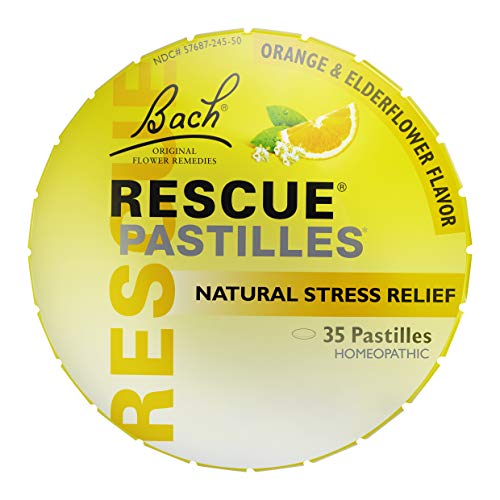
This might just be all in my head, but these rescue pastilles claim to relieve stress and honestly I need as much of that as I can get! Plus they're a yummy treat backstage.
5. Metronome/Tuner
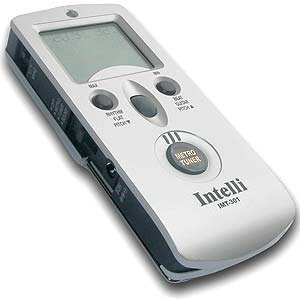
Nerves got your heart racing? You probably don't even realize how much faster you're speeding through those excerpts as a warm up. The last thing you want to do is lose control or panic because you feel out of control RIGHT before your audition. I keep a metronome handy to make sure I'm locked into my ideal tempo at all times.
You want to be so in tune it hurts when you hit the audition room. I am constantly tuning before an audition. I recommend getting your hands on a metronome/tuner that does both. The one pictured gives drones, frequencies, beats, and subdivisions. I don't think I would be able to perform some of the excerpts at a high level if it weren't for all of these functions.
6. A Book
Sometimes audition days involve more waiting than playing. I tend to get antsy if I'm left idle for too long. I don't want to overplay so I bring a book with me. In between rounds (if I make it that far) I trade off between reading and playing to keep myself warmed up but also sane.
7. Headphones
This is for listening (duh). I spend much time leading up to auditions listening to the repertoire. It becomes my running playlist, my driving playlist, my blog writing playlist, you name it. It is really helpful to have access to the music backstage as well. I also use music to get myself pumped up to perform and compete - Michael Phelps and I have so much in common - so it is not uncommon to find me listening to Rihanna, Beyoncé, or some other non-classical #bosslady before I perform. Anything to get you in that winning zone.
8. Water
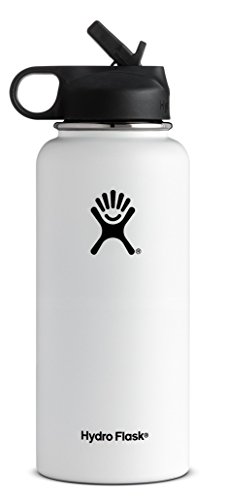
Lots and Lots of H2O!!!! Flush those nerves away! I don't know about you, but I get a dry mouth when I'm nervous. I often feel parched before a performance and filled with the intense desire to guzzle fluids. So to save myself the anxiety of running back and forth to a water fountain I just bring a huge container of my own and refill it as needed.
9. Other Repertoire
Let's face it, if you don't have a solid grip on the excerpts and your concerto by audition day you're probably not prepared. I tend to work myself into a bit of a lather if I keep playing the audition repertoire over and over again backstage. I get really hung up on little mistakes, and it tends to hurt me in the audition. To stay warmed up and prepared, I pack some music that no orchestra committee cares about hearing. I am a devout Flesch practicer. He's my man. Rarely a day goes by that my dog does not wince at my Flesch scales, arpeggios, 3rds, 6ths, octaves, 10ths, broken 3rds, and chromatic scales. When I first get to the audition, this is typically the first thing I pull out and start playing.
As a pedagogical exercise, I have been playing through 'student' etudes lately, and some of them are so beautiful! I have two books of Mazas Etudes, and I think they are all wonderful. He writes lovely melodies and the technical demands are not Paganini level impossible making for a nice mental break from Schumann Scherzo, Don Juan, Midsummer Night's Dream, etc. This music keeps me warmed up and fresh without the anxiety and mind games of excerpts. Keep it Calm. That's the name of my backstage game
10. Ibuprofen/Aspirin/Advil/Excedrin
A pain reliever is so helpful to have on hand! You might not need it, but who knows, better to be prepared! I don't drink coffee on audition days because it makes me too jittery. Unfortunately, that means sometimes I get a withdrawal headache (ugh! Addiction is no joke!) or maybe it is tension related. Or maybe your period started that morning, and you're battling serious cramps on top of audition day jitters (yeah, that definitely happened, and it was NOT fun). Either way - having something on hand to relieve that discomfort is tremendously helpful.
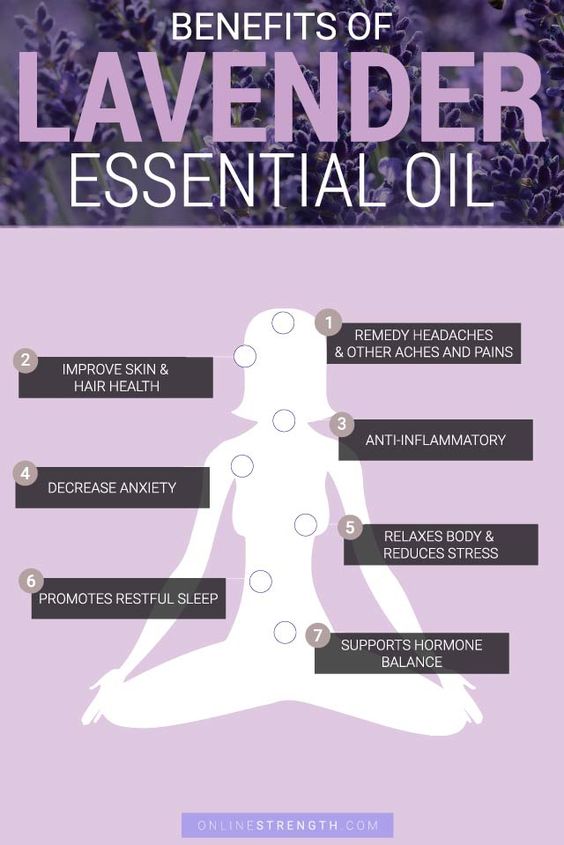
11. Lavender
My how New Age, Right? Lavender is proven to have a calming effect. Why do you think there's all that Lavender scented bubble bath out there? I do carry this little bottle with me. I used to put a dab on my wrists, but now I just take a nice, long sniff periodically.
NOT PICTURED
There are a few things always included in my day that are not pictured above. The following are the other things I do prior to an audition to make sure it goes as smoothly as possible.
Airplane Mode is for more than just the Sky

Stay off of social media! Who cares what inflammatory comment or article somebody just posted on Facebook 3 minutes ago?! Is there any photo on Instagram that you NEED to see right now? NOPE! Who needs that kind of distraction!? Just to be safe, I put my phone on airplane mode. Several years ago I was backstage at a concerto competition and looked at my phone to see what time it was. My screen lit up with a text message from an unexpected number that totally threw me off. My head was not in the game, and I finished 3rd. This was really frustrating! I was distracted when I couldn't afford to be distracted and when there's a job or money on the line you don't have the luxury of distraction like that.
I do think it is important to have a support team, so I will send update texts or make a phone call to a loved one if I need a little love or played poorly and need to blow off a little steam before the (potential) next round.
A good breakfast
I am blessed with a magnificent person in my life who has gone to school for nutrition. She is pretty much on speed dial in situations like this (or all the time...Hi Madeline) to consult with regarding fueling events such as this. Madeline is a classically trained musician, and she is acutely aware of the stress of auditions and performing. Who do you think introduced me to Natural Calm all those years ago???
I'm pretty good about eating well, but I have not had hours of schooling on the subject. To cover my bases, I check in with Mad Dog to make sure I'm not going to regret my breakfast choices later on in the day (don't mind the autocorrect here - iphones still can't exactly read our minds yet).

Breathing Exercises
You know that thing where you get all panicky and feel out of control? These yoga people figured that one out a while ago and I have to say it is an awesome inclusion to audition days. I don't sit on a Turkish Rug and meditate for hours the morning of but I do close my eyes and do the following breathing exercise before hitting the stage. Yes, the proctor will look at you with concern like 'OMG what is going on!? Has this candidate lost their mind? Do I need to call a Doctor? Or maybe a psych ward?' But when you win it will all be worth it.
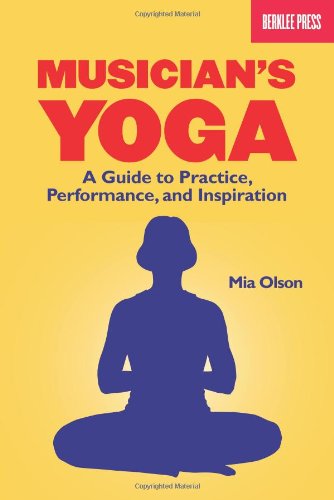
A great resource regarding the inclusion of yoga in your preparation is Musician's Yoga by Mia Olson. As a yoga teacher, performer, and educator she has done a wonderful job of applying yoga to the unique environment of performers.
Comfortable Shoes and clothes
This is probably not the best time to try out those cute new heels or that pantsuit. Stick with the tried and true. You don't want to suddenly discover you can't lift your bow arm fast enough minutes before your audition time.
Wonder Woman Pose
According to Amy Cuddy, your behavior and emotions are firmly tied. The most powerful leaders don't merely think a certain way, they carry themselves a certain way. You should do the same.
Or fake it til you make it? (At least in the bathroom mirror right before the audition).

Best of Luck to anyone taking an audition soon! I hope this is helpful!
What do you do to prepare for auditions? Any suggestions or recommendations?
Leave a comment below!
Self Care
Self-Care!
Here's mine - What's yours?
Share your secrets, habits, tips, and tricks for staying at the top of your game.
What do you need to feel like you can handle anything?
Recently, there has been an article about self-care circulating around Facebook via several ladies I know. The tag, if you look closely is Self Care: How to Take Care of Yourself When You Have Depression. I am not a person who suffers from depression unless you count a few relatively short bouts of sadness, but this article really got me thinking about how one does and should take care of one's self.
What does Self-Care Even Mean?
Social media leads me to believe that self care is motivational quotes served over a Sex And The City style boozy brunch, blowing off impending deadlines in favor of some fabulous time with my ladies and/or a credit card, eating decadent meals and treats, buying expensive things, wearing incredible 'impromptu' outfits and taking beautiful Instagram photos (And yes, it is true that there is something totally cathartic about these things). OR a hike in the woods, with a spur of the moment pretzel-twist yoga pose with perfect lighting and a "You are Enough" tagline. Don't get me wrong - that's the kind of Self-Care I yearn for but is not necessarily practical in the day to day marathon of my Life.

The Atlantic wrote a really lovely piece on Self-Care, and how it fits with the rest of the internet (click here to read it)
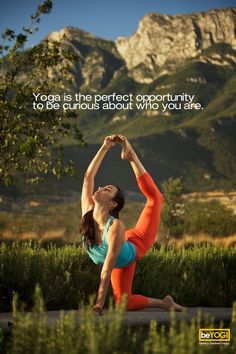
According to dictionary.com Self-Care is
noun 1. care of the self without medical or other professional consultation.
goodtherapy.org says
The term self-care describes the actions that an individual might take in order to reach optimal physical and mental health. Mental health professionals often use the term self-care to refer to one's ability to take care of the activities of daily living, or ADLs, such as feeding oneself, showering, brushing one's teeth, wearing clean clothes, and attending to medical concerns. Physical self-care, such as sleep and exercise, is also an ADL.
Self-care can also refer to activities that an individual engages in to relax or attain emotional well-being, such as meditating, journaling, or visiting a counselor. Because an extended failure to care for one’s self can result in illness or hospitalization, individuals who find themselves unable to take care of their own needs may find it helpful to speak to a therapist.
In fact, I think Self-care is really what you need it to be. It can be anything from wearing clean clothes and feeding yourself to indulging in recreational activities. The University of Kentucky has a nice little hand out on the subject that covers the generals quite nicely (click here) I don't necessarily think this solves any of the things that need self care solving.
Anyways, my brain started churning and I started evaluating my habits and habit goals to figure out where I hide some self-care and what it looks like.
I broke my self-care goals and habits into daily practices and long term habits to see what I do to LITERALLY take care of myself. Some of these things are really unfun and were covered in the aforementioned articles (e.g. paying bills, eating food, wearing clean clothes, brushing teeth etc.) and some are the "does that really count as self-care?" kind of way.
Behold! A list of what I do (and try to do) in order to maintain some sort of control over life on the musical run.
DAILY
Read a Book
Every night. Before Bed. Fiction if possible. Obviously not a whole book all at once. A couple pages will do. This will make you a more empathetic person. I'm not lying! The research is in and you can read it here
If you need a musical reason - look what the Kronos Quartet tweeted a few days ago... (click here to read the full Washington Post article)

This is scary guys! Don't let books die! Research says we need them! They make us human, they help us communicate! We need that, dare I say more than ever these days.
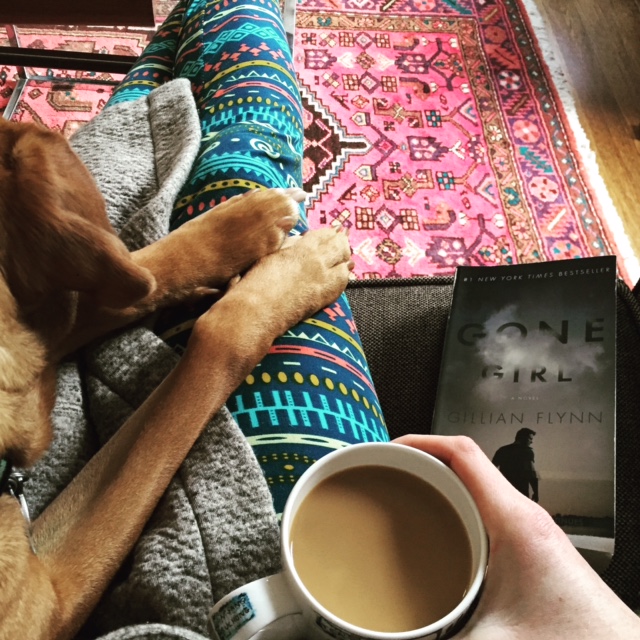
I still love this book. For the record, Blanche loves books and despises technology.
Calm
Magnesium. Not really something we think about very often. I will be the first to say that I didn't even know it was a thing we really needed until a few years ago and now I firmly believe that every performer needs to be hooked on this like drugs (or sugar). Our poor little adrenal glands are just pumping away and we drown them in coffee and stimulants making us more haggard, grumpy, groggy, anxious, nervous, etc. I started 'using' during my Masters Degree. Almost immediately I felt the effects. I was calm in the face of snarky professors, I didn't take things super personally, I felt rested in the morning , less jittery at performances and all around more clear headed (don't even get me started on bowel movements).

From www.breakingmuscle.com
According to the makers of Natural Calm, magnesium deficiency can result in symptoms such as: stress, low energy, muscle tension, muscle spasms and cramps, headaches, insomnia, fatigue and weakness, abnormal heart rhythms, hormonal imbalances, weakening bones, constipation, anxiety, and irritability.
~Hello everyday anxiety! I know I'm not the only one who complains about these things at rehearsals~
About Natural Calm
Natural Calm comes in powder form and should be dissolved into hot water. You will see the powder react to the water forming a fizzy solution.
According to Natural Vitality, Natural Calm is an ionic form of magnesium, which increases its bioavailability. As their brochure explains, "An ionic mineral is an element that has a charge, either positive or negative. On the molecular level, that means the element has either one too many one too few electrons. This unstable ionic state allows the element to bond readily with water, making it possible for the body to absorb it.” Natural Calm is easier to absorb into the body because of its liquid form and therefore more advantageous than taking magnesium by pill or capsule. In addition, Natural Calm is designed to have low acidity to allow it to both dissolve properly in water and not affect the pH-balance of your body.
For a good time add some Melatonin to the mix. I recommend writing your dreams down if you do this.
Stretch/Do Yoga
You don't have to go to a fancy yoga studio to stretch your body. You don't always have to do 'Power Yoga'. You don't have to lose albs of sweat to have a yoga practice.

Sometimes I have to squeeze my yoga in backstage, in heels and concert clothes.....that's how important it is to me!
In fact, just buy a book, or google a yoga class, or move your body in a way that makes you groan and moan (in a PG kind of way). I've been doing this long enough to know there are some pretty tight and 'juicy' spots in my body that need attention everyday. If I don't do this I literally feel like my body has been shrink wrapped in super tight plastic wrap. Do you know what that does to your psyche!? TERRIBLE, STIFF THINGS! The yoga teachers of the world know a thing or two about this and have written books galore on the topic. If you're new to my blog you might not know how cool I think B.K.S. Iyengar is and I really encourage you to skim some of his writings on the topic of yoga, pranayama, asanas, the sutras of Patanjali.
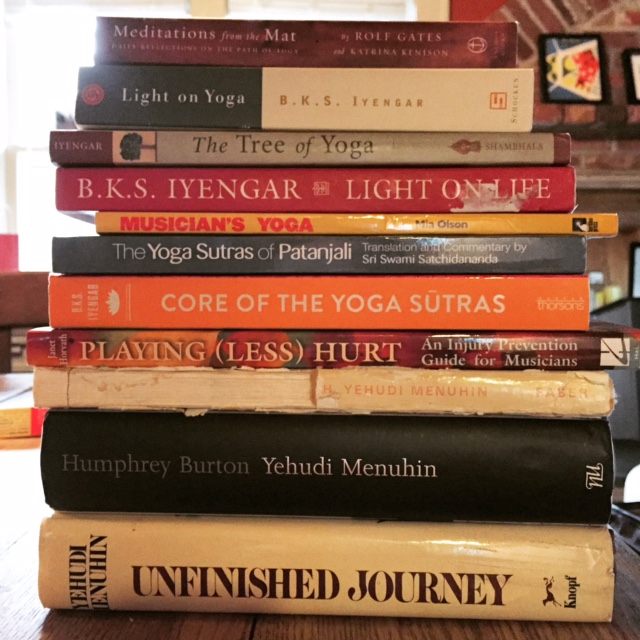
Books about YOGA, Violin, Music, B.K.S.Iyengar, meditation.....you probably need all of these.
I do this for a minimum of 30 minutes a day. Two words - HIPS and SHOULDERS. If you hit these bad boys with some yoga you will breathe deeper and feel calmer. I guarantee it. Sometimes I like to challenge myself and work on the 'fancy' stuff that you see all over Instagram, sometimes I like to hang out in poses for several minutes at a time, sometimes I do both.
Move your body
I consider exercise a daily necessity. I need to burn off some of the stress. I need to make my heart pump, my muscles sore, and my body sweat. I don't consider my physical maintenance a luxury, I consider it a necessity. A requirement for high caliber violin playing and teaching and inter-personal skill(ing).

running - just one kind of body moving I partake in.
Practice
Doesn't this count as work? Yes, I guess? But I'm not talking about prepping for the weekend concert, I'm talking about technical maintenance and improvement. I spend 30-60mins per day doing technical warm ups and drills. My dog and boyfriend hate me (and Carl Flesch) but again, this is not a luxury it is a requirement filed under Self-care.
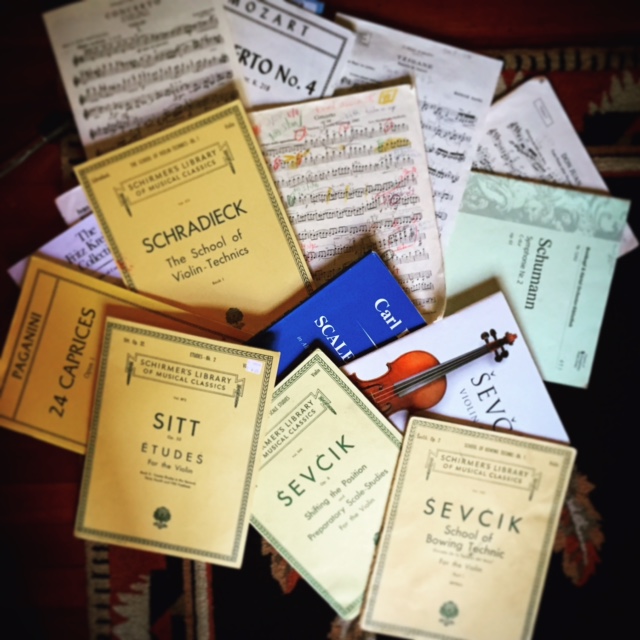
I see you hiding there Mr. Flesch.....
Hydrate
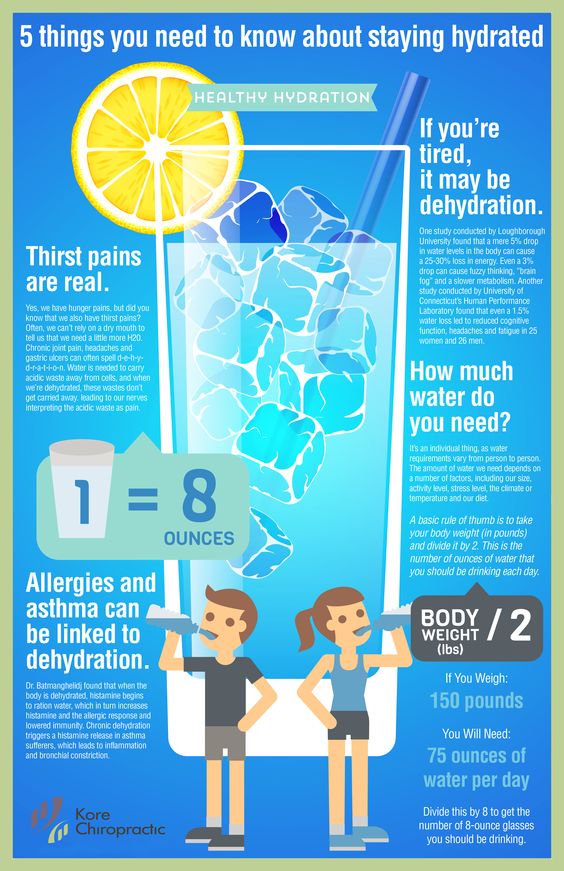
A constant struggle. I can typically be seen clutching an over-sized water bottle. No matter what this is difficult for me. One day my body will just give in and be hydrated. Until then I will neurotically keep my Hyro Flask close by at all times. Drinking enough water everyday flushes out all that yuck from your body, and helps you feel more energetic
WEEKLY
A Day Off!
This one is hard won. I am always so tempted to over schedule myself. MUST TAKE ALL WORK OFFERED is the general mindset of freelance musicians. This year, I have fought hard to keep one day obligation free. Don't get me wrong - I still 'work' I just don't get out of my pajamas, I don't teach a single lesson, and I certainly don't go anywhere work related.
This is tough.
When rescheduling lessons I'm often tempted to use this day to work with students or help out in the music library. Then my nagging internal voice says "NO! BE SELFISH!" And so far I don't regret it.
Sarah Paulson recently kind of spoke about this in an interview for GQ. She talks about finding success later in life, taking naps and reading books on a day off, and not feeling the need to work constantly. I used to think naps were for the weak! Now I applaud the confident napper. Your brain thanks you for those minutes (or hours) of snooze. Also, her interview is pretty great if you, like me, are not a child prodigy and didn't become wildly successful in your career early on in life.
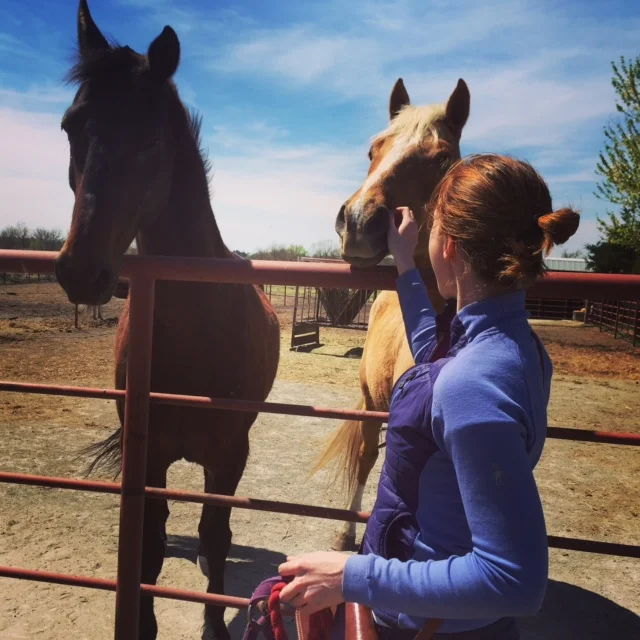
This mythical, mystical day off is also the day I go to my happy place - the horse barn - for a riding lesson and a few hours away from emails, phone calls, metronome speeds, bills, auditions, and dissertation writing. I always return home rejuvenated. Something about horses, man......more on that some other time.

Sonrise Stables
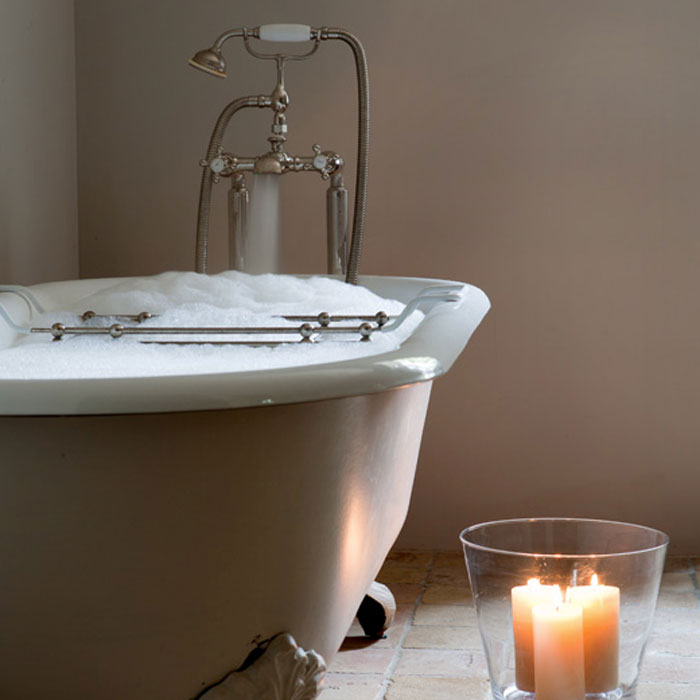
Bubble Bath
This is borderline Social Media Luxury. Honestly, I intend to do this once a week but it happens more like once a month.
Run a hot bath,
add Epson Salts,
add bubbles,
toss a few drops of Essential Oil in there.
apply a face mask,
light some candles,
turn on some music,
or a podcast, or book on tape (cramming empathy into every corner of my life!)
Just chill out.
Do NOT make To-Do lists, text, email, worry, stress, or let what is outside of the bathtub get you down.
After your bath go straight to bed. You will sleep like a baby and wake the next morning feeling refreshed and revived.
Monthly/Long term
Boring Stuff
Pay bills/clean the house/file all of the receipts/stare blankly at personal accounting software.
You get the picture. Some of this tuff should probably go on my weekly self-care list but honestly this is just a pile of 'care' that I do because I know it needs to be done.
Pedicure
I mean come on, a foot rub and some toe nail TLC never hurt anyone. Reflexology is a thing! Don't deny those pressure points! When was the last time you gave yourself a foot massage?...Exactly!

Plus this is pretty much the only time I ever open a magazine. It feels good to catch up on the gossip and fashion while my feet are being made fancy.
Body Massage
I wish this happened more often than it does. I know I sound like such a broken record over here whining about the aches and pains of string players but I genuinely believe the human body was not created with the intent of holding a string instrument for 3+ hours per day. A good body worker/massage therapist pretty much takes a rolling pin to the kinks (not really, obviously) and puts everything pretty much back in place. Plus it helps prevent and ease depression. So find yourself a good one and never let them go!

as read on www.MassageEnvy.com
Massage Therapy Helps Lift Depression
Taking time for massage is as important for people dealing with depression as it is for people dealing with arthritis, sports injuries and carpal tunnel syndrome. WebMD reviewed more than a dozen studies that revealed how massage can fight depression by lowering cortisol levels.
Cortisol is the body's response to stress, and massage therapy lowers it by as much as 50%. At the same time, massage provides many benefits and can also increase the levels of serotonin and dopamine, which are both neurotransmitters that help stabilize your mood.
Results of Massage
The International Journal of Neuroscience studied a group of people with spinal cord injuries who were also suffering from depression. Twice a week for five weeks, half the patients received two 40-minute sessions of motion exercises while the other half received two 40-minute massages.
Both groups improved their physical abilities during that time, but the people who received massage therapy also became less depressed. So even while exercise has long been accepted as a means of combating depression, massage not only provides additional benefits but can also relieve stiffness and soreness resulting from physical exercise.

What do you do to take care of yourself? Any seemingly boring tips? What about the fun and glamorous things? Leave a comment below and share your Self-Care!
Prepping Like a Pro

Piles and piles of progress!
Over the past few months I was forced to step my performance and practice game up several notches. I gave my final doctoral recital in April, won an orchestra audition the week after, assumed a principal position in 2 orchestras and played some freaky hard 20th century music, all while maintaining my regular teaching and orchestra schedule. It was tough! The following tips are lessons I gleaned from others and truths I realized along the way. Many of them are tried and true and have been written about by many great pedagogues and performers. Some of them are little things I discovered on my own and a few may seem totally unrelated to the act of playing violin but are extremely important.
1. Use a metronome! - as if you've never heard that one before! Sometimes we forget the versatility capable of such a seemingly simple device. I use my metronome for lots of random things.
a. Slow practice. You think that's slow? Do it Slower! Fast movement of Bach got ya down? Work that sucker from the ground up. If I have a long passage of 16th notes for example - I put my metronome at 16th = 80 and I work it faster little by little. If you trip over a few notes go back and do them again AND THEN repeat the passage. This is the short cut. Practicing like this builds fantastic muscle memory. Nerves on Stage? Something about highly rhythmic, slow practice keeps your left hand working even when your mind might not be so calm.
b. Use it to test your memory. Here's another Slow practice tip I learned from Sally O'Reilly. Are you trying to memorize that Presto movement? Test your memorization skills by playing it with the metronome at 16th= 60-80 (or whatever the smallest subdivision of the beat is) without the music but with all of the correct bowings, dynamics and fingerings etc. Did your mind wander? Did you space out for a second? Did you come to a spot that is easy when played quickly and hard to organize when played slowly? BUSTED! Slow metronomic practice increases your mental endurance as well. I'm telling you - if you can't play it slow, you shouldn't play it fast.
c. Play it faster. This is especially appropriate for excerpts. Can you play it at the proper tempo? Good. Now do it faster. Did you find a place that falls apart? That is your weak spot. If you can't play it cleanly at multiple different speeds - both fast and slow - then you have some weak spots in your playing. Maybe your shifting gets a little sloppy and desperate when you crank up the speed. Maybe you find some weird accidental or unintentional accents caused by faster tempos. Welcome to the problem that needs to be addressed. And say hello to some technical exercises (see below).
d. Keep the subdivision. It is important to physically memorize the feeling of a consistent subdivision. If your little beats rush your big ones will too. Playing a passage 2 against 3? Triplets? Quintuplets? Guess you better figure those out EXACTLY before you start flippantly rushing through them. Play it 3 against 2, 2 against 3 etc. You get the idea. Figure out the precise placement of all those notes before you start making artistic decisions about slowing down and speeding up.
2. Drone! Pick a note, any note! Okay maybe not any note but something that will be consonant or perfect with at least 80% of the passage at hand. Play slow. No vibrato and align your intonation with the drone. Then pick another pitch and do the same - the root and 5th of a chord are a good starting place with this type of work. This tightens up your chords and passagework so your putting your fingers down in exact places and not just willy nilly in the heat of the moment. Speed it up once you are acing it and see if it sticks at a faster tempo. The last thing you should add is vibrato.
3. Record Yourself. Everyday and Every way. I was fortunate enough to work with a teacher who recorded every lesson I had. It made me cringe! But wow do you learn a ton from watching and listening to yourself. Sometimes you're so busy trying to pull off all of the fireworks on the page you can't hear everything that is actually coming out of the instrument. The only way to find the weak spots and improve is to hear them or have a teacher catch them for you. What happens when you don't have a teacher? You have to find these sections yourself - and this is the best way to do it.
I recorded little portions, larger sections, whole movements, rehearsals with pianists and lessons. I heard a whole bunch of stuff that made me want to quit the violin and never pick it up again. Yikes! It was tough listening to it all. But we do it in the name of progress and the quest for near perfection. Remember! YOU DO THIS TO IMPROVE NOT TO FEEL SORRY FOR YOURSELF!! Each day I would record numerous tracks then listen to them during my drives to work and gigs and teaching. Sometimes I was in tears, sometimes I was pleasantly surprised and always I had a distinct idea of what needed fixing or changing. Don't forget to listen for the musical elements as well as intonation and technique. You might stumble across a moment of your most natural musicality and it will be a pleasant surprise.
4. Sing. Sing for phrasing, sing for musicality, and sing for intonation. If you can sing it you can play it! If you have no idea what the next note should sound like how on earth are you going to find it on the violin? Don't cross your fingers and hope for the best, make a plan and stick to it. The first part of the plan includes what note comes next! Is there a big shift? Sing the note you're aiming for, once you figure that out you're halfway there. Sing against a drone. Its funny how your own tonal center, as in the one INSIDE you, needs to be just as precise as your intonation on the instrument. It helps you anticipate the correct pitches and plan more precisely.
If you're looking for some real fun sing and play at the same time. Working on Bach A minor fugue I realized its kind of fun, and at the very least interesting to sing one voice as you play 1 or 2 of the others. Its hard! And funny - and according to my dog sounds absolutely terrible but if you can play in tune with yourself those double stops and chords will be so in tune it hurts. I started working on all double stops like this. It keeps your inner ear in tip top shape which only serves to improve your left hand.
5. Breathe. Breathe, breathe, breathe, BREATHE. You must practice this. Breathing is calming. Breathing helps your brain function the best it can. If you hold your breath, you deprive your brain of oxygen and send your body into panic mode. This makes you rush, tighten up, forget things, miss shifts and function in a state of desperation. This undermines all of the work you calmly did in your practice room. Don't let a lack of breath get the best of you. Spend some time before the performance or audition or whatever calmly taking large, expansive breaths. Then continue this throughout the performance. Do you feel yourself clamming up? Or sense the tension from a tricky passage coming up? Replace that anxiety with a reminder to breathe. Even write it in your music if it helps. Keeping your breath calm and not shallow is essential for performing at your best.
6. Stretch. Amping up your practice schedule in anticipation of a big event can lead to tight and overworked muscles. I'm a huge fan of yoga. I practice on my own, attend class whenever I can and throw in a few poses mid rehearsal if I feel extra stiff. Almost immediately I can feel my body expand and relax, like a massive THANK YOU to my whole system. Even my brain feels better. I like to start and end my day with a little bit of yoga. At the minimum 20-30minutes in the morning and right before bed do a world of good. You can stretch however you'd like but yoga has always been the most effective for me. At times of my life when I feel really stressed I turn to slow, meditative and restorative yoga. Your body needs to open up and find length - not tighten up and muscle through a workout. I aim for that Yoga High at the end of practice. If I achieve that in yoga I know my violin practicing will go much more smoothly.
7. Drink Water. Sounds Silly, I know but staying hydrated helps you concentrate and also wards off feelings of exhaustion. The last thing you want to do is battle fatigue while you're working up a recital. I like to think that I'm flushing all of the stress out of my body with every gulp of water. Its amazing the effect of being properly hydrated has on your entire system and ability to work.
8. Practice the thoughts. Thoughts are things. I'm not kidding! If you think 'I can't do this' or 'this is the spot I always mess up' guess what happens? Practice the positive thoughts, the helpful ones, the ones that give you success. Like 'I am calm' or 'Breathe' or even the practical rational things like 'where is my contact point?' Make a mental plan - sometimes the distraction of having real and practical things to focus on gives you no room for all of the awkward freak out thoughts that like to creep into our heads in times of stress. THINK RATIONAL THOUGHTS.
9. Sleep. Your brain needs a chance to throw out the garbage and clean all of the cogs and wheels of the mind. If you never hit the off switch you never have a chance to recharge. Don't skip the zzzzzzs. Not only does it hit reset it also magically helps all of the things you've worked so hard to solidify stay in place. That metronome work you did yesterday? Still there. That shift that was really difficult last week? Still improving. I love sleep, it feels good to be well rested. Don't deprive yourself the luxury of several horizontal hours.
10. Technique. Don't skimp on your scales! Seriously! A little a day keeps you a lean, mean, playing machine. I highly regret not spending more of my practice time solidifying the basics prior to my recital. Gearing up for the audition I amped up the Sevcik and Flesch and man were my hands well behaved and my playing was pretty rock solid. Now I keep a little practice log so I don't repeat the same things too often. The following is a sampling of my current favorites. I take a taste from each everyday. On a good day I spend 1.5-2.5 hours on this stuff. It feels good to dive in. At the end of your practice session you feel instant improvement. The benefits of practicing technique are far reaching and you will feel the effects in repertoire almost immediately.
Flesch Scales - all on 1 string, 3 octaves, arpeggios, broken thirds, chromatic. A new key each week
Sevcik Bowing - Like meditation for the right hand. Slows me down so I appreciate every inch of my bow. Hones specific techniques that might be a little weak (aka up bow staccato)
Sevcik Shifting - I rotate through a few of these every week. My shifting was getting sloppy and now I feel much more finely tuned. I practice slow, without vibrato.
Sevcik Double Stops - Intonation. FEEL THE INTERVALS.
Galamian Scales and Arpeggios - I pick the same key as the Flesch and do these for the accelerations and alternative chord progression in the arpeggios.
Schradieck - A messy, poorly behaved left hand cannot play efficiently. This helps my concentration and my dexterity.
Etudes/Caprices - Right now I'm challenging myself to some Paganini. Its the toughest of the tough but I think I'm getting there.
I could keep going. But these are the points I find most helpful in prepping for anything. Anyone have some good ideas to add? Leave a comment!

proof of all the personal recordings I took as part of the preparation process.