
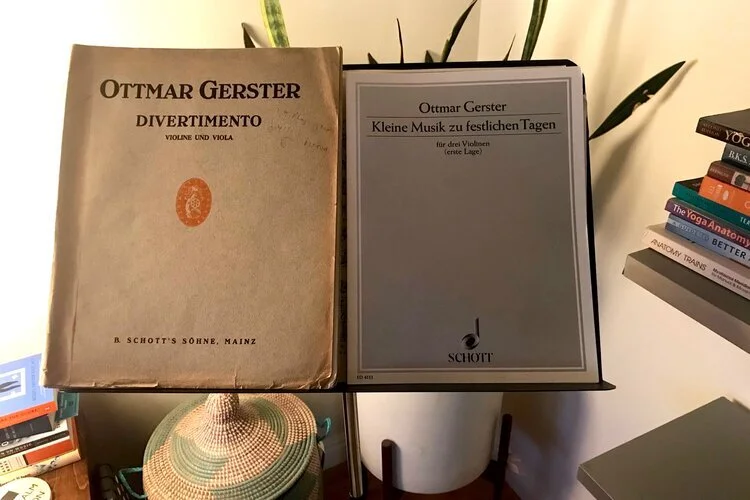
The Violin Music of East Germany Part VI: Ottmar Gerster
This month, the spotlight is on composer Ottmar Gerstner. He is difficult to learn much about BUT I’m excited to share a rough recording of myself playing a movement of his violin trio. He was a Nazi sympathizer during his lifetime which put him in a precarious political position after the war and he chose to move to Soviet German (later the GDR) which better aligned with his ideals and politics.
This month, the spotlight is on composer Ottmar Gerster, another composer who is difficult to learn much about these days beyond Wikipedia. This is a relatively short post BUT I’m excited to share a rough recording of myself playing a movement of his violin trio.

About
Ottmar Gerster was born on the 29thof June, 1897 in Braunfels, Germany and died August 31, 1969 in Borsdorf (near Leipzig). He was a German viola player, conductor and composer.

His mother was a pianist and so he learned piano and also violin from an early age. In 1913 he moved to Frankfurt/Main to study violin with Ferdinand Kaufmann and music theory with Bernhard Sekles.
Between 1916 and 1918 his music education was interrupted when he was called up for military service. He completed his music studies in 1920 and began working with the Frankfurt Symphony Orchestra in 1921. Initially, he was the Concertmaster and then between 1923 and 1927 he was the solo viola player. During the 1920s Gerster also joined the labor movement and organized Workers' Choral Groups. In addition, from 1927 till 1947 he taught violin, viola, chamber music, music theory and composition at the Folkwang University of the Arts in Essen.
In January 1933 the NSDAP (Nazi Party) took power and quickly set about creating a one-party state out of Germany. During the ensuing twelve years, Gerster's relationship with the Hitler regime was often collaborative, but at other times problematic. He composed a "Consecration piece" for the regime in 1933 as well as a "battle hymn" for (Nazi) German Christian organization entitled "You should burn," setting a text by Baldur von Schirach. In 1936 there was a popular song entitled "The stranger bride" and a choral song "German airmen". In 1939, he was briefly required to undertake "army service" as a "Road construction soldier".
During the closing period of the war, Hitler included him on the official schedule of "Divinely gifted artists", produced in August/September 1944. This listed more than 1,000 people from the arts establishment who on account of their cultural value should be kept away from involvement in fighting even, as the enemy armies advanced, on the home front. Around this time Gerster returned to Essen where he lived until 1947.
When the war ended, Gerster found himself on the blacklist of the occupying American army but he continued to lecture in Essen till 1947 when he relocated from the British occupation zone to the Soviet occupation zone which was in the process of being transformed into the German Democratic Republic (East Germany). He became a member of the Socialist Unity Party in 1946 and was a distinguished and important composer for the GDR and accepted a professorship in composition and music theory at the Franz Liszt Music Academy in Weimar, where he served as the rector between 1948 and 1951. His composition "Festouvertüre 1948" - a work to commemorate the 100th anniversary of the revolution in 1848 - was one of the most performed pieces in the GDR.In 1950, he was a founding member of the East German Cultural Academy (the central Arts Academy in the GDR. It existed under several different names between 1951 and 1993 when it merged with another art school and became the Academy of Arts, Berlin. In 1951 Gerster left Weimar and took a position at what was then called the Mendelssohn Music Academy (now the University of Music and Theatre) in Leipzig, where he remained until his retirement in 1962.
Between 1951 and 1968 Gerster was also the Chairman of the country's Association of Composers and Musicologists.
Style
Gerster was a relatively traditional composer. He stuck to the framework of conventional extended tonality, often using church music modes, building chord structures on fourths and fifths. His works were mostly classical in their architecture and like many composers at this time, he felt an affinity with folk songs, from which his music sometimes incorporates melodies. There is also a stress on a "hand-crafted" element in his tonality.
Gerster was an early exponent of music for the masses and had no difficulty in accommodating his work to the guidelines of Socialist realism – music and art that portrayed the working lives of the socialist regime as ideal which at least during the early 1950s, was the preferred artistic style of the state. Sometimes his style resembles that of his student contemporary, Paul Hindemith.
Music I’m looking for:
(for someone who is hard to find out about, his violin music was relatively easy to purchase and find online from multiple publishers.
Violin concerto (1939)
String quartet Nr.1 in D (1920/21)
String quartet Nr.2 in C (1954)
String trio op.42 (ca. 1922)
Sonata for Violin and Piano (1950/51) ACQUIRED
Divertimento für Violine und Viola ACQUIRED
Kleine Musik zu Festlichen Tag für drei Violinen (1950) ACQUIRED
Drei musikalische Spielzeuge for violin and piano ACQUIRED
Sources:
https://www.tobias-broeker.de/rare-manuscripts/g-l/gerster-ottmar/
https://en.wikipedia.org/wiki/Ottmar_Gerster
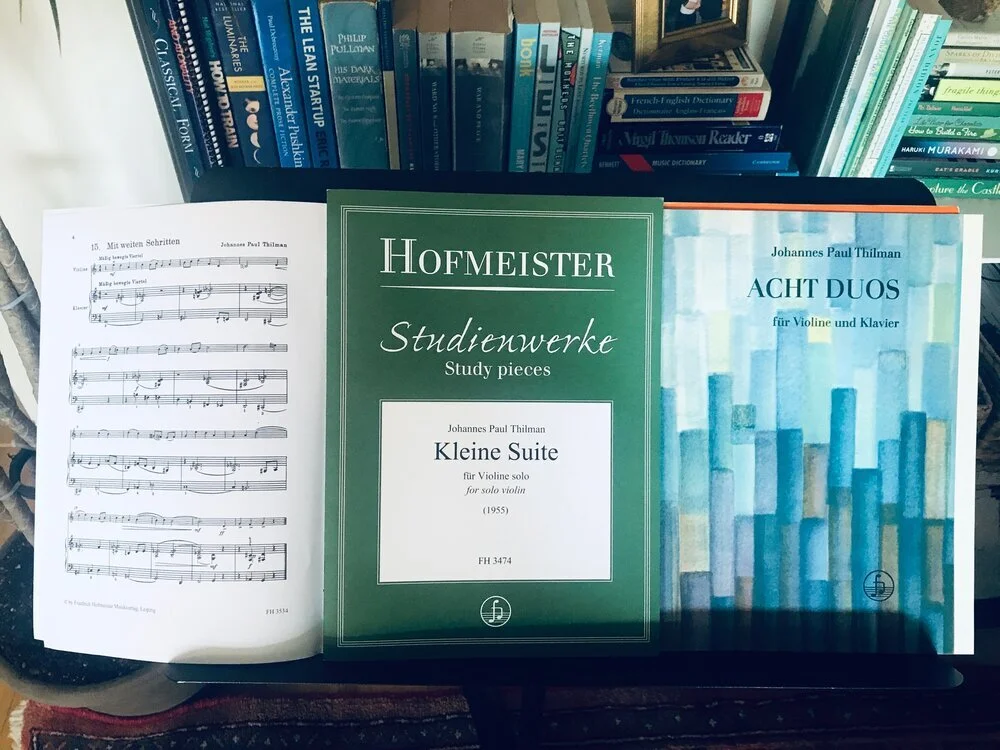
The Violin Music of East Germany Part III: Johannes Paul Thilman
Part 3 of my exploration of violin music from East Germany focuses on Johannes Paul Thilman from Dresden. While Thilman was very popular and celebrated during his lifetime his music has mostly been (sadly) forgotten - a shame because he wrote some wonderful violin music. I am so excited to introduce one of my new musical friends to you!
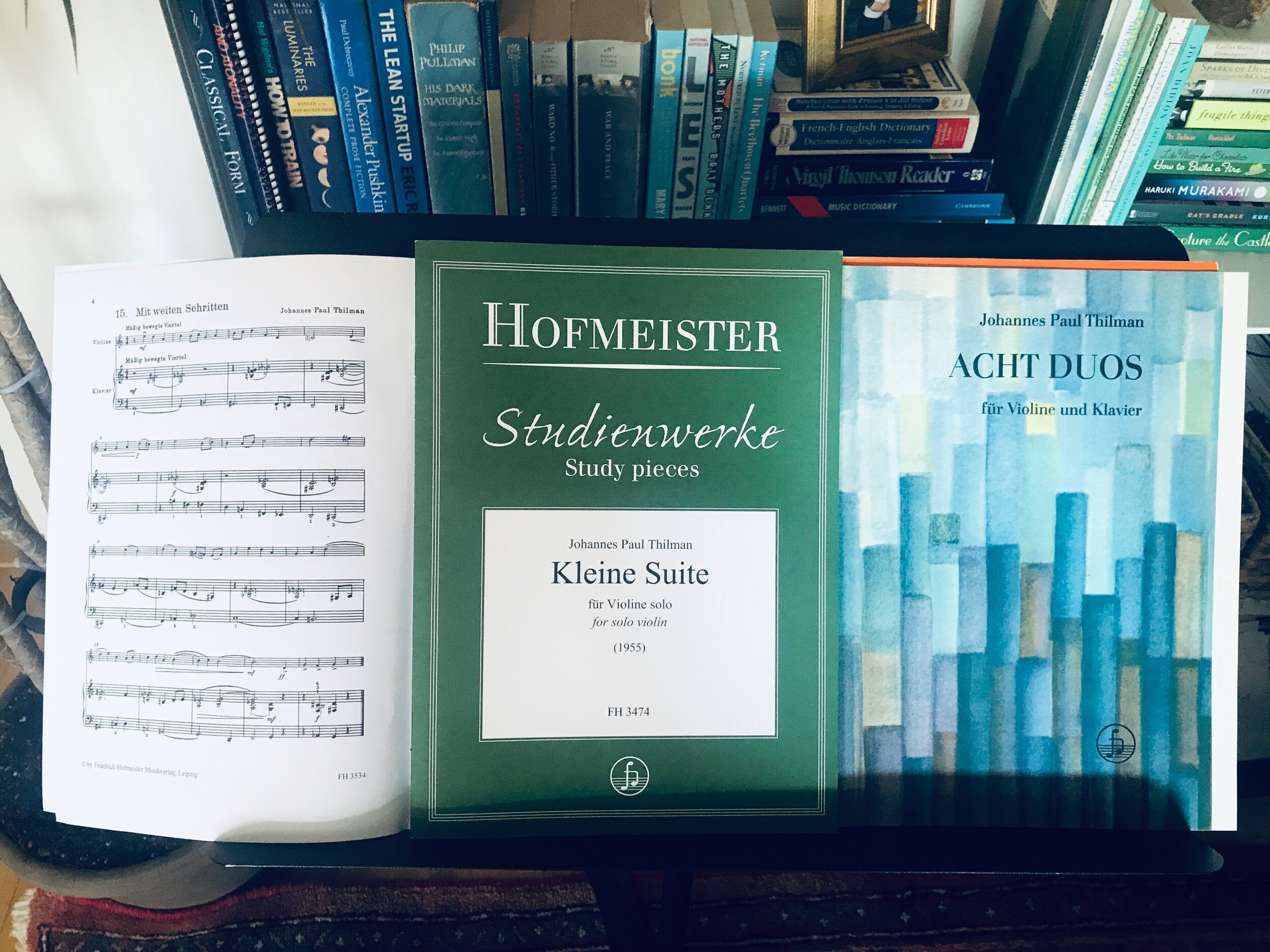
The spotlight in this installment of my East German Violin Music blog series is dedicated to Johannes Paul Thilman. While information about Thilman is quite hard to find, some of his scores were more readily available. Unfortunately for me, several of my recent acquisitions are stuck in Germany due to COVID-19 related shipping restrictions between the EU and United States. The sellers assure me that they are holding them for me and will send them as soon as the holds are lifted. I cannot wait to explore these scores and the waiting only makes my excitement grow more ferocious.
I’ll start with a few personal notes regarding my exploration of the music I already own.
I really like Thilman’s musical style and harmonies. He is considered a conservative composer and his music is reminiscent of the Romantic Era tonalities, and maybe I just like that stuff, but it fits nicely on the violin. Some works, like the 8 Duets for violin and piano, are quite simplistic and use folk-like melodies. The virtuosic technique is very manageable and makes this music well suited for younger music students. This is similar to some of Schwaen’s music – one could conceivably put together a student recital consisting solely of music from East Germany...that would be a cool history lesson/experience! The Kleine Suite for Solo violin is difficult and virtuosic in a similar way to the solo music of Bach, Prokofiev, and Ysaye. I had to sit at the piano and play through many of the harmonies to get a better sense of the sonorities. I think it is particularly challenging because I have no recordings to refer to for style, articulation, tempo, etc.
The Research:
Johannes Paul Thilman - German composer and pedagogue; b. Dresden, Jan. 11, 1906; d. there, Jan. 29, 1973.

Thilman, who actually wanted to become a teacher, encountered music at the age of 18 and was initially self-taught. He was a pupil of Hindemith, Grabner, and Scherchen and attended the Leipzig Conservatory in 1929. He also studied at the Dresden Technical Univ. During the Nazi era (1933-5) he was declared an unacceptable composer, and it was only after the fall of the 3rd Reich that he was permitted to pursue his career in earnest. In 1940, he became the instructor of composition at the "Carl Maria von Weber" School of Music (also called the Dresden Conservatory) in his hometown, Dresden. He was a professor there from the year 1956 until he became an Emeritus professor in 1968. Among his students were composers Friedrich Goldmann and Udo Zimmermann. Besides his academic activities, he was also involved in the musical life of Dresden. He was the founder-director of the “New Music in Dresden” concert series (1947-51) and later taught at the University of Dresden. Thilman went on to become the Professor of composition at the Dresden Hochschule für Musik beginning in 1965.* In 1960, he was the recipient of the coveted National Prize of East Germany.
*these schools listed above may be related in some way. I’m not 100% certain about the University/Conservatory setup in Germany and how it may have changed.
His academic publications include, Probleme der neuen Polyphonie (1949), Neue Musik: Polemische Beiträge (1950), and Musikalische Formenlehre (1952).
Among his compositions are 7 symphonies and other orchestral works, chamber music, choral works, piano pieces, and numerous works for school and “domestic use” (I assume this means to be sang or played at home by amateur musicians?).
During his life, his 4th Symphony was very popular. It really is beautiful - as are the images in the video.
Musical Style:
Thilman was a conservative Composer. His music is tonal and refers to the form and harmony of Romantic music. His melody is always catchy and uncomplicated. Thilman was particularly inspired by folk music. This influence can be heard clearly in many of his works. Most of his works are short. Generally, his tone is fresh and uncomplicated rather than dramatic. Undoubtedly, Thilman oriented his works towards the aesthetics of the Socialist realism.
~Just in case you need a refresher on Socialist Realism, here is what Wikipedia says:
Socialist realism is a style of idealized realistic art that was developed in the Soviet Union and was the official style in that country between 1932 and 1988, as well as in other socialist countries after World War II. Socialist realism is characterized by the glorified depiction of communist values, such as the emancipation of the proletariat.
In his later works, he often chose unusual settings and freer forms for his works. Thilman was very respected in East Germany. Today, however, he is mostly forgotten. This last point seems to be sad but true for many composers in East Germany, even those that were popular, famous, or highly regarded. The quest to find his music and information about him has been surprisingly limited, and as I said at the beginning, his scores are some of the easier ones to find. I’ll be sharing clips of his work on social media soon so make sure to follow me on Instagram (@activeviolinist ) to watch some of those stories.
Repertoire I am looking for:
Solos:
Concerto for Violin and Orchestra Op. 59, 1952 FOUND – stuck in Germany
Lichtenberger Konzert for violin and string orchestra, 1958
Concerto for Violin and Chamber Orchestra, 1972
Sonata No. 1 for Violin and Piano Op. 50 FOUND – stuck in Germany
Sonata No. 2 for Violin and Piano Op. 80
Kleine Suite for Solo Violin, 1955 ACQUIRED
Sonatine for Violin and Piano Op. 82 FOUND – Stuck in Germany
8 Duos for Violin and Piano ACQUIRED
Duo Drama for Violin and Piano
Chamber Music:
Sontatine for String Quartet Op. 49
String Quartet No. 1
String Quartet No.2, 1954
Piano Quartet No. 2 Op. 70
Piano Quintet, 1955
String Quartet No. 3 in D major Op. 81
String Quartet No. 4 “in einem satz” Op. 84, 1958
Piano Trio, 1963
Dramatische Szenen for String Quartet, 1969
Kammerspiel for String Quartet, 1970
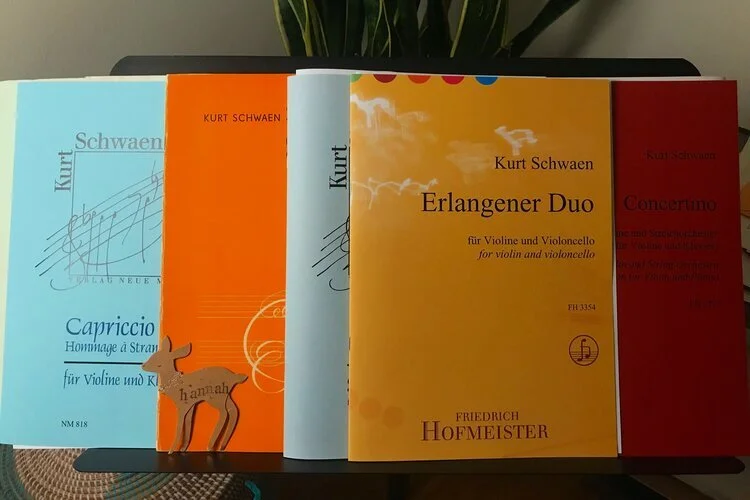
The Violin Music of East Germany Part II: Kurt Schwaen
Spotlight on the life and music of Kurt Schwaen, a composer who lived and worked in East Germany and wrote many pieces for violin, and string chamber ensemble. This is the second installment in my Violin Music of East Germany series. I am writing about the people and music I uncover as I pursue this research and performance endeavor. Enjoy!
This post is the 2nd installment of my GDR music project research. Over the past few months, during this era of social distancing, I have done quite a bit of research and score collection for this project. I have found many names and scores, many rabbit holes to jump down and treasure to hunt. As always, with research, you uncover more questions than you do answers, but that's just part of the game. I haven't come out completely empty-handed, though. Thankfully, some scores are not impossible to find, and I will be highlighting some of those people and their work here.
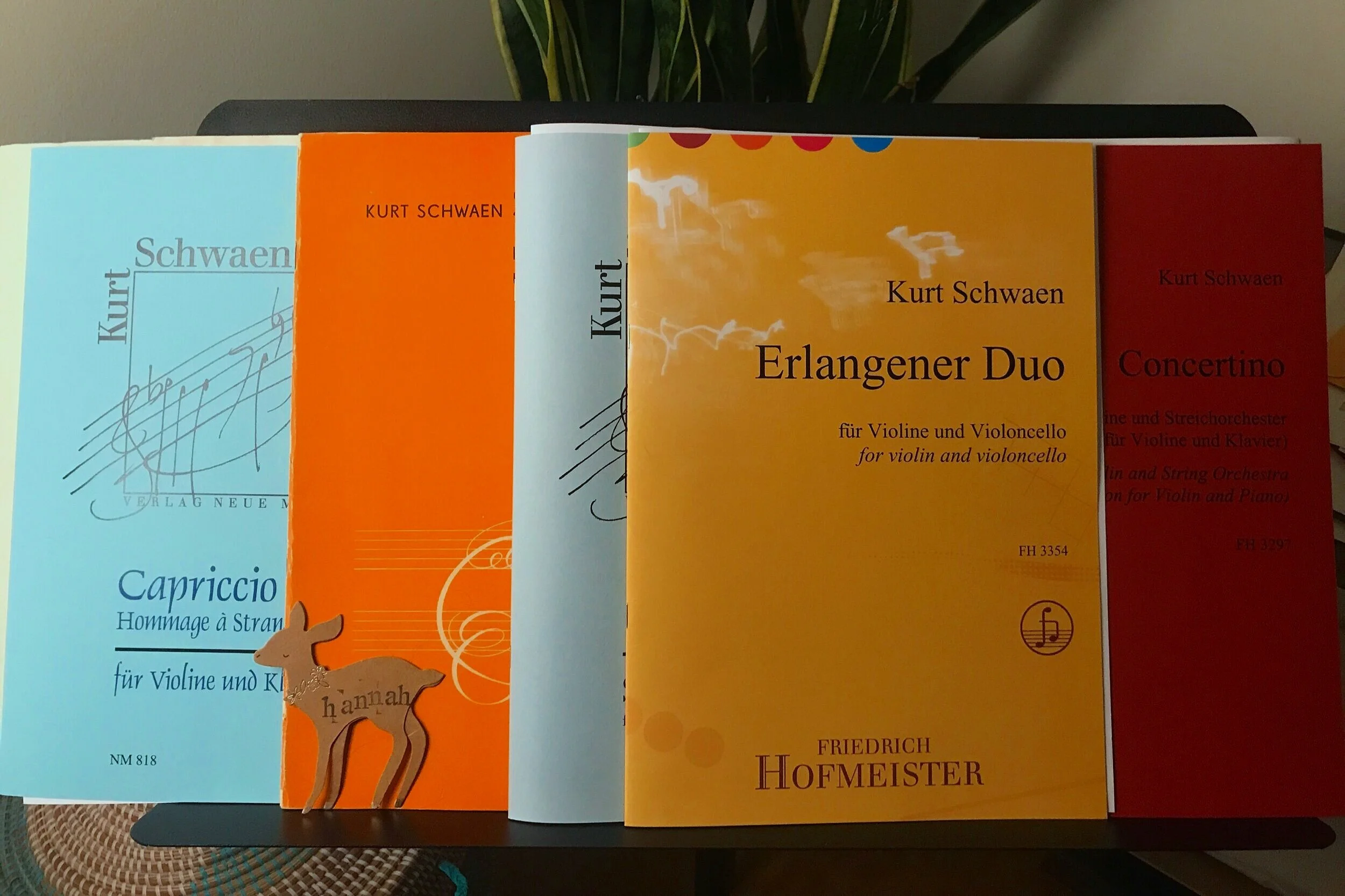
In my preliminary research about the composers and pieces written in East Germany, Kurt Schwaen's name is one of the most readily available. Before starting this project, I didn't know the name at all, and I'm guessing several of you are equally as unaware (but bravo if his name is already in your library). There is a website devoted to Schwaen's musical career that is updated and curated by Dr. Ina Iske-Schwaen, but this is certainly not the case for most East German composers. It has added to the ease and simplicity of finding and collecting some of his scores.
To clarify: I'm most interested in finding violin music written between 1949-1989, including solo works, concerti, sonatas, and works for small chamber ensembles (quartets, piano trios, duos, etc.). Many composers wrote works before and after this period, and I will probably end up collecting many of these scores too. Below, you will find a list of compositions found on various sources online. I have noted which ones I have successfully obtained at the time of writing this.
The following is a little bit about Kurt Schwaen and his music.
b. June 21, 1909, in Katowice, Poland (under Nazi occupation during WWII)
d. October 9, 2007, Berlin, Germany
From 1929 to 1933, Schwaen studied musicology, art history, philosophy, and German at the universities in Breslau, Poland, and Berlin, Germany.
In 1930 he met Hanns Eisler (more on him later) who greatly influenced his compositional style. After becoming active in an anti-fascist student group, he joined the Communist Party of Germany, and from 1935 to 1938, and he spent time in prison because of his political views. After his release, Schwaen found enduring inspiration from his work as a pianist with renowned dance soloists in a studio for expressive dance in Berlin.
After the war, he returned to Berlin. He spent much of his time working to rebuild the musical culture of that city by writing compositions for amateur music groups, choirs, music schools, and chamber ensembles. After the end of World War II, which Schwaen survived in the Penal Division 999, he found ample work in the rebuilding of the public music schools and as musical advisor to the German Volksbühne Theatre.
Between 1953 and 1956, he worked with Bertolt Brecht, who had a profound impact on his future compositions. He worked with Brecht from 1953-1956. In 1961 he became a member of the DDR Akademie der Künste, where he was head of the music department from 1965 to 1970. From 1962 to 1978, he was president of the East German National Folk Music committee. Between 1973 and 1981, he directed the children's musical theatre in Leipzig.
Schwaen has held numerous honorary positions, including being named an official member of the Association of Composers and Musicologists, the Academy of Arts in 1961. In 1983 he was awarded an honorary doctorate from Leipzig University and received several other state awards. His compositional output, which spans seven and a half decades, contains more than 600 works in every genre, from song and chanson to choral music, piano works, chamber music, and orchestral works, and includes opera and works for the ballet.
Schwaen later settled in Berlin-Mahlsdorf, where he died at the age of 98. His widow, Dr. Ina Iske-Schwaen, maintains an archive dedicated to his works in his Mahlsdorf home.
There are a couple of great quotes from Schwaen on his website that I enjoy:
Everything easy is unusual.
Everything easy is unusually difficult.
I am for shortness.
But shortness because you choose no length, not because you are not able to.
Compositions applicable to my project:
· Piano Trio No. 3 for violin, violoncello, and piano (1982)
· Suite Classique (Classical Suite) for violin and piano (1980) ACQUIRED
· Piano Trio No. 4 for violin, violoncello, and piano (1983)
· Capriccio. Hommage à Strawinsky for violin and piano (1986) ACQUIRED
· Sequences in Es-flat. Four movements for violin and piano (1996)
· Piano Trio No. 5 – »en miniature« for violin, violoncello, and piano (1987)
· Serenade for Solo Violin and 3 Solo or Tutti Violins (1998)
· Violin Concerto KSV 433 (1979)
Pieces Not listed online, but (somehow) acquired:
· Concertino for Violin and String Orchestra (1971) ACQUIRED
· Sonatine for Violin and Piano (1951) ACQUIRED
· Erlangener Duo for Violin and Cello ACQUIRED
A little about some of the music listed above:
In the Suite Classique (Classical Suite) for violin and piano, Schwaen consciously employs traditional form to organize this piece. Of course, he uses this model for his unique purposes in the formation of different movement characters. The outer movements are determined and virtuosic, whereas the inner ring, which frames the unrestrained third movement, are more »cantabile«. Whether calm or active, tense or relaxed, powerful or floating and light, complicated or simple – Schwaen writes with a compelling musicality.
These traits also apply in the case of the Capriccio for violin and piano. Written for the same instrumental combination, Schwaen here channels his intention toward the presentation of a particular genre, an »Hommage à Stravinsky«. The role model function of this master is well-known. Schwaen even spoke of influence. This work is built on formula-like circular, short repetitive motions. It presents itself dancingly light, even playful. A melodic, at times improvisatory sounding middle section allows the »capriccioso« to come to the fore, especially clearly.
Surprisingly, considering how easy – relatively speaking – his violin music was to obtain, there are very few recordings of his music available online. I checked Youtube, Vimeo, Spotify (there is only one album of simple pieces with German introductions), Amazon Music, Apple Music, and Soundcloud. One recording that I did find and enjoy is this recording on youtube of his Concerto Grosso for String Quartet and chamber orchestra.