
The Graceful Ghost
I’ve been putting together a few recital programs and have grown to love this piece. Bolcom’s “Graceful Ghost” is a charming combination of haunting and humorous. There are so many interpretations of this piece, and I’ve included a few here - which one is your favorite?
I haven’t done a post like this in a long time! Truthfully, I meant for this to be a “Music Monday” Post, but I got a little preoccupied practicing my instrument and watching the Lorena docuseries (and eating dinner with a friend) to finish it in time so now it is just an anyday-of-the-week music appreciation post about a new piece I am working on.
Recently, I started putting together a few recital programs worth of music that I’ve always wanted to play. Delving into new solo repertoire has been a really enjoyable endeavor and enhances my love of this instrument. Rather than just practicing repertoire for orchestra concerts and excerpts for auditions, I have added several sonatas and various other solo selections to my regular practice regiment. I spent quite a bit of time researching music and eventually selected several pieces that were either entirely new to me, or that I was fairly unfamiliar with. I realized after some investigation that there are some vastly underrated pieces in the violin world that deserve a little more attention and spotlight. I am dedicating several of my Music Monday posts (even if they don’t get published until Wednesday) to the discoveries I have made, and the selections that I have decided to learn and one day, hopefully quite soon, perform.
The first piece from my chosen Recital Repertoire is “The Graceful Ghost” by William Bolcom.
I first came across this charming piece for violin and piano several years ago when sight-reading through music with my dear friend James Barnett, the creator of the LOFT recital series in Minneapolis.
The piece is titled “Graceful Ghost Rag, Concert Variation for Violin and Piano.” It was written in 1979 and was originally a solo piano piece that the composer arranged for violin and piano. According to allmusic.com
William Bolcom had a strong interest in classic American popular music, especially ragtime. Graceful Ghost, his most popular composition, sprang from that interest. Bolcom’s earlier career was centered on New York City and Yale University. While in New York, he investigated the great compositions of the ragtime era (roughly 1890 to 1925), exemplified by composers such as Joplin, Turpin, Hayden, and others. His investigation into their proper interpretation (especially Joplin's recurring but widely overlooked admonition never to play ragtime fast) led him to becoming a leading pianist in the ragtime revival of the 1960s, along with Paul Jacobs and Joshua Rifkin, among others. Among the items Bolcom recorded was his own set of Three Ghost Rags, a commemoration of his late father. Graceful Ghost, with a stately, benign melody and a wistful sense of loss, was the breakout hit of the album on which it appeared and has remained Bolcom's most widely known composition. (The other two "ghost rags" are Poltergeist and Dream Shadows.)
In 1979, Bolcom prepared the violin version, which he and Sergiu Luca played in 1981. It eschews bravura effects, instead concentrating on the violin's lyrical qualities in sonorities, mainly at mezzo piano and quieter. There appears to be a slight expansion of the piece in this version, including a little more material in the accompaniment to compensate for the lines that are lifted from the original piano piece to the violin. However, the violin does not simply take all the melodic material. Instead, the melodies pass weightlessly from the keyboard to the violin, requiring close interpretive sympathy and each instrumentalist's ability to pick up the other's phrasing and dynamics. Lacking that quality, the music becomes earthbound, preventing the ghost from serenely floating in the violin part.
The Graceful Ghost is performed and recorded quite regularly BUT what I find really interesting is that this piece is a Rag. A Rag is a style of music originally credited to Scott Joplin that became popular around the beginning of the twentieth century. It is classified as a type of jazz ‘that emphasizes a syncopated melody with a heavily accented accompaniment part. Ragtime music is in 2/4.” (from the free dictionary)
The interesting question is “to swing, or not to swing” – in many forms of Jazz the melodic line is “swung” meaning that the rhythm is relaxed so that two eight notes (or sixteenth notes) form a long-short relationship with the first of every pair receiving more impetus/inflection/accent. Ragtime is not typically a style of music that receives this treatment, and if you listen to early recordings of Scott Joplin play his own compositions they are quite strict and in time, especially when compared to more contemporary performers.
Here is a comparison (sometimes the internet is so cool):
When researching this piece and listening to different versions, I heard several different approaches – some swing and some don’t. Some take great liberties with the timing, some play it fast, and others play it slow. So what is correct? Well, I watched a ton of videos, and listened to countless recordings. Below are a few for you to compare. I can’t play all of the videos here, but here are a few of my favorite performances – of the original piano version, as well as the violin and piano version.
I am still coming to my own conclusions about how to interpret this piece, but I think I will reflect on Joplin’s upright rhythmic nature, and refrain from swinging throughout this piece. I love the melodic line of this piece, I also love the sonorities and how this piece is both somber and playful. I think that is the charm of this piece, and most likely why it has remained one of Bolcom’s most popular compositions. I hope you enjoy both versions of this piece. Which is your favorite from this selection? Leave a comment below.
Piano Solo
Violin and Piano
This next one is in the original key of B-flat (the violin version was transcribed to A minor).
Buy Sheet music:
 look inside
|
Graceful Ghost Rag - Concert Variation Violin and Piano. Composed by William Bolcom. Piano. American, Jazz, Ragtime, Classical, Contemporary. 12 pages. Published by Edward B. Marks Music (HL.9430). |
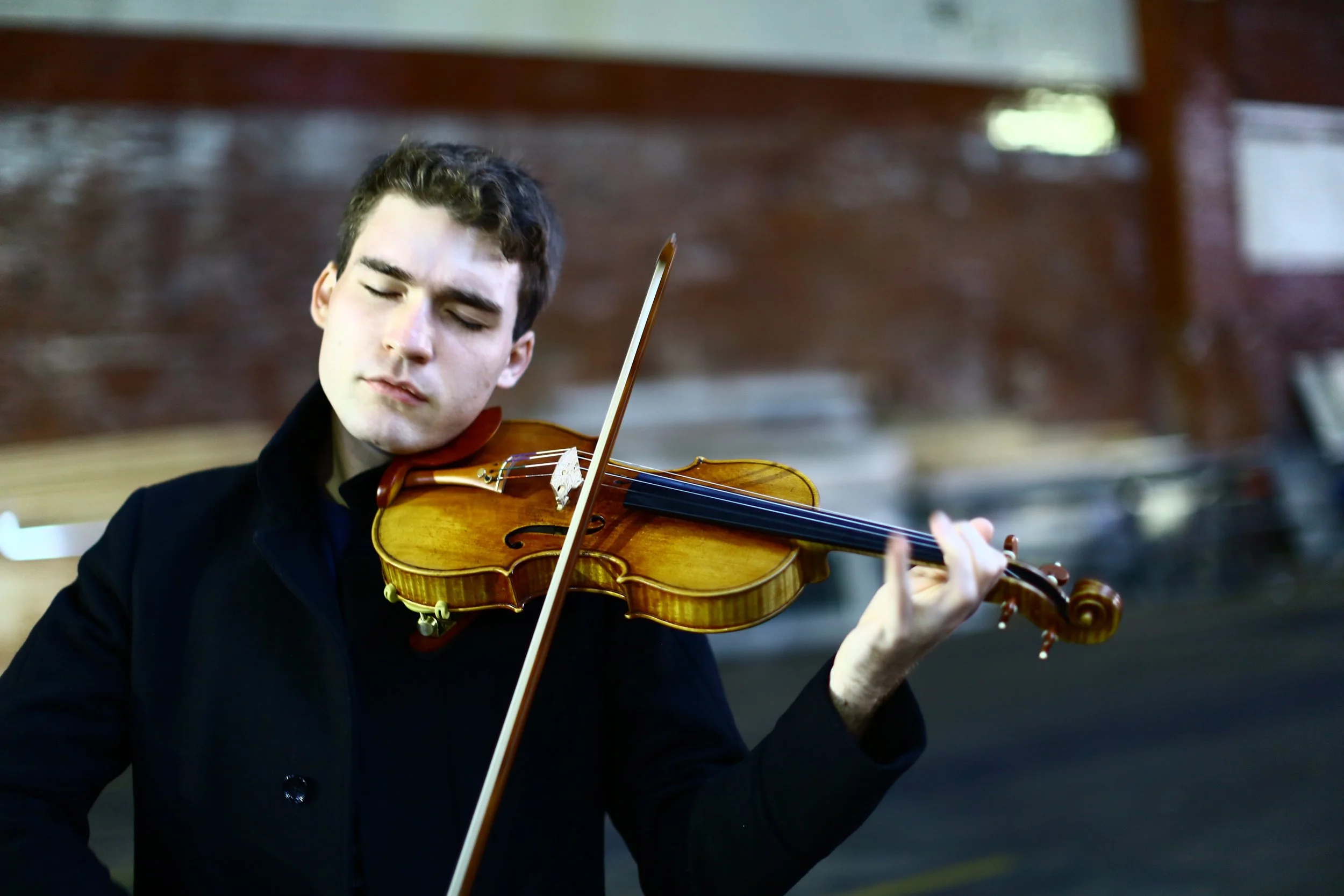
Mini-Series Part V: Alexi Kenney
The final installment of my Mini Series is here. Featuring Alexi Kenney with SoNA and Maestro Paul Haas.
This (final) installment in my season-long series is a few weeks late. Oops! Sorry about that!
The first weekend in March, Alexi Kenney performed the Sibelius Violin Concerto with the Symphony of Northwest Arkansas (SoNA) and Maestro Paul Haas.
I was super excited about this concert. The program included The Sibelius Violin Concerto, Beethoven Symphony #5, and Fratres by Arvo Pärt. I adore all of these pieces, and until the week we received our music I was jumping with excitement assuming we would play the solo violin version of Fratres (see my fairly recent Music Mondays Blog Post titled Fratres).
The Sibelius Concerto has long been one of my absolute favorites, and incidentally, the only instrumental concerto that Sibelius ever wrote.
Here is what the ever so scholarly Wikipedia has to say:
The Violin Concerto in D minor, Op. 47, was written by Jean Sibelius in 1904, revised in 1905. It is his only concerto. It is symphonic in scope, with the solo violin and all sections of the orchestra being equal voices. An extended cadenza for the soloist takes on the role of the development section in the first movement.
Sibelius originally dedicated the concerto to the noted violinist Willy Burmester, who promised to play the concerto in Berlin. For financial reasons, however, Sibelius decided to premiere it in Helsinki, and since Burmester was unavailable to travel to Finland, Sibelius engaged Victor Nováček (1873–1914), a Hungarian violin pedagogue of Czech origin who was then teaching at the Helsinki Institute of Music (now the Sibelius Academy). The initial version of the concerto premiered on 8 February 1904, with Sibelius conducting. Sibelius had barely finished the work in time for the premiere, giving Nováček precious little time to prepare, and the piece was of such difficulty that it would have sorely tested even a player of much greater skill. Given these factors, it was unwise of Sibelius to choose Nováček, who was a teacher and not a recognized soloist, and it is not surprising that the premiere was a disaster. However, Nováček was not the poor player he is sometimes painted as. He was the first violinist hired by Martin Wegelius for the Helsinki Institute, and in 1910 he participated in the premiere of Sibelius's string quartet Voces intimae, which received favorable reviews.
Sibelius withheld this version from publication and made substantial revisions. He deleted much material he felt did not work. The new version premiered on 19 October 1905 with Richard Strauss conducting the Berlin Court Orchestra. Sibelius was not in attendance. Willy Burmester was again asked to be the soloist, but he was again unavailable, so the performance went ahead without him, the orchestra's leader Karel Halíř stepping into the soloist's shoes. Burmester was so offended that he refused ever to play the concerto, and Sibelius re-dedicated it to the Hungarian "wunderkind" Ferenc von Vecsey, who was aged only 12 at the time. Vecsey championed the work, first performing it when he was only 13, although he could not adequately cope with the extraordinary technical demands of the work. The first time Sibelius himself conducted the revised version was in 1924, in Stockholm, at the same concert as the premiere of his Seventh Symphony.
The initial version was noticeably more demanding on the advanced skills of the soloist. It was unknown to the world at large until 1991, when Sibelius's heirs permitted one live performance and one recording, on the BIS record label; both were played by Leonidas Kavakos and conducted by Osmo Vänskä. The revised version still requires a high level of technical facility on the part of the soloist. The original is somewhat longer than the revised, including themes that did not survive the revision. Certain parts, like the very beginning, most of the third movement, and parts of the second, have not changed at all. The cadenza in the first movement is exactly the same for the violin part.
Pretty interesting stuff!
The first interpretation of this concerto I remember listening to regularly was recorded by Anne Sophie Mutter. That was many (many) moons ago. When I hear that performance now, it feels so nostalgic - like the first time you did anything with enthusiasm, it forever holds a special place in your heart but these days, even though I don't turn to this recording first, I still listen to it on occasion.

Back to Alexi...
When SoNA first announced the 2016/17, I was unfamiliar with the name Alexi Kenney. So in preparation, I did a little research (aka internet stalking).
Here is a slightly abbreviated bio from his website www.alexikenney.com

The recipient of a 2016 Avery Fisher Career Grant, violinist Alexi Kenney has been praised by the New York Times for “…immediately drawing listeners in with his beautifully phrased and delicate playing.” His win at the 2013 Concert Artists Guild Competition at the age of nineteen led to his critically acclaimed Carnegie Hall debut recital at Weill Hall.
He has given recitals at the Kennedy Center in Washington, D.C., Jordan Hall and the Isabella Stewart Gardner Museum in Boston, Napa’s Festival del Sole, Chicago’s Dame Myra Hess series, and the Mondavi Center for the Performing Arts, and he has been featured on Performance Today, WQXR-NY’s Young Artists Showcase, WFMT-Chicago, and NPR’s From the Top. Recent concerto engagements include the Santa Fe Symphony, Las Vegas Philharmonic and Roswell Symphony in New Mexico, the Hofheim Academy Orchestra in Bad Soden, Germany, and the NEC Philharmonia at Symphony Hall in Boston in a performance of John Adams's Violin Concerto with Hugh Wolff.
Chamber music continues to be a focus of Alexi"s life, touring with Musicians from Marlboro and Musicians from Ravinia's Steans Music Institute and regularly performing at festivals including Caramoor, “Chamber Music Connects the World” at the Kronberg Academy (Germany), ChamberFest Cleveland, the Lake Champlain Chamber Music Festival, Marlboro, Music@Menlo, Open Chamber Music at Prussia Cove (UK), Ravinia, and Yellow Barn. He has collaborated with artists including Pamela Frank, Miriam Fried, Gary Graffman, Steven Isserlis, Kim Kashkashian, Gidon Kremer, and Christian Tetzlaff.
He is the recipient of top prizes at the 2012 Yehudi Menuhin International Competition, the 2010 Mondavi Center Competition, and the 2013 Kronberg Academy master classes. He was praised by Strings magazine for his “beautiful, aching tone” for a performance of the Sibelius Concerto with the China Philharmonic Orchestra in Beijing during the Menuhin Competition.
Born in Palo Alto, California in 1994 and currently residing in New York, Alexi Kenney received his Bachelor’s of Music degree from the New England Conservatory of Music in Boston, where he is currently the only violinist in its selective Artist Diploma program. At NEC he studies with Donald Weilerstein and Miriam Fried on the Charlotte F. Rabb Presidential Scholarship. Former teachers include Wei He, Jenny Rudin, and Natasha Fong.
In layman's terms, Alexi is a young and rising star with a massive career ahead of him.
What struck me as particularly interesting was the performance excerpts he includes on his website. I had just been listening to one of my favorite podcasts, Meet The Composer, hosted by Nadia Sirota, where she interviews Kaija Saariaho, and it sent me on a quest to acquaint myself with more of her music. I ran into her piece for violin and electronics called Frises. It is so cool - I even went so far as to look up some images of the score - yikes it is hard! You can read more about the piece here OR Saariaho's own program notes here. All this to say that Alexi Kenney includes recordings of 2 movements of this piece on his website, along with a few other contemporary, and 20th-century works. I increasingly admire performers who choose to perform and endorse contemporary composers. A Champion of the Present, is often how I think of them, and I admire their investment in the music that is shaping the future. I recommend exploring the recordings on Alexi's website.
http://www.alexikenney.com/listen/
I ended up running into him at a local coffee shop in Fayetteville, and we chatted for a little bit. It turns out that the week before, he was serving as guest concertmaster of the Pittsburgh Symphony, where -small world- the assistant conductor, Andres Franko, also happens to be the music director of the Signature Symphony in Tulsa where I am the Associate Concertmaster. Sometimes the music world is crazy small! It was fun to share that little connection and chat about the differences and challenges of performing as an orchestral musician, chamber musician, and soloist, life in Brooklyn and on the road (he travels to perform almost constantly), cheap tickets at the Met and Carnegie Hall, good coffee, and yummy food around town.
I really loved Alexi's interpretation of the Sibelius. The guy has bow control for days! I was so relieved NOT to be on the front stand for this performance so I could relax a little bit and watch him perform. On his website, Kenney includes a performance quote from the New York Times that reads;
"a spellbinding, thoroughly honest performance that revealed his architect’s eye for structure and space and a tone that ranges from the achingly fragile to full-bodied robustness”.
This is spot on. His musical pacing is exact: effortlessly exciting, and convincingly unique. I loved his 3rd movement, which, all of a sudden seemed to be infused with an almost Latin groove. I had never even thought that could be a thing with this piece. A war horse of the violin repertoire, I heard Kenney's performance and just couldn't believe how it danced and grooved in a completely new and refreshing way. Donald Tovey refers to the third movement as a "polonaise for polar bears" but this had something a little more sizzling about it.
The video above is a few years old, and I think his tone is much more blazing now but unfortunately I could not find a more recent performance of the Sibelius. The 3rd movement starts roughly 10 mins from the end, but I recommend savoring the entire performance.
As a perfect compliment, Alexi performed Piazzolla's Tango Etude #3 as an encore. Oh man was it fun!
Not to sound biased, BUT, this may have been my favorite violin performance of the season. What a treat to hear, and meet a violinist at the beginning of an exciting career, playing one of the greatest pieces in the repertoire.
I can't wait to see where Alexi's Career takes him.
Mini-Series Part IV: Rachel Barton Pine
Mini-Series Part IV is here!
Read about Rachel Barton Pine, Vivaldi's Four Seasons, Baroque Bows, and violinists playing in bands here!
True Confessions: I had way too much fun writing this!
This week Rachel Barton Pine performed Vivaldi's The Four Seasons with the Wichita Symphony and Maestro Dan Hege (I seem to be playing quite a few violin concertos with Maestro Hege this season).

I have been looking forward to this concert all season. The Four Seasons feel like the classic rock of classical music. They are so famous, so beloved, and so riveting I'm pretty sure they still hold the record as the most recorded piece(s) ever. In preparation for this week, I have been listening to them pretty much non-stop. They are the soundtrack to my driving, research, work in the music library, and social media scrolling. They make me want to rock out and dance around.
This program consisted of all Baroque music. Pretty much all of the super famous stuff that you might hear at a wedding, and play in Suzuki recitals. Handel's Water Music and Bach's Suite No.3 made up the first half of the program.

How I felt this week.
To put a cherry on top of an already exciting week, we string players were loaned baroque bows for the performance. That doesn't happen very often! True confessions: I've never performed with a Baroque bow. It feels pretty different, and I was not convinced about it until Rachel gave us a demonstration and explained some of the unique sound qualities that our modern bows just don't execute particularly well.

baroque violin, viola, and cello bows

My view for this concert. The very back row of the 1st violins.
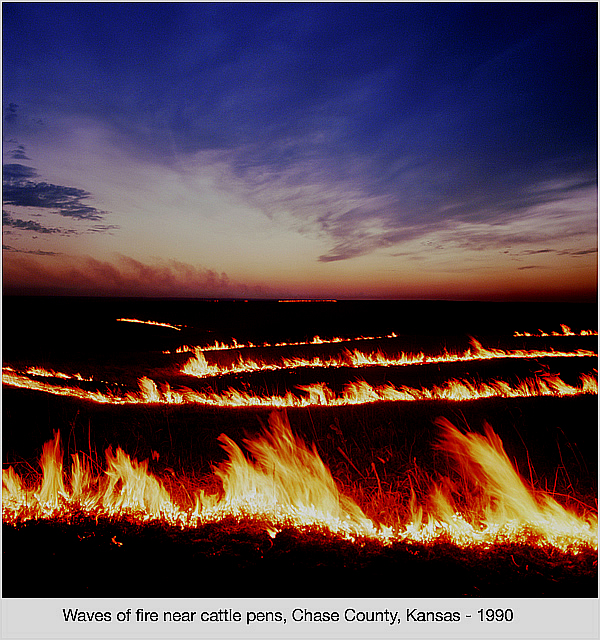
Our concerts featured seasonal photography of Kansas by photographer Larry Schwarm.
This concert was also a quasi-lecture where Rachel would explain some of the effects in each season and perform a few demonstrations before playing the work. It was super cool! I really appreciated hearing her descriptions and then emulating that effect - bird calls, bagpipes, dogs, raindrops, the wind, bugs, storms - you name it! All of those sounds you hear outdoors throughout the year as performed by an orchestra.
Here is the explanation of Le Quattro Stagioni found on britannica.com
The Four Seasons is the best known of Vivaldi's works. Unusually for the time, Vivaldi published the concerti with accompanying poems (possibly written by Vivaldi himself) that elucidated what it was about those seasons that his music was intended to evoke. It provides one of the earliest and most detailed examples of what was later called program music - music with a narrative element.
Vivaldi took great pains to relate his music to the texts of the poems, translating the poetic lines themselves directly into the music on the page.
His arrangement is as follows:
Spring (Concerto No. 1 in E Major)
Allegro
Spring has arrived with joy
Welcomed by the birds with happy songs,
And the brooks, amidst gentle breezes,
Murmur sweetly as they flow.
The sky is caped in black, and
Thunder and lightning herald a storm
When they fall silent, the birds
Take up again their delightful songs.
Largo e pianissimo sempre
And in the pleasant, blossom-filled meadow,
To the gentle murmur of leaves and plants,
The goatherd sleeps, his faithful dog beside him.
Allegro
To the merry sounds of a rustic bagpipe,
Nymphs and shepherds dance in their beloved spot
When Spring appears in plendour.
Summer (Concerto No. 2 in G Minor)
Allegro non molto
Under the merciless sun of the season
Languishes man and flock, the pine tree burns.
The cuckoo begins to sing and at once
Join in the turtledove and the goldfinch.
A gentle breeze blows, but Boreas
Is roused to combat suddenly with his neighbour,
And the shepherd weeps because overhead
Hangs the fearsome storm, and his destiny.
Adagio
His tired limbs are robbed of rest
By his fear of the lightning and the frightful thunder
And by the flies and hornets in furious swarms.
Presto
Alas, his fears come true:
There is thunder and lightning in the heavens
And the hail cuts down the tall ears of grain.
Autumn (Concerto No. 3 in F Major)
Allegro
The peasant celebrates with dancing and singing
The pleasure of the rich harvest,
And full of the liquor of Bacchus
They end their merrymaking with a sleep.
Adagio molto
All are made to leave off dancing and singing
By the air which, now mild, gives pleasure
And by the season, which invites many
To find their pleasure in a sweet sleep.
Allegro
The hunters set out at dawn, off to the hunt,
With horns and guns and dogs they venture out.
The beast flees and they are close on its trail.
Already terrified and wearied by the great noise
Of the guns and dogs, and wounded as well
It tries feebly to escape, but is bested and dies.
Winter (Concerto No. 4 in F Minor)
Allegro non molto
Frozen and shivering in the icy snow,
In the severe blasts of a terrible wind
To run stamping one’s feet each moment,
One’s teeth chattering through the cold.
Largo
To spend quiet and happy times by the fire
While outside the rain soaks everyone.
Allegro
To walk on the ice with tentative steps,
Going carefully for fear of falling.
To go in haste, slide, and fall down to the ground,
To go again on the ice and run,
In case the ice cracks and opens.
To hear leaving their iron-gated house Sirocco,
Boreas, and all the winds in battle—
This is winter, but it brings joy.
I don't know who the dude playing 'Winter' is, but that video is NEXT LEVEL
On a somewhat related note - does everyone remember Vanessa Mae's Album Storm? I was reminiscing about this album and her white electric violin with a violinista colleague - oh the 90s (and techno)! How special!
Rachel Barton Pine
I first came across Rachel Barton Pine when I was a student in Minnesota. At the time, I was playing in a band and feeling a little alone in the "classically trained violinist wanting to pursue more than a traditional music career" category. I was browsing Myspace (I know, right? Who even remembers that) for violinists who play in bands and found Rachel. I was so intrigued....and very confused. She plays metal like classical music and classical music like metal. It is insane!
I bet you didn't think a Guarneri Del Jesu could play metal like that! Pretty crazy right?
Her bio includes pretty much everything. I was going to include an excerpt but it is so long and insane that it would take up too much room. She is the recipient of numerous awards, winner of many competitions, and performs as a soloist and recitalist all over the world, as part of the metal band Earthen Grave, and as part of Trio Settecento.
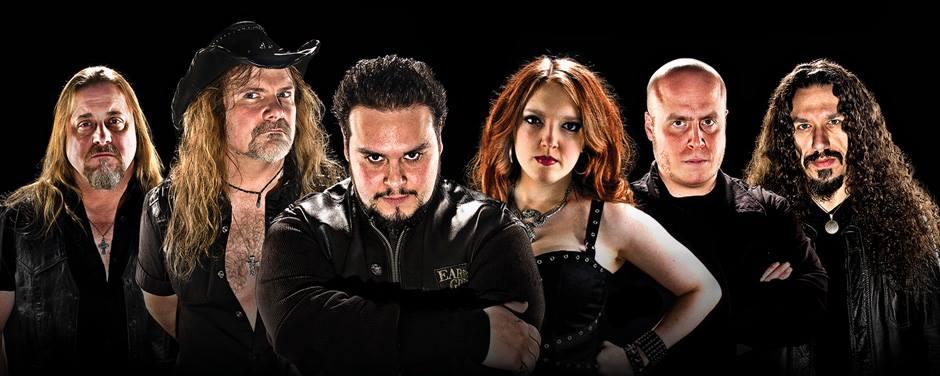
Earthen Grave
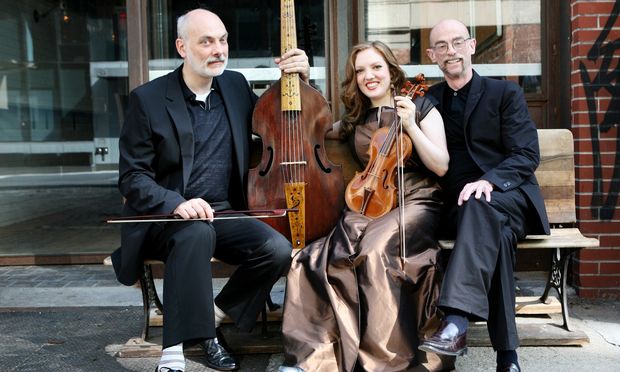
Trio Settecento
She records music in a variety of different genres and time periods. If you scroll through Spotify you can find recordings of the Bach Sonatas and Partitas, lesser known repertoire associated with American virtuoso Maude Powell, the Viola D'amore concertos of Vivaldi, violin concertos composed by African-American composers, the sonatas of Handel, etc. Not your typical fare.
Another recording of Rachel's that I love is this one of Deliver My Soul by David Baker. I studied with David Baker at the Jamey Aebersold Summer Jazz Workshop several summers ago and learned so much! He is the original jazz cellist, and long time faculty member at Indiana University. Sadly, Baker passed away last year. Not many people seem to know this work, but I think it is fantastic and I hope it makes its way onto more recital programs in the future.
I really love Rachel's investment in the obscure and lesser known. I admire a famous virtuoso who has the interest, diligence, and enthusiasm for the less-than-pop classical music. When she speaks about performing Baroque music, and using a Baroque bow it is with experience and full understanding. She is academic but not stale. It is exciting AND informed. It is so refreshing!
Back to that Viola D'Amore reference I threw in there....
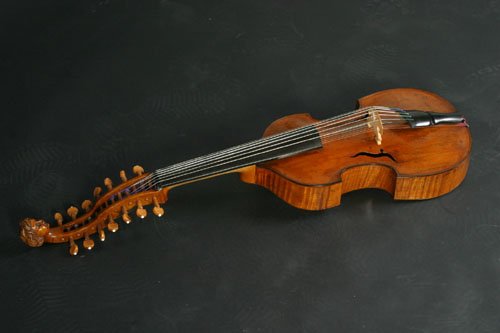
The viola d'amore is a 6 or 7 stringed instrument held under the chin and was popular in the Baroque era.
Rachel performed her encore on a Viola D'Amore and at rehearsal she invited us to come and try it. It was AWESOME! I want one now! (also, fangirl moment - she was so approachable and nice, it was really cool).

That smile is genuine JOY.
So after all that, yeah - this concert put a skip in my step. I am going to buy the Urtext of the Bach solo sonatas and partitas, I'm now eyeing a Baroque bow online, and want to play in a band again...any takers?
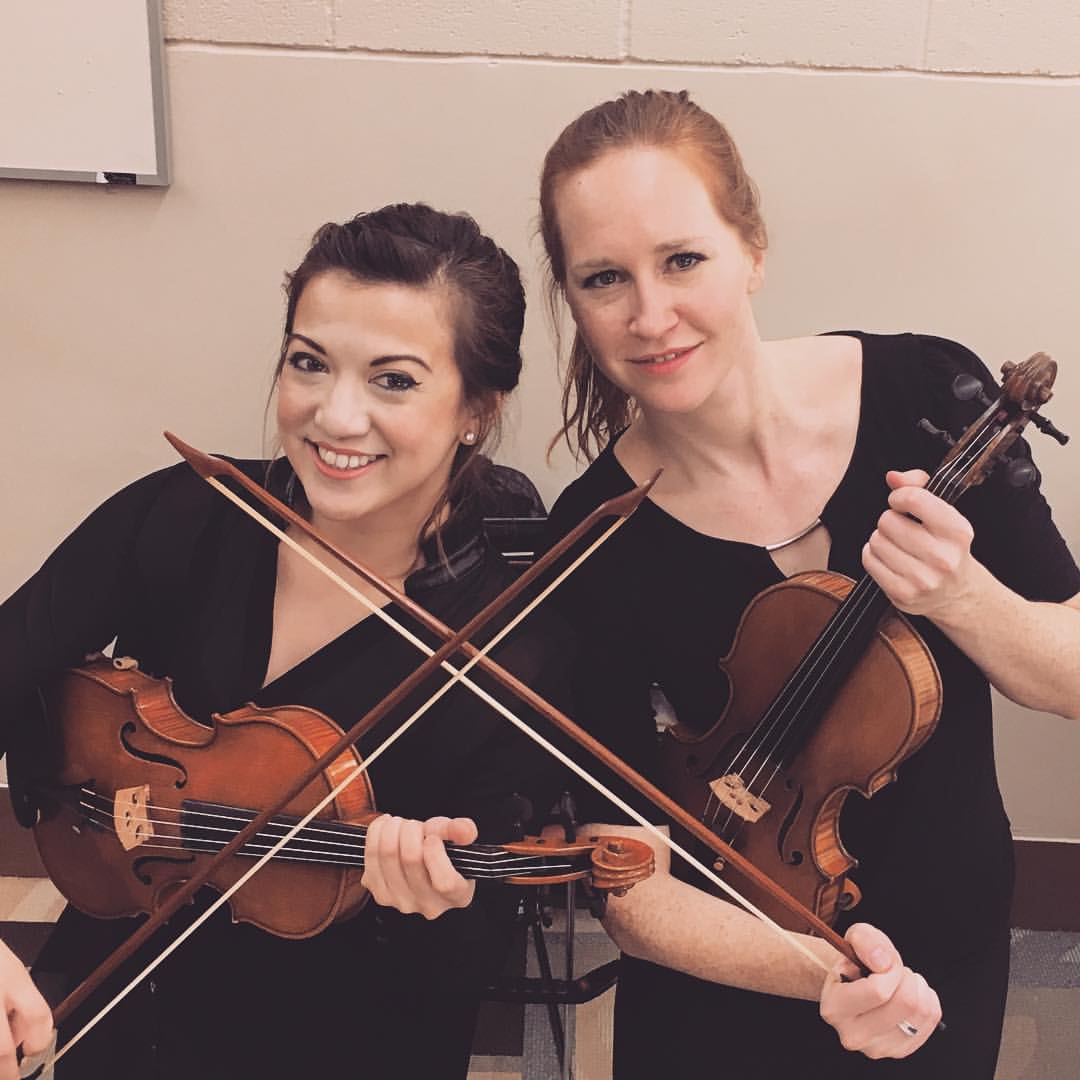
Two Baroque Girls
When I grow up I want to be Rachel Barton Pine. Did I mention she's also a redhead? (It must be a sign!)
I hope you enjoyed this post! Leave your comments below.