
The Timani Post I've meant to write for months.
I’ve been making Timani hints for month now and alluding to the training I did this summer for months now. You can finally read a little bit more about why I signed up for the training and about how magical this stuff really is. Timani is a game changer for all musicians!
I’ve been talking about my Timani Training since June (maybe May?). I’m excited to finally share why I signed up for something virtually unheard of in the United States. I'll do my best to explain a tiny bit of the magical powers of Timani.
Brief Recap:
I wrote a post last summer (you can read it here) about my very first Timani experience and lessons with Tina Margareta Nilssen, the creator of Timani. Tina came to LA to present at the PAMA conference, and lucky me, I managed to sneak in 2 lessons, one private session and one joint class with a colleague. I also observed a session with a bassoonist. I joined the Timani Community, which provides emails with more information and exercises and access to a private group on Facebook. I kept in touch with Tina and had another lesson with her a few months later. It was all so fascinating, and I fell in love, and I knew I had to do the training. The post link above articulates my honeymoon phase and early enthusiasm well.

Our incredible teacher Lotta - explaining some core principles of Timani.
Fast forward to this summer. Every morning for about 2 weeks, I sat at my kitchen table with a fresh cup of coffee, ready to start class at 6am. My classmates logged in from the Netherlands, England, Sweden, Norway, and beyond. I can't explain it, but by the end of those two weeks, I felt like these were some of my closest friends, and I haven't met any of them in person yet.
I knew it was a 3-year training to become a master teacher. I signed up for the first year with the idea that I didn't have to continue if I did't like it, but knowing it would still be a good experience. Now, level 2 can't come soon enough. If you get me started on the topic, it is tough to make me stop gushing about how incredible it is and how everyone needs this information. If you're not careful, I will probably beg you to schedule a zoom call with me just so I can keep talking about it. (Take this as your warning).
Before I say more about Timani, you should know, I probably have an above-average enthusiasm for musician's health and movement.
I've done lots of reading and research.
I wrote my dissertation about using Iyengar yoga to enhance violin playing.
I co-founded corpSonore – sound | body | wellness, a platform for musician's health and wellness.
I've attended yoga retreats for musicians.
I attended the PAMA conference.
I'm on the PAMA Young Professionals committee.
I'm working on a Yoga Teacher Certificate.
I’ve taken Alexander Technique and Body Mapping classes.
You name it, I’ve dipped at least a toe in it.
But none of these answer my questions the way Timani does.
Timani does something no other method does. It synthesizes information, research, exercises, training, and movement from a wide variety of modalities and applies it specifically to the needs of musicians…in extreme detail. It draws on a considerable wealth of resources and knowledge to suit precisely what musicians need. It is a method of muscle differentiation that optimizes musical performance. And what a difference it makes.
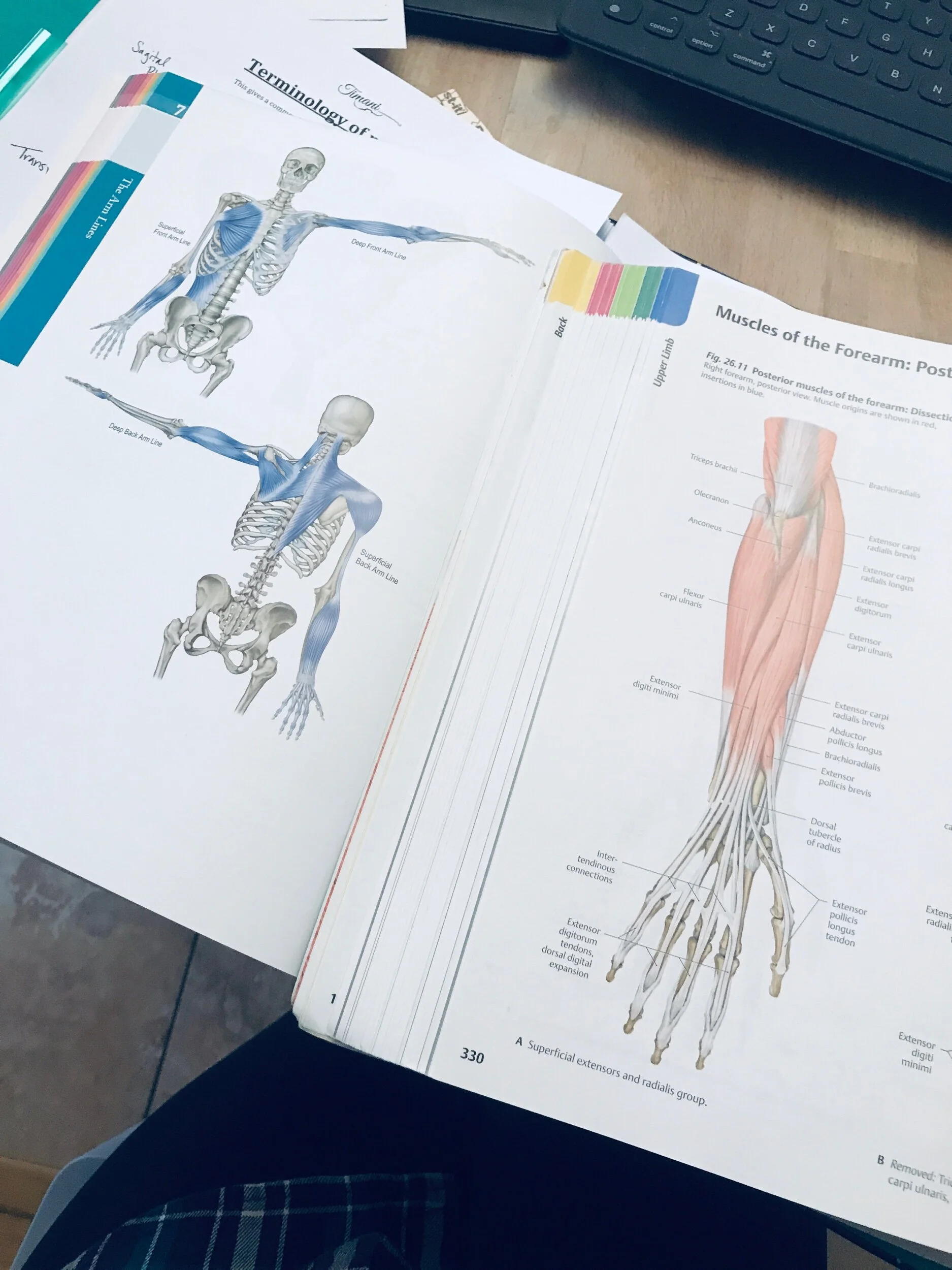
It is all connected.
The fun thing is, you don’t have to spend hours at the gym or do yoga to feel these effects. You don’t have to have rocking abs to develop a strong Timani core. The notion that we HAD to work out to play music used to be appealing to me – because I like to sweat – but at some point, it stopped making much sense. It didn't add up when I thought about my favorite musicians and how much yoga they didn't and don't do. I'm not sure I've ever heard Itzhak Perlman talk about his workout routine. If I missed it, please send me that article/podcast/video. It begs the question: How come his body is working in his favor, and the rest of us have to hit the gym? Turns out, maybe we don't. Unless you want to, of course. I am certainly not advocating for an inactive lifestyle. I love moving my body. I just don't think you should have to be in marathon shape to play a violin concerto.
Let me explain.
Sometimes we get so distracted and excited about tight, weak, or injured muscles that we forget or don’t consider what muscle should or could be doing a specific task. For example, as a violinist, I need to stabilize my instrument AND move the bow (and left hand). Ideally, I need to recruit different muscles to do these jobs. I need my stabilizers to stabilize so my movers can move. The problem is, we musicians often recruit movers to stabilize. In doing so, we set up compensation patterns that can cause fatigue, pain, discomfort, and a whole host of other issues and ailments. Fortunately, our bodies are perfectly capable of making music with optimal muscle engagement as long as we don't get in the way. Timani, among other things, provides a series of exercises to retrain the musical body to recruit muscles more efficiently and effectively.
Sounds easy and obvious, right? So why haven't we all been taught this in our musical training?
Let me tell you a little about my frustrations with musical training at this point. I apologize for this next bit because it really gets me fired up and tends to turn into a rant.

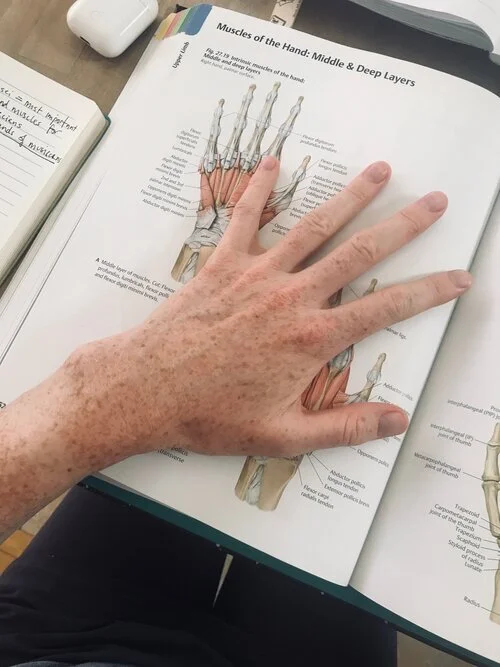
The hand of a violinist (with a watch tan/freckle line)
What I learned in level 1 Timani training this summer broke my heart. It broke my heart because it made me realize how much we trust our music teachers with our bodies. Still, rarely can our music educators tell us very much about how the body works. For example, it wasn’t until this summer that I finally learned about the muscles in the hands.… AND I PLAY VIOLIN!!!! When you think about it, doesn’t that just seem wrong?
For decades, I've had violin teachers tell me what I "should" be doing with my hands and fingers based on what they've been told, or based on some bygone teaching guru. We've been upholding these “rules” without questioning them. Until very recently, I included myself in this category, by the way. But the information provided by music teachers is usually not based on the anatomical principles of how the hands actually work. Even if we have teachers who "know," they typically don't really have any idea at all. So as good students, we slave for hours to squeeze our bodies into shapes that are ultimately inefficient and can even cause damage and injury. Simply because that’s what our teachers told us to do and our teachers don't know any better.
How is it that our music education system thinks this is okay? How did it happen that our highest-paid, most sought-after teachers assign intricate repertoire to practice every week, but they can't explain how the fingers bend? Does this seem right to you? Essentially, our current musical training system works if you’re lucky. The dogma of elite training is stacked against the human body's natural functions and shapes. It needs to stop.
Thank you, body, for getting the job done, now let's do it well.
Since the course ended, I've been doing my Timani exercises regularly since then. Already, I can hear the change in my sound. Some of the Timani exercises are for the feet. You spend 15 minutes exercising your toes, then pick up your instrument, and boom! This huge new sound comes barreling out of the F-holes. To traditional music training, this seems to make no sense. But Timani turns music-making into a full-body experience. Everything is vibrating, everything is working, nothing feels fatigued, and you create sound more effortlessly than you could ever imagine.
How is that possible?
You're simply using the right muscles for the right jobs.
That big sound?
That's your body saying thank you and rewarding you for working smarter.
Aren’t you intrigued? Don’t you want to feel that too? The incredible thing is that you don’t have to be injured or in pain to feel and experience the benefits of Timani. It optimizes what is already working well AND improves what might be holding you back. As musicians, we are accustomed to working hard and practicing for our entire careers. It comes with the job. So why not learn how to do it effectively and efficiently? Why not take your beautiful tone and use your whole body to make it better? Do you need to warm up for hours before a performance? Perhaps there is a way to activate some of those much-needed stabilizing muscles without breaking a pre-concert sweat.
The answer is Timani.
If you want to know more, please send me a message, drop me a line, leave a comment, etc. I love talking about this stuff and want to share it with you.
My Timani Lesson
A quick recap of my introduction to Tina Nilssen and Timani. I am so excited about this work and have been thinking about it nonstop for the past month. Working with Tina was the highlight of the whole PAMA weekend. She has such amazing insight into the body of the musician. Enjoy!
This year I (finally) had the good fortune of attending the Performing Arts Medicine Association (PAMA) Symposium. When I discovered that it was going to be held at UCLA this year, I jumped at the chance to be there. I read and reread the schedule and topics presented and planned out my days. The symposium ran from Friday - Monday morning with a certificate course, “The Essentials of Performing Arts Health” scheduled for the Thursday before. I relied heavily on their journal, Medical Problems of Performing Artists(MPPA), for source material when I was researching my dissertation, “Using Iyengar Yoga to Enhance Violin Playing.” It is by far the most comprehensive source for articles about musicians health.
The Workshop
One of the Seminars was lead by Tina Margareta Nilssen, from Norway. Her workshop was titled “How Can We Help to Prevent Repetitive Strain Injury in Music Students While Simultaneously Enhancing Musical Expression,” and took place on Saturday afternoon. I was excited to attend her workshop because Tina and I had connected via social media, and it is not every day you meet someone also invested in Musicians Health and Wellness in person.
Her workshop politely blew my mind. While her workshop title is long and kind of ungainly, she emphasizes “Anatomical knowledge and physical implementation to create freedom and joy of playing.” Her workshop was upbeat and engaging. She has the type of presentation that is compelling and instantly makes you feel like you know her but also that you want to know more. I pretty much rushed the stage afterward to pepper her with more questions, and she (shockingly) asked if I would like to meet outside of the symposium to do more work (so I said yes, duh).
The Lesson
We met at Disney Hall for a private lesson and in true music student fashion (I got nervous beforehand). The first thing we did was discuss the ideal body of a musician (turns out it’s a chocolate-covered caramel – delicious) before I played for her, and she videotaped it. When I watched the footage, I thought my posture looked pretty good, but after 20-30 minutes or so of work together, I could see a subtle but dynamic difference in my playing. It was shocking.
We worked for approximately another hour, going over sitting posture and standing posture, and subtle cues to bring awareness back to areas of my body I was neglecting. After I played, we did not run scales and talk about technique or wrist placement, or anything most violin teachers narrow in on. Instead, we worked on how to breathe 3-dimensionally. We also talked about the appropriate musculature necessary for playing the violin, the function of specific muscles, and which muscles should be holding and supporting versus moving and applying pressure. I have news for you: much of violin pedagogy and what you are/have been taught by violin teachers with no anatomy knowledge or training can be damaging and does not provide optimal motion. This rocked my boat. For years during graduate school I had a teacher who was so “right” about alignment and somatic integration for violinists and being the good student that I was, I tried to do everything he asked by at least 110%. Come to find out that a teacher who is only partially informed and armed with an overabundance of confidence (and an exacting attitude) can do more harm than good. He celebrated my posture but chastised my performance nerves. I felt betrayed when I discussed this with Tina. For years, in an attempt to do what is correct, I was doing what is incorrect.
I always felt reasonably competent when it comes to filling my lungs, particularly in the front and sides. I have worked on this, for seemingly countless yoga hours. What I quickly realized is that I do not breathe into the back of my chest and ribcage. Also, I have always received praise for my great posture when I play. People point it out onstage, and I took pride in my stance, either seated or standing. But very subtly it is not so great. My chest and lower ribs jut forward, and my bottom pops out making it difficult to breathe into my back and also puts a strain on my Psoas muscle (which, incidentally, I learned quite a bit about at a different PAMA Symposium workshop). When I get nervous, which I was, it makes it even more difficult to breathe, make a good sound, and remain calm. It also exacerbates the nerves because again, as I discovered at the symposium, the Psoas muscle is intricately connected to the body’s fight or flight response. So everything I thought I was doing “right” was hindering my internal alignment and putting a considerable strain on my whole system making playing the violin, particularly when nervous even harder! This type of revelation makes me want to turn back the clock and redo all those silly auditions where I was so nervous and desperate to find control, without realizing I’m impeding my body’s natural wellbeing.

Alex Rosales Garcia working with Tina Nilssen on sitting posture at Disney Hall
I stayed after my lesson to observe her work with a bassoon player. Our instruments have different demands, but the improvement in sound with just a small amount of breath and posture work was so profound it was almost hilarious. To the untrained eye, it might appear that not much had changed, but internally, his body was supporting his breath and instrument more fully resulting in a tone that was large, round, and singing. It was beautiful and sounded so natural and free.
I would have stayed even longer to see another violinist have a lesson, but I had to run off to a gig. Tina graciously agreed to meet with us the next day and continue working together. It was fun, and the group setting (there were two of us plus Tina) had a relaxed workshop feel where we could freely ask questions as they arose and learned different applicable exercises or practices. She kept having to remind us that we were skipping around in her typical training but still, we could see and hear results. I was so excited to go home and practice because I LOVED my sound. My violin was singing, and I had a positive full-body experience while playing. How many of my colleagues can relate to that last statement? Sometimes I love to play but am sore afterward. Sometimes I play and feel great but am disconnected from the sound. These two days opened my eyes to the sensation of fully feeling the music pass through me and my instrument. It feels borderline profound, and I wish I could explain it better.

Tina is the first musician I have encountered that synthesizes information in a way that is practical, attainable, easy to understand and apply, and musically focused. I have tried Alexander technique, some body mapping, yoga, etc. but this is the first time I have experienced the results so immediately and thoroughly in a manner that focuses on optimal musical expression by the performer.
I signed up for the Timani community after our work together so I could learn more and keep improving. The last thing I want to do is mismanage my body in the practice room, or even worse – pass on incorrect information to my students. As I internalize some of these points, I want to incorporate them into my own teaching and pass them on to my students. You can check out more about Tina click here and Timani here, and you can sign up for the community (the first month is free and packed full of useful information) here.