
The Timani Post I've meant to write for months.
I’ve been making Timani hints for month now and alluding to the training I did this summer for months now. You can finally read a little bit more about why I signed up for the training and about how magical this stuff really is. Timani is a game changer for all musicians!
I’ve been talking about my Timani Training since June (maybe May?). I’m excited to finally share why I signed up for something virtually unheard of in the United States. I'll do my best to explain a tiny bit of the magical powers of Timani.
Brief Recap:
I wrote a post last summer (you can read it here) about my very first Timani experience and lessons with Tina Margareta Nilssen, the creator of Timani. Tina came to LA to present at the PAMA conference, and lucky me, I managed to sneak in 2 lessons, one private session and one joint class with a colleague. I also observed a session with a bassoonist. I joined the Timani Community, which provides emails with more information and exercises and access to a private group on Facebook. I kept in touch with Tina and had another lesson with her a few months later. It was all so fascinating, and I fell in love, and I knew I had to do the training. The post link above articulates my honeymoon phase and early enthusiasm well.

Our incredible teacher Lotta - explaining some core principles of Timani.
Fast forward to this summer. Every morning for about 2 weeks, I sat at my kitchen table with a fresh cup of coffee, ready to start class at 6am. My classmates logged in from the Netherlands, England, Sweden, Norway, and beyond. I can't explain it, but by the end of those two weeks, I felt like these were some of my closest friends, and I haven't met any of them in person yet.
I knew it was a 3-year training to become a master teacher. I signed up for the first year with the idea that I didn't have to continue if I did't like it, but knowing it would still be a good experience. Now, level 2 can't come soon enough. If you get me started on the topic, it is tough to make me stop gushing about how incredible it is and how everyone needs this information. If you're not careful, I will probably beg you to schedule a zoom call with me just so I can keep talking about it. (Take this as your warning).
Before I say more about Timani, you should know, I probably have an above-average enthusiasm for musician's health and movement.
I've done lots of reading and research.
I wrote my dissertation about using Iyengar yoga to enhance violin playing.
I co-founded corpSonore – sound | body | wellness, a platform for musician's health and wellness.
I've attended yoga retreats for musicians.
I attended the PAMA conference.
I'm on the PAMA Young Professionals committee.
I'm working on a Yoga Teacher Certificate.
I’ve taken Alexander Technique and Body Mapping classes.
You name it, I’ve dipped at least a toe in it.
But none of these answer my questions the way Timani does.
Timani does something no other method does. It synthesizes information, research, exercises, training, and movement from a wide variety of modalities and applies it specifically to the needs of musicians…in extreme detail. It draws on a considerable wealth of resources and knowledge to suit precisely what musicians need. It is a method of muscle differentiation that optimizes musical performance. And what a difference it makes.
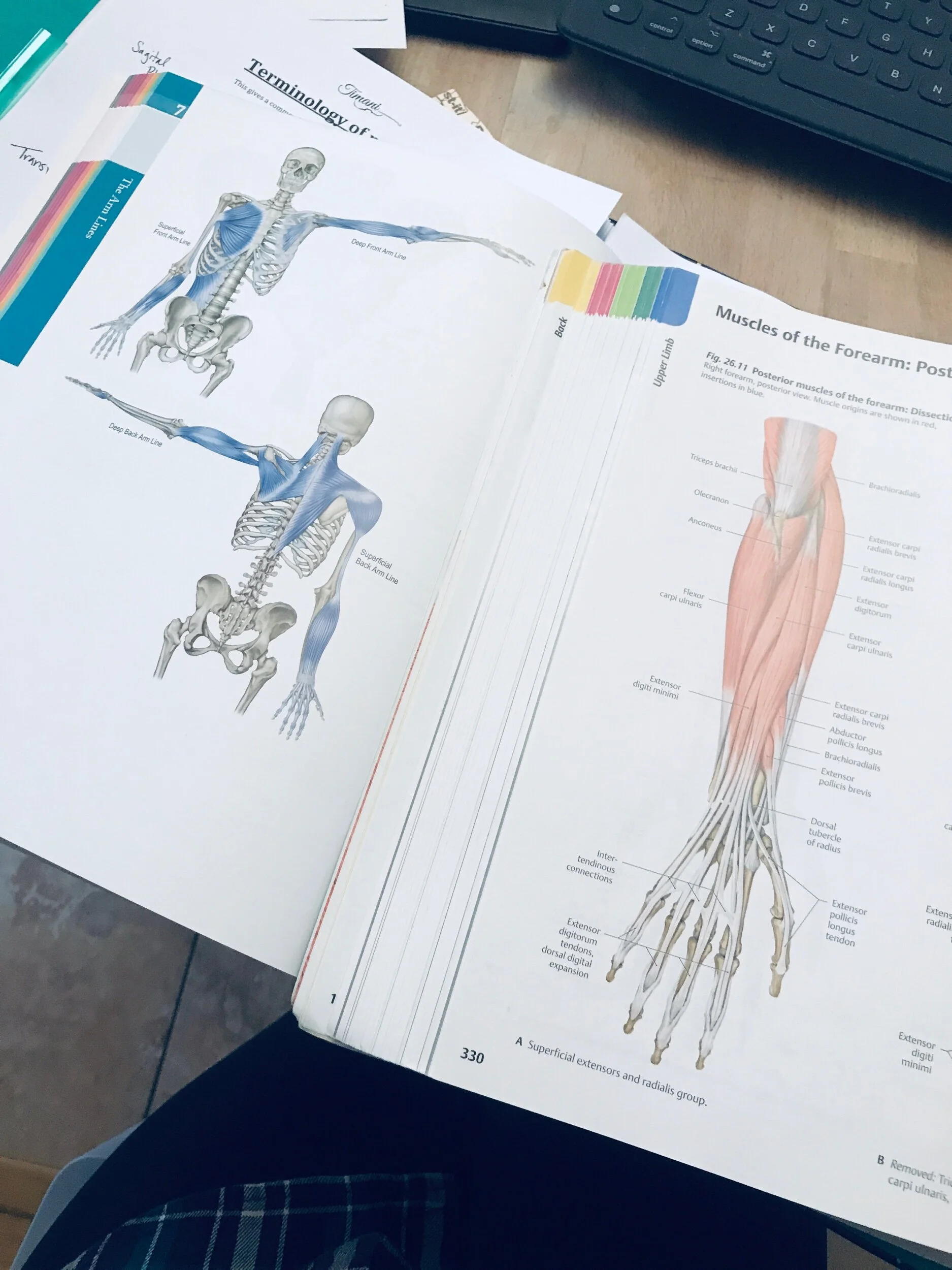
It is all connected.
The fun thing is, you don’t have to spend hours at the gym or do yoga to feel these effects. You don’t have to have rocking abs to develop a strong Timani core. The notion that we HAD to work out to play music used to be appealing to me – because I like to sweat – but at some point, it stopped making much sense. It didn't add up when I thought about my favorite musicians and how much yoga they didn't and don't do. I'm not sure I've ever heard Itzhak Perlman talk about his workout routine. If I missed it, please send me that article/podcast/video. It begs the question: How come his body is working in his favor, and the rest of us have to hit the gym? Turns out, maybe we don't. Unless you want to, of course. I am certainly not advocating for an inactive lifestyle. I love moving my body. I just don't think you should have to be in marathon shape to play a violin concerto.
Let me explain.
Sometimes we get so distracted and excited about tight, weak, or injured muscles that we forget or don’t consider what muscle should or could be doing a specific task. For example, as a violinist, I need to stabilize my instrument AND move the bow (and left hand). Ideally, I need to recruit different muscles to do these jobs. I need my stabilizers to stabilize so my movers can move. The problem is, we musicians often recruit movers to stabilize. In doing so, we set up compensation patterns that can cause fatigue, pain, discomfort, and a whole host of other issues and ailments. Fortunately, our bodies are perfectly capable of making music with optimal muscle engagement as long as we don't get in the way. Timani, among other things, provides a series of exercises to retrain the musical body to recruit muscles more efficiently and effectively.
Sounds easy and obvious, right? So why haven't we all been taught this in our musical training?
Let me tell you a little about my frustrations with musical training at this point. I apologize for this next bit because it really gets me fired up and tends to turn into a rant.

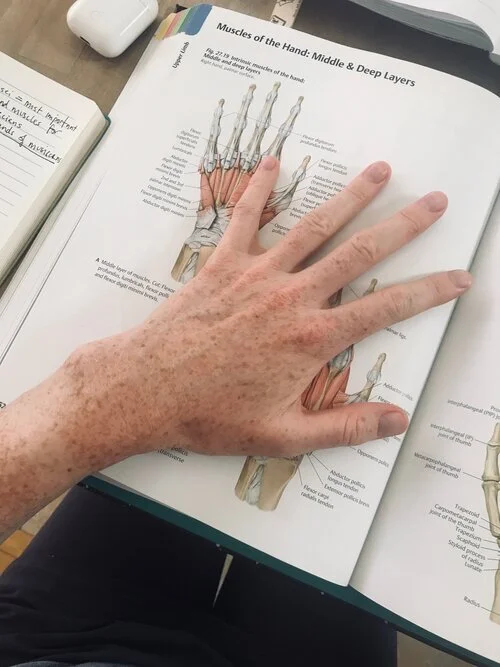
The hand of a violinist (with a watch tan/freckle line)
What I learned in level 1 Timani training this summer broke my heart. It broke my heart because it made me realize how much we trust our music teachers with our bodies. Still, rarely can our music educators tell us very much about how the body works. For example, it wasn’t until this summer that I finally learned about the muscles in the hands.… AND I PLAY VIOLIN!!!! When you think about it, doesn’t that just seem wrong?
For decades, I've had violin teachers tell me what I "should" be doing with my hands and fingers based on what they've been told, or based on some bygone teaching guru. We've been upholding these “rules” without questioning them. Until very recently, I included myself in this category, by the way. But the information provided by music teachers is usually not based on the anatomical principles of how the hands actually work. Even if we have teachers who "know," they typically don't really have any idea at all. So as good students, we slave for hours to squeeze our bodies into shapes that are ultimately inefficient and can even cause damage and injury. Simply because that’s what our teachers told us to do and our teachers don't know any better.
How is it that our music education system thinks this is okay? How did it happen that our highest-paid, most sought-after teachers assign intricate repertoire to practice every week, but they can't explain how the fingers bend? Does this seem right to you? Essentially, our current musical training system works if you’re lucky. The dogma of elite training is stacked against the human body's natural functions and shapes. It needs to stop.
Thank you, body, for getting the job done, now let's do it well.
Since the course ended, I've been doing my Timani exercises regularly since then. Already, I can hear the change in my sound. Some of the Timani exercises are for the feet. You spend 15 minutes exercising your toes, then pick up your instrument, and boom! This huge new sound comes barreling out of the F-holes. To traditional music training, this seems to make no sense. But Timani turns music-making into a full-body experience. Everything is vibrating, everything is working, nothing feels fatigued, and you create sound more effortlessly than you could ever imagine.
How is that possible?
You're simply using the right muscles for the right jobs.
That big sound?
That's your body saying thank you and rewarding you for working smarter.
Aren’t you intrigued? Don’t you want to feel that too? The incredible thing is that you don’t have to be injured or in pain to feel and experience the benefits of Timani. It optimizes what is already working well AND improves what might be holding you back. As musicians, we are accustomed to working hard and practicing for our entire careers. It comes with the job. So why not learn how to do it effectively and efficiently? Why not take your beautiful tone and use your whole body to make it better? Do you need to warm up for hours before a performance? Perhaps there is a way to activate some of those much-needed stabilizing muscles without breaking a pre-concert sweat.
The answer is Timani.
If you want to know more, please send me a message, drop me a line, leave a comment, etc. I love talking about this stuff and want to share it with you.
Prepping Like a Pro

Piles and piles of progress!
Over the past few months I was forced to step my performance and practice game up several notches. I gave my final doctoral recital in April, won an orchestra audition the week after, assumed a principal position in 2 orchestras and played some freaky hard 20th century music, all while maintaining my regular teaching and orchestra schedule. It was tough! The following tips are lessons I gleaned from others and truths I realized along the way. Many of them are tried and true and have been written about by many great pedagogues and performers. Some of them are little things I discovered on my own and a few may seem totally unrelated to the act of playing violin but are extremely important.
1. Use a metronome! - as if you've never heard that one before! Sometimes we forget the versatility capable of such a seemingly simple device. I use my metronome for lots of random things.
a. Slow practice. You think that's slow? Do it Slower! Fast movement of Bach got ya down? Work that sucker from the ground up. If I have a long passage of 16th notes for example - I put my metronome at 16th = 80 and I work it faster little by little. If you trip over a few notes go back and do them again AND THEN repeat the passage. This is the short cut. Practicing like this builds fantastic muscle memory. Nerves on Stage? Something about highly rhythmic, slow practice keeps your left hand working even when your mind might not be so calm.
b. Use it to test your memory. Here's another Slow practice tip I learned from Sally O'Reilly. Are you trying to memorize that Presto movement? Test your memorization skills by playing it with the metronome at 16th= 60-80 (or whatever the smallest subdivision of the beat is) without the music but with all of the correct bowings, dynamics and fingerings etc. Did your mind wander? Did you space out for a second? Did you come to a spot that is easy when played quickly and hard to organize when played slowly? BUSTED! Slow metronomic practice increases your mental endurance as well. I'm telling you - if you can't play it slow, you shouldn't play it fast.
c. Play it faster. This is especially appropriate for excerpts. Can you play it at the proper tempo? Good. Now do it faster. Did you find a place that falls apart? That is your weak spot. If you can't play it cleanly at multiple different speeds - both fast and slow - then you have some weak spots in your playing. Maybe your shifting gets a little sloppy and desperate when you crank up the speed. Maybe you find some weird accidental or unintentional accents caused by faster tempos. Welcome to the problem that needs to be addressed. And say hello to some technical exercises (see below).
d. Keep the subdivision. It is important to physically memorize the feeling of a consistent subdivision. If your little beats rush your big ones will too. Playing a passage 2 against 3? Triplets? Quintuplets? Guess you better figure those out EXACTLY before you start flippantly rushing through them. Play it 3 against 2, 2 against 3 etc. You get the idea. Figure out the precise placement of all those notes before you start making artistic decisions about slowing down and speeding up.
2. Drone! Pick a note, any note! Okay maybe not any note but something that will be consonant or perfect with at least 80% of the passage at hand. Play slow. No vibrato and align your intonation with the drone. Then pick another pitch and do the same - the root and 5th of a chord are a good starting place with this type of work. This tightens up your chords and passagework so your putting your fingers down in exact places and not just willy nilly in the heat of the moment. Speed it up once you are acing it and see if it sticks at a faster tempo. The last thing you should add is vibrato.
3. Record Yourself. Everyday and Every way. I was fortunate enough to work with a teacher who recorded every lesson I had. It made me cringe! But wow do you learn a ton from watching and listening to yourself. Sometimes you're so busy trying to pull off all of the fireworks on the page you can't hear everything that is actually coming out of the instrument. The only way to find the weak spots and improve is to hear them or have a teacher catch them for you. What happens when you don't have a teacher? You have to find these sections yourself - and this is the best way to do it.
I recorded little portions, larger sections, whole movements, rehearsals with pianists and lessons. I heard a whole bunch of stuff that made me want to quit the violin and never pick it up again. Yikes! It was tough listening to it all. But we do it in the name of progress and the quest for near perfection. Remember! YOU DO THIS TO IMPROVE NOT TO FEEL SORRY FOR YOURSELF!! Each day I would record numerous tracks then listen to them during my drives to work and gigs and teaching. Sometimes I was in tears, sometimes I was pleasantly surprised and always I had a distinct idea of what needed fixing or changing. Don't forget to listen for the musical elements as well as intonation and technique. You might stumble across a moment of your most natural musicality and it will be a pleasant surprise.
4. Sing. Sing for phrasing, sing for musicality, and sing for intonation. If you can sing it you can play it! If you have no idea what the next note should sound like how on earth are you going to find it on the violin? Don't cross your fingers and hope for the best, make a plan and stick to it. The first part of the plan includes what note comes next! Is there a big shift? Sing the note you're aiming for, once you figure that out you're halfway there. Sing against a drone. Its funny how your own tonal center, as in the one INSIDE you, needs to be just as precise as your intonation on the instrument. It helps you anticipate the correct pitches and plan more precisely.
If you're looking for some real fun sing and play at the same time. Working on Bach A minor fugue I realized its kind of fun, and at the very least interesting to sing one voice as you play 1 or 2 of the others. Its hard! And funny - and according to my dog sounds absolutely terrible but if you can play in tune with yourself those double stops and chords will be so in tune it hurts. I started working on all double stops like this. It keeps your inner ear in tip top shape which only serves to improve your left hand.
5. Breathe. Breathe, breathe, breathe, BREATHE. You must practice this. Breathing is calming. Breathing helps your brain function the best it can. If you hold your breath, you deprive your brain of oxygen and send your body into panic mode. This makes you rush, tighten up, forget things, miss shifts and function in a state of desperation. This undermines all of the work you calmly did in your practice room. Don't let a lack of breath get the best of you. Spend some time before the performance or audition or whatever calmly taking large, expansive breaths. Then continue this throughout the performance. Do you feel yourself clamming up? Or sense the tension from a tricky passage coming up? Replace that anxiety with a reminder to breathe. Even write it in your music if it helps. Keeping your breath calm and not shallow is essential for performing at your best.
6. Stretch. Amping up your practice schedule in anticipation of a big event can lead to tight and overworked muscles. I'm a huge fan of yoga. I practice on my own, attend class whenever I can and throw in a few poses mid rehearsal if I feel extra stiff. Almost immediately I can feel my body expand and relax, like a massive THANK YOU to my whole system. Even my brain feels better. I like to start and end my day with a little bit of yoga. At the minimum 20-30minutes in the morning and right before bed do a world of good. You can stretch however you'd like but yoga has always been the most effective for me. At times of my life when I feel really stressed I turn to slow, meditative and restorative yoga. Your body needs to open up and find length - not tighten up and muscle through a workout. I aim for that Yoga High at the end of practice. If I achieve that in yoga I know my violin practicing will go much more smoothly.
7. Drink Water. Sounds Silly, I know but staying hydrated helps you concentrate and also wards off feelings of exhaustion. The last thing you want to do is battle fatigue while you're working up a recital. I like to think that I'm flushing all of the stress out of my body with every gulp of water. Its amazing the effect of being properly hydrated has on your entire system and ability to work.
8. Practice the thoughts. Thoughts are things. I'm not kidding! If you think 'I can't do this' or 'this is the spot I always mess up' guess what happens? Practice the positive thoughts, the helpful ones, the ones that give you success. Like 'I am calm' or 'Breathe' or even the practical rational things like 'where is my contact point?' Make a mental plan - sometimes the distraction of having real and practical things to focus on gives you no room for all of the awkward freak out thoughts that like to creep into our heads in times of stress. THINK RATIONAL THOUGHTS.
9. Sleep. Your brain needs a chance to throw out the garbage and clean all of the cogs and wheels of the mind. If you never hit the off switch you never have a chance to recharge. Don't skip the zzzzzzs. Not only does it hit reset it also magically helps all of the things you've worked so hard to solidify stay in place. That metronome work you did yesterday? Still there. That shift that was really difficult last week? Still improving. I love sleep, it feels good to be well rested. Don't deprive yourself the luxury of several horizontal hours.
10. Technique. Don't skimp on your scales! Seriously! A little a day keeps you a lean, mean, playing machine. I highly regret not spending more of my practice time solidifying the basics prior to my recital. Gearing up for the audition I amped up the Sevcik and Flesch and man were my hands well behaved and my playing was pretty rock solid. Now I keep a little practice log so I don't repeat the same things too often. The following is a sampling of my current favorites. I take a taste from each everyday. On a good day I spend 1.5-2.5 hours on this stuff. It feels good to dive in. At the end of your practice session you feel instant improvement. The benefits of practicing technique are far reaching and you will feel the effects in repertoire almost immediately.
Flesch Scales - all on 1 string, 3 octaves, arpeggios, broken thirds, chromatic. A new key each week
Sevcik Bowing - Like meditation for the right hand. Slows me down so I appreciate every inch of my bow. Hones specific techniques that might be a little weak (aka up bow staccato)
Sevcik Shifting - I rotate through a few of these every week. My shifting was getting sloppy and now I feel much more finely tuned. I practice slow, without vibrato.
Sevcik Double Stops - Intonation. FEEL THE INTERVALS.
Galamian Scales and Arpeggios - I pick the same key as the Flesch and do these for the accelerations and alternative chord progression in the arpeggios.
Schradieck - A messy, poorly behaved left hand cannot play efficiently. This helps my concentration and my dexterity.
Etudes/Caprices - Right now I'm challenging myself to some Paganini. Its the toughest of the tough but I think I'm getting there.
I could keep going. But these are the points I find most helpful in prepping for anything. Anyone have some good ideas to add? Leave a comment!

proof of all the personal recordings I took as part of the preparation process.