
For your consideration
The following are thoughts and ruminations floating around in my mind recently. Does any of this ring true for you? Leave a comment below!
What if we celebrate our differences?
What if our strengths lay in our unique and individual qualities?
How does that effect you as a musician/artist/person/community member?
How does that change or augment your goals?
What unique gift/perspective/experience do you possess?
Is this your key to 'success'?
Choc-o-late Pie
Five years ago I moved to Oklahoma to pursue my Masters Degree in violin. I proceeded to stay for my D.M.A. and have found Oklahoma a fertile land for planting violin seeds and gaining an enormous amount of playing and teaching experience. Shortly after my big migration south, I began building a private teaching studio.
One of my very first students in Oklahoma was brand new to violin. She was almost ten years old at the time and had never taken music lessons before and could not read music or play any other instruments. She was shy, very sweet, and you could tell that she was extremely intelligent. She picked up the basics quickly...like super quickly. She was playing confidently within a few weeks and was reading music almost as quickly.
My former teacher and lifelong mentor Sally O'Reilly wrote two excellent technique books for the aspiring student; Fiddle Magic, which covers all of the frills and fireworks of violin technique, and Fiddle Rhythms which covers different rhythms (obviously) and introduces real-life examples of each from standard repertoire.
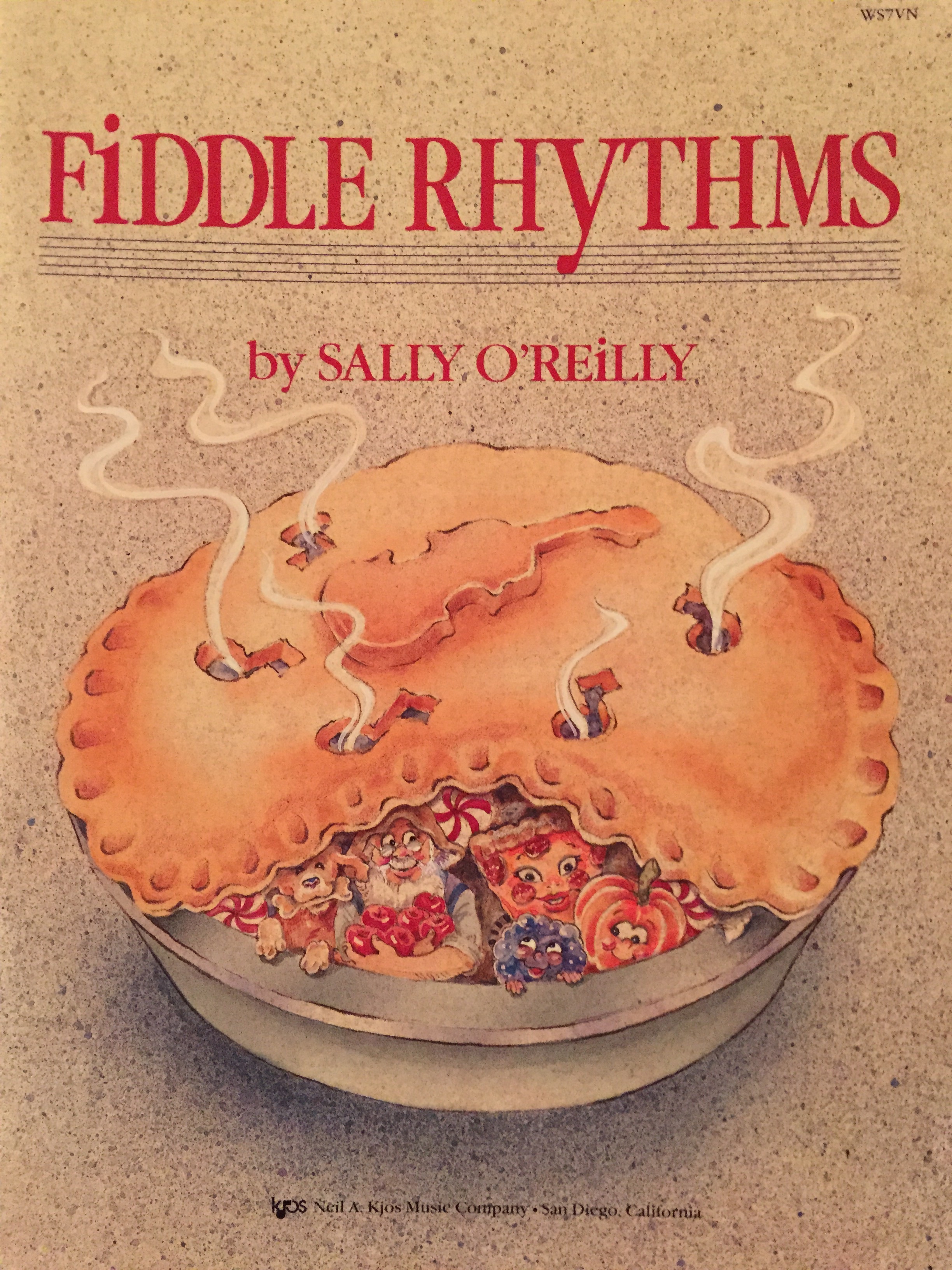
More about Fiddle Magic later (it is one of my all time favorite technique books). Fiddle Rhythms introduces each rhythm separately and then puts it in the context of I-like-(insert rhythm here)-pie. Each rhythm is digested as a food - the menu is an all-you-can-eat buffet of pie types and covers a variety of dietary delights including pizza, rhubarb, peppermint, apple, vanilla, orange, banana, butterscotch and even mixed rhythm combos and uneven rhythmic groupings. After the student has a comfortable handle on the rhythmic pie du jour, real world examples are introduced from a diverse array of music - classical, folk, Irish, Scottish, Children's songs, symphonic repertoire, you name it. Each rhythm is accompanied by illustrations and they are pretty darn cute. Some of my super cool high school students roll their eyes at using books with pictures but deep down I know they appreciate it.

I mean come on! How can you dislike this? A girl in a field dreaming of pie.
Back to my student in Oklahoma. We were just starting the Chocolate Rhythm (code for a triplet). Triplets are much easier when they are delicious. While working on the 'I Like Choc-o-late Pie' exercise I candidly mentioned that I had never had chocolate pie, to which my student informed me that it is delicious. We continued with the lesson and I didn't really give it another thought.
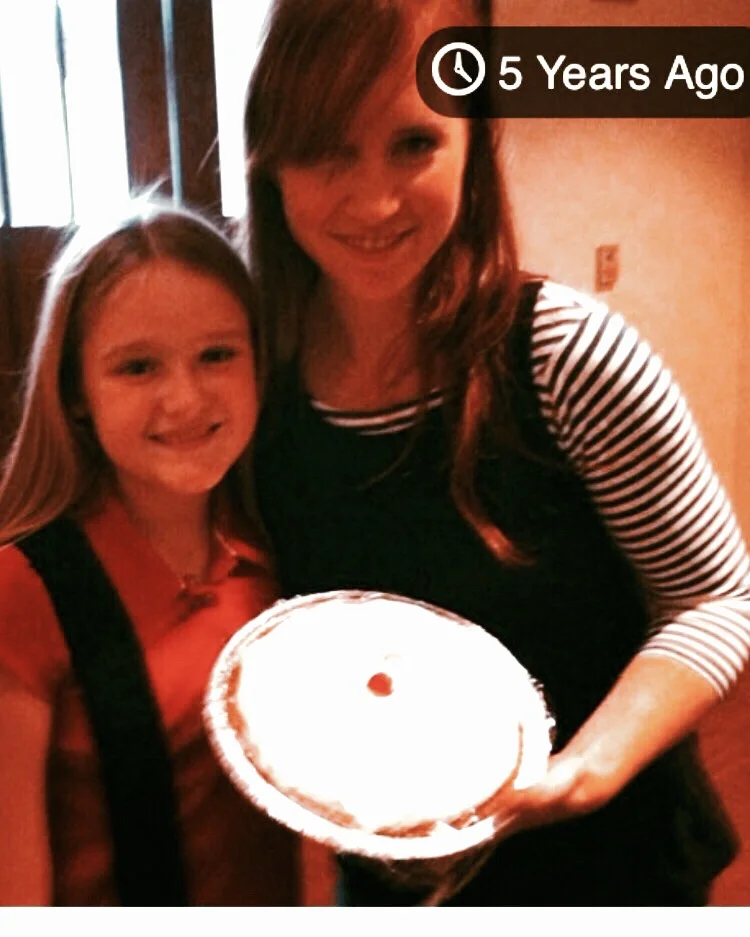
The next week she arrived at her lesson with a homemade chocolate pie! It was heavenly. I didn't have many friends at the time so I took it home that night and ate the whole thing myself. I probably gained 20 delicious pounds over the course of a week but it was so worth it. I was so surprised and excited by this that I posted a photo on facebook and not too long ago I was reminded of my 5 year anniversary of chocolate pie.
Then.....

apologies for the blurry image. Camera phones just weren't the same 5 years ago!
My birthday was a few weeks ago and guess what that very student gave me? Yep you guessed it! She is far beyond learning rhythms and basic tunes and patterns. Now she is in Youth Symphony and will be touring Europe with them this summer. She is also starting to look into music schools, is putting together her first recital program, and is tackling her first Viotti concerto - a far cry from Chocolate Pie. As a token of our 5 year anniversary we took our second pie photo. My how we have changed!
And now....

The Moral of this story is that everyone should use Fiddle Rhythms (and shamelessly drop hints to their students about pie). It will feed your students technique, your teaching abilities....and your hungry grad student belly.
Bon Appetite!
Tzigane - a few notes on Aesthetics
A month or so ago I had the pleasure of watching Sarah Chang perform Tzigane live with the Wichita Symphony Orchestra (I was sitting on stage as part of the orchestra). It really got me thinking about style as a performer, and also about what makes a performance successful for the listener. I performed this piece on my final doctoral recital in April 2014 and listened to numerous recordings and interpretations in preparation. Hearing Sarah Chang perform it live really brought it back to the foreground of my thoughts. So bear with me as I wax lyrical about it.
First of all, let's start with Sarah Chang's performance. Her shoes were insane! And by insane I mean all the ladies of the orchestra were commenting on them, couture, heel height, style...everything. They were fierce! I can't even fathom playing violin in high heels - let alone doing it well! That in itself was a feat! Her gowns were gorgeous (yes, there were two) and were eye catching both on and off stage. Bravo on the wardrobe choices! Also on the program was a selection from West Side Story by Leonard Bernstein for violin and orchestra specifically arranged for her. I was surprised how much I enjoyed the two pieces on the same program. They both have such big personalities awesome melodies, and violinistic flair. It made for an impressive showcase of 20th century music. This blog post however, is dedicated solely to the Ravel (Sorry Lenny).
What is challenging for violinists, or any musician I'm sure, is hearing an interpretation of a piece that conflicts with your own. If it is not how you would play it, is it automatically bad? There were certain things Sarah Chang did in her performance (her tempo at the beginning of the last page, how long she held notes in the opening cadenza, what sort of character she assumed for particular passages, how long she let the rests and fermatas linger etc.) that I personally wouldn't do. Does that make her wrong? No. Does it make me right? No. You cannot argue that she is a supremely talented violinist. Her technique has been, and will always be light years beyond my own and I don't dare question that. But what is it in the performance of a piece - particularly this piece - that really makes it successful? Wow! What a loaded, and multi-faceted/layered/complicated question to puzzle over! The great thing and the unsatisfying thing is that we will never have a concrete answer to this one. So I hope you enjoy my musings on the subject; A violinist searching for meaning and understanding in aesthetics and style. (does that even make sense?)
The Piece...
Tzigane by Maurice Ravel is hands down one of the coolest, most awesome pieces for violin! No arguing - it is a fact! It is one of my all time favorite pieces ever written for violin. I don't even remember the first time I heard this piece but for as long as I can remember I have adored it. Those of you close to me may know that it is featured in my Skype account name - that is how much I love it!
For those who don't know it (and yes, I am judging you a little bit right now) Tzigane is Ravel's take on the gypsy music heard in Hungary and Eastern Europe. Ravel heard a performance of Bartók's music by Jelly d'Arányi and Béla Bartók in London in the 1920s and was completely taken with the flair and character of the music and the young violinist. Sources say that after the performance Jelly played gypsy songs for Ravel all through the night and by the end he was determined to write a gypsy piece for her. Sadly, there is no recording of her playing but i must assume she had a great deal of panache and enthusiasm as well as virtuosic ability.
When it came down to actually composing the piece, Ravel pulled out Liszt's Hungarian Rhapsodies Brahms' Hungarian Dances, and The Caprices of Paganini for inspiration. He did not turn to the ethnomusicological findings and compositions of Béla Bartók, which is curious considering that was the original impetus for the composition. Instead, (and there are TONS of scholarly articles written on the subject) Ravel based his Gypsy music on the music written as imitations of Gypsy music and not on the traditional folk tunes themselves. Essentially Tzigane is a fake of a fake.
A few words about the violinist -
Jelly d'Aranyi, (1893 – 1966) was born in Budapest and was the grand-niece of Joseph Joachim Whoa! Talk about a famous violinist! Joachim was not trained in the Hungarian school at all and was actually a champion of the German Romantic composers, premiering works by Schumann and Brahms, to name just two. Jelly began her studies as a pianist, but switched to violin at the Music Academy in Budapest when Jenö Hubay accepted her as a student. She and Belá Bartók gave sonata recitals together in London and Paris. His sonatas were dedicated to her sister Adila, but Jelly and Bartók presented them in London in March 1922 (No. 1) and May 1923 (No. 2).
She was an excellent interpreter of Classical, Romantic and modern music. Aside from Tzigane by Ravel, Ralph Vaughn Williams dedicated his Concerto Academico to her, Gustav Holst's Double Concerto for Two Violins was written for Jelly and Adila, and the D'Aranyi String Quartet is named after her.
Not a bad bio. She seemed to catch the attention of many big name composers. I can't help but be a little green with envy - pretty lucky lady having some great repertoire written for her!
But back to me.....
When I was attempting to learn this piece I hacked away at it - Tzigane is tough! There are so many fancy tricks all over the piece that trip one up almost constantly. From left hand pizzicato to false harmonics to fingered octaves and passages way up high on the G string. Tzigane is a tour de force. But above all there is so much character in this piece! The real challenge is pulling off all of the fireworks while making it seem improvisatory and, dare I say, casual. The piece begins with a two page solo violin cadenza at the very beginning. No warm up allowed just BOOM! Superstar, fireworks, everything all at once and not even a pianist to offer some support. Cruel....but awesome. In all of the recordings I have listened to I find myself drawn to the ones where the performer can exude immense strength and personality almost immediately - They grab the attention of the audience and hold it, even when they take time, the silence is full of passion and flair.
Interpretation and Style
The best performances are poised, bold and exciting. How do you do this? Well of course there is a technical answer to this question - you practice (duh)! But ultimately I believe you must have your own story to tell. You must paint a specific scene, act out a specific monologue or bring to life emotions and feelings with your entire performance, and as if that's not hard enough, also play in tune.
Performances of this piece vary enormously. Can any of them be considered bad? Perhaps - but why? Simply put it comes down to how the performer approaches this piece. Perhaps their interpretation is very different from your own. Yes, the notes will always be the same but in each of the following performances the style is dramatically different. The same issues arise in a performance of Beethoven or Mozart or Sibelius etc. but these pieces are restrained to the confines of performance practice, genre, meter, ensemble etc. whereas Tzigane opens with an unaccompanied cadenza, filled with fermatas, pauses, extremely long notes, and incredibly short ones too, and throughout the piece the tempo markings fluctuate almost constantly. It is up to the performer to decide exactly how these transitions should happen.
Tzigane can be performed with orchestra or piano but was originally written for violin and luthéal - a sort of hybrid piano that extends the range and possible effects of the keyboard, allowing it to imitate some traditional Hungarian and folk instruments. Sadly they are not made any more as they prove to be quite fussy and difficult to work with. Daniel Hope actually recorded Tzigane with luthéal and it is so RAD! the timbre mixes with the violin pizzicato and harmonics in ways no other instrument can.
So here are a few recordings and performances of Tzigane. Which one is your favorite? Why? I won't tell you which one I like the most - I don't want to sway your opinion. I will say that I played a few of these for my pedagogy class and each student liked a different recording. I was shocked by their reasons and their aesthetics. It just goes to show, there is more than just one way to play a piece well - particularly this piece!
There is a good mix of old and new, orchestra and keyboard, male and female performers. I may have gone a little overboard and I totally understand if you get a little burned out, or don't want to listen all of them. I just couldn't stop! Curiously, I cannot find an interpretation from Hilary Hahn, I hope this changes soon!
Of course I had to include Sarah Chang's recording - so you could hear what I heard in Wichita. Enjoy!